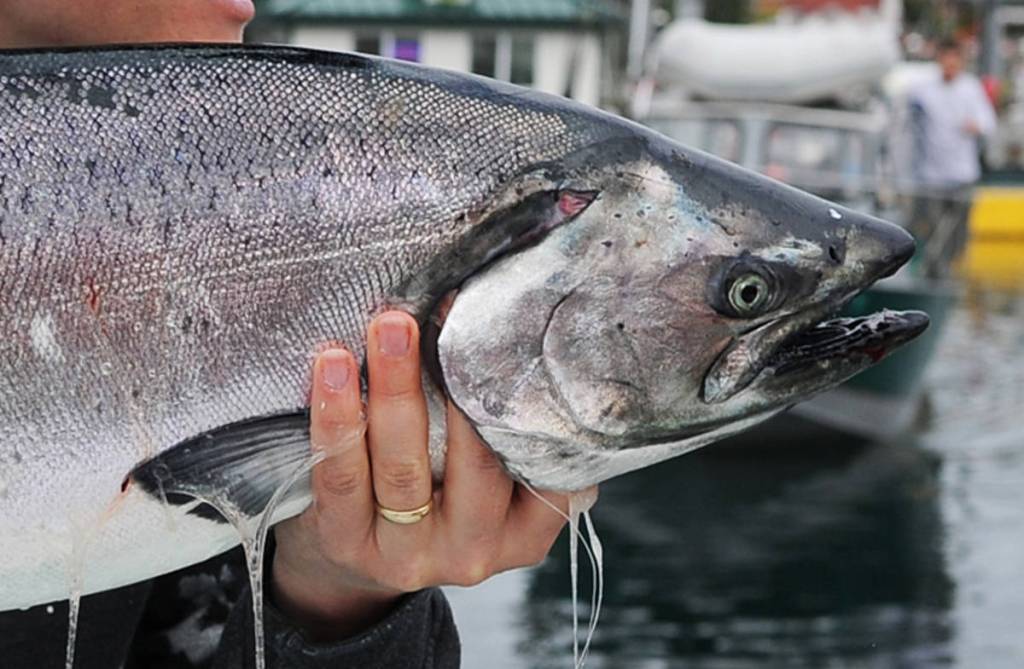
A king salmon is seen in August 2013. (Michael Penn | Juneau Empire)

A king salmon is seen in August 2013. (Michael Penn | Juneau Empire)

Fish and Game forecasts below average 2020 king salmon run

The 2020 forecast for the early run is well below the 1986-2019 average of 9,196 large fish.

Alaska’s Department of Fish and Game forecasts a historically below-average year for king salmon runs in the Kenai River.

For the early run, which occurs from mid-May to early June, the ADF&G has forecast 4,794 large fish, according to a Jan. 27 news release from the department. Large fish, as defined by the department, are greater than or equal to 75 cm from mideye to tail fork or approximately 34 inches in total length.

The 2020 forecast for the early run is within the optimum escapement goal of 3,900 to 6,600 large fish, but well below the 1986-2019 average of 9,196 large fish. Optimum escapement is defined by the Board of Fisheries as the number of fish allowed to escape the fisheries and spawn that ensures sustainable runs and healthy returns for commercial, sport, subsistence, cost-recovery and personal use harvests. The 2020 forecast is also slightly lower than the recent five-year average of 5,110 fish.

In 2019, the ADF&G forecast for the early run was lower than what was actually observed during the run. ADF&G forecast approximately 3,167 large fish in the 2019 early run, but observed around 4,216.

According to a memo from Fishery Biologist Robert Begich, the error in forecasting was due to underestimating the production of the broods from 2012 and 2013. Chinook salmon included in the annual forecasts are primarily five, six or seven years old, according to the memo, so 2020’s forecast is based on production estimates of broods from 2014 and 2015. If accurate, the 2020 early run will be the eighth lowest in 35 years.

The late king salmon run, which occurs from early July to season closure on the Kenai River, has a forecast of 22,707 large fish. This forecast is about 60% larger than the estimated total for the late run of 2019, which saw about 12,780 large fish, but would still be the sixth lowest run in 35 years. The average late run for 1986-2019 is 43,239 fish, and the recent five-year average is 21,665 fish. The largest run recorded since 1986 in the Kenai River occurred in 2004, when 91,312 large fish were observed in the late run.

2019’s late-run forecast, like the early-run forecast, was also inaccurate when compared to the observed total. In 2019, ADF&G forecast a late run of approximately 22,105 fish but only observed about 12,780, for an overestimate of about 42%. According to the memo from Begich, this forecasting error was attributed primarily to an overestimate of the 2013 and 2014 brood years, which saw two of the lowest escapements on record prior to 2019.

View the king salmon outlooks for both the Kenai River and Deshka River online at www.adfg.alaska.gov.

More in News

A snowmachine rider takes advantage of 2 feet of fresh snow on a field down Murwood Avenue in Soldotna, Alaska, on Monday, Dec. 12, 2022. (Jake Dye/Peninsula Clarion)
Ice fishing opens on some Kenai National Wildlife Refuge lakes

Snowmachines are permitted for ice fishing access on Hidden, Kelly, Petersen, Engineer and Watson lakes.

The waters of Cook Inlet lap against Nikishka Beach in Nikiski, Alaska, where several local fish sites are located, on Friday, March 24, 2023. (Jake Dye/Peninsula Clarion)
Kenai asks for fishery economic disaster declaration

The Kenai City Council requested that Gov. Dunleavy declare a disaster and support a recovery plan for the Upper Cook Inlet East Side Set Net fishery.

The Kenai Peninsula Borough School District logo. (Photo courtesy of Kenai Peninsula Borough School District)
District superintendent dispels rumors about student construction

Superintendent Clayton Holland said student involvement in Seward High School construction is “based on rumor, not fact.”

Anchorage-based singer and songwriter Keeley Boyle is pictured in Anchorage<ins>, Alaska,</ins> on Sept. 26, 2023. Boyle, who was raised on the Kenai Peninsula, will use a $10,000 grant she received from the Rasmuson Foundation to create an album of songs about her grandparents’ home in Nikiski. Photo courtesy of Jovell Rennie
Musician hailing from Kenai receives Rasmuson grant

Keeley Boyle will record an album of songs about her grandparents’ Nikiski home.

Commercial fishing and recreational vessels are docked in the Homer harbor on Oct. 23, 2025. The commercial fishing industry endured a series of challenges over the year, some of them imposed by the new Trump administration. (Photo by Yereth Rosen/Alaska Beacon)
Alaska fisheries in 2025: turmoil, economic and environmental challenges and some bright spots

NOAA cuts, economic headwinds and invasive species pose problems, but there was some recovery in crab stocks and salmon harvests.

Cook Inlet near Clam Gulch is seen on Oct. 23, 2025. (Photo by Yereth Rosen/Alaska Beacon)
Disputed oil lease sale in Alaska’s Cook Inlet upheld in new Trump administration decision

After completing a court-ordered environmental study, the Bureau of Ocean Energy Management said no changes are needed for the 2022 sale that drew just one bid.

The Kenai Peninsula Borough School District logo.
School district projects $7.5 million budget deficit for fiscal year 2027

Decreased enrollment and increased property values mean less local and state funding.

The sign in front of the Homer Electric Association building in Kenai, Alaska as seen on April 1, 2020. (Photo by Brian Mazurek/Peninsula Clarion)
Homer Electric Association announces rate increase

The proposed increase, if approved by the Regulatory Commission of Alaska, will go into effect Jan. 1.

A photo of Anesha “Duffy” Murnane, missing since Oct. 17, 2019, in Homer, Alaska. (Photo provided, Homer Police Department)
Calderwood pretrial hearing rescheduled

The omnibus hearing for Kirby Calderwood was continued to Jan. 21. Trial week is currently scheduled for Feb. 17, barring finalization of a plea agreement.

Most Read