
Federal rule for Cook Inlet EEZ commercial fishing published, implements May 30

The rule comes after years of back and forth that began in 2012

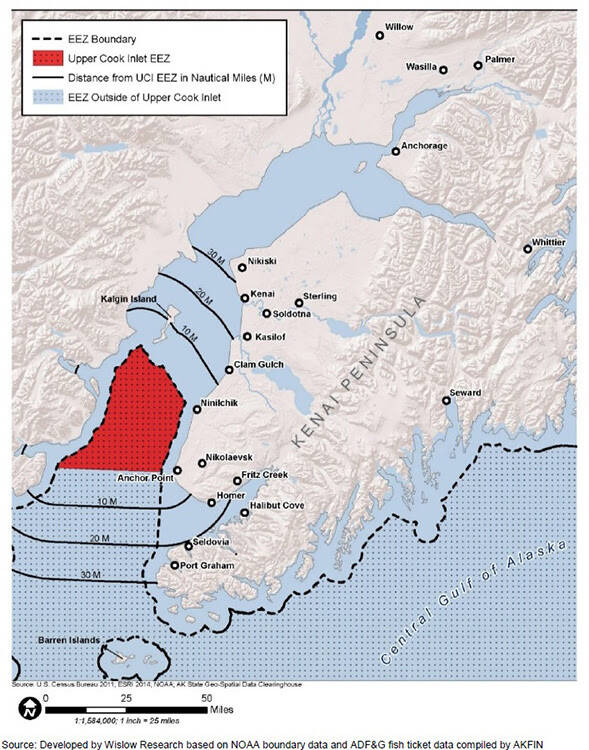
Upper Cook Inlet Exclusive Economic Zone can be seen on this map provided by the National Oceanic and Atmospheric Administration. (Image via fisheries.noaa.gov)

Upper Cook Inlet Exclusive Economic Zone can be seen on this map provided by the National Oceanic and Atmospheric Administration. (Image via fisheries.noaa.gov)

Federal management of the Cook Inlet exclusive economic zone will begin on May 30, after the National Oceanic and Atmospheric Administration Fisheries published on Monday their long developing regulation.

Commercial drift gillnet fishers in the zone, which is a space of Cook Inlet waters from south of Kalgin Island to about Anchor Point, will have new regulations and requirements under the new rule. According to a release from NOAA Fisheries, they will need a federal permit, maintain a fishing logbook and have a vessel monitoring system installed, among other regulations.

The fishery will also use “total allowable catch” limits for management, as opposed to fishing based on escapement goals like state fisheries. If those counts are hit for any salmon, the fishery will be closed. Proposed counts for each species of salmon are described in an April publication, though final numbers are expected to be published in June.

In the proposed numbers, the total allowable catch for Kenai River late-run sockeye salmon is 492,100. Kasilof River sockeye salmon are also included in the chart, as well as “aggregate other” but neither have limits described.

For king salmon, the low abundance of which have seen several other sport and commercial fisheries entirely closed, the total allowable catch is set at 240 in the proposed regulation.

For coho salmon, the limit is 25,000; chum salmon is 99,400; pink salmon is 121,700.

The commercial fishing season in the zone will begin June 20 and close “on or before” Aug. 15, with closures coming earlier if total allowable catch for any salmon species is reached before the end of the season.

Sport fishing will be allowed in the zone, with no federal permits, but fishers will need to comply with federal regulations and state regulations — including bag limits.

The rule comes after years of back and forth that began in 2012, according to previous Clarion reporting, when the zone was removed from the federal Fishery Management Plan. In 2016, a Court of Appeals ruling required the North Pacific Fishery Management Council reintroduce the zone into their plan by 2020, but when that group elected to close the commercial fishery in the area for the 2022 season, the United Cook Inlet Drift Association sued to keep the waters open.

Per a decision by an Alaska District Court in June 2022, NOAA was directed to implement an amendment to the Salmon Fisheries Management Plan by May of this year.

When proposed regulations were published in October, the State Department of Fish and Game said it had “significant concerns” with the details of the rule. They said that the proposed management conflicts with state objectives to conserve and manage weak stocks, specifically by using a total allowable catch metric rather than allowing opportunity above escapement goals like in state managed fisheries.

Informational meetings will be held in Kenai and Homer this month to familiarize fishers with the new regulations. In Kenai, a meeting will be held at the Quality Inn on May 15, from 5:30 p.m. to 7:30 p.m. In Homer, a meeting will be held at the Best Western Bidarka Inn on May 16, also from 5:30 p.m. to 7:30 p.m.

An online webinar will also be held on May 22, from 10 a.m. to 12 p.m.

For more information, including to view the whole text of the rule or join the webinar, visit fisheries.noaa.gov.

Reach reporter Jake Dye at jacob.dye@peninsulaclarion.com.

More in News

David Ross is sworn in as Kenai Police Chief on Tuesday, May 31, 2016 at Kenai City Hall. The Alaska Association of Chiefs of Police named Ross the 2025 Police Chief of the Year, recognizing over two decades of service. Photo by Megan Pacer/Peninsula Clarion
Kenai police chief named 2025 Police Chief of the Year

The Alaska Association of Chiefs of Police recognized David Ross for his more than two decades of leadership.

The cast of Nikiski Middle School’s upcoming performance of “Alice in Wonderland” is pictured on Dec. 2, 2025. The upperclassmen-directed play opens on Friday, with additional showtimes Saturday and next weekend. Photo courtesy of Carla Jenness
Nikiski Middle School debuts student-led “Alice in Wonderland”

The show opens on Friday, with additional showtimes this weekend and next.

On Tuesday, the Kenaitze Indian Tribe unveiled Kahtnu Area Transit, a public transportation service open to the entire Peninsula Borough community. Photo courtesy of Kahtnu Area Transit
Kenaitze Indian Tribe unveils Kahtnu Area Transit

The fixed bus route offers 13 stops between Nikiski and Sterling.

The Kenai Chamber of Commerce and Visitor Center hosts the annual Christmas Comes to Kenai on Nov. 28<ins>, 2025</ins>. The beloved event began over 40 years ago, and this year over 1,000 attendees enjoyed hot chocolate, fireworks, pictures with Santa and shopping. Photo courtesy of the Kenai Chamber of Commerce
 Photo courtesy of the Kenai Chamber of Commerce
The Kenai Chamber of Commerce and Visitor Center hosted the annual Christmas Comes to Kenai on Nov. 28. The beloved event began over 40 years ago, and this year over 1,000 attendees enjoyed hot chocolate, fireworks, pictures with Santa and shopping.
Kicking off a month of holiday festivities

Last weekend’s holiday events, including the annual Christmas Comes to Kenai and the Soldotna Turkey Trot, drew folks from all over the Kenai Peninsula.

Starting Dec. 2, Aleutian Airways will offer roundtrip flights between Anchorage and Unalakleet every Tuesday, Friday and Sunday.
Aleutian Airways to offer roundtrip flights between Anchorage and Unalakleet

Starting Dec. 2, Aleutian Airways will offer three roundtrip flights per week.

The Trump administration’s “Big Beautiful Bill” act requires the Bureau of Ocean Energy management to hold at least six offshore oil and gas lease sales in Alaska between 2026-2028 and 2030-2032. The first of these sales — known as “Big Beautiful Cook Inlet 1,” or BBC1— is scheduled for March 2026. Photo courtesy of the Bureau of Ocean Energy Management
Cook Inletkeeper launches petition against federal government

The organization is calling for transparency in Cook Inlet offshore oil and gas sales.

Winter dining has always carried more weight than the menu might suggest. In the off-season, eating out isn’t just about comfort food or convenience; it’s a way of supporting local businesses as they hold steady through the slower months. Photo credit: Canva.
The ripple effect: How local spending builds stronger communities on the Kenai Peninsula

From cozy cafés to fine-dining bistros, purchases made close to home sustain local jobs and services

Courtesy Harvest
On the Kenai Peninsula, a dormant liquefied natural gas export plant could be repurposed to receive cargoes of imported LNG under a plan being studied by Harvest, an affiliate of oil and gas company Hilcorp. The fuel would be transferred from ships to the tanks on the left, still in liquid form, before being converted back into gas and sent into a pipeline.
Utilities say Alaska needs an LNG import terminal. Consumers could end up paying for two.

Planning for two separate projects is currently moving ahead.

A map shows the locations of the 21 Alaska federal offshore oil and gas lease sales proposed by the Trump administration. (Map provided by the U.S. Bureau of Ocean Energy Management)
Trump administration proposes offshore leasing in almost all Alaska waters

A new five-year offshore oil and gas leasing plan proposes 21 sales in Alaska, from the Gulf of Alaska to the High Arctic, and 13 more off the U.S. West Coast and in the Gulf of Mexico.

Most Read