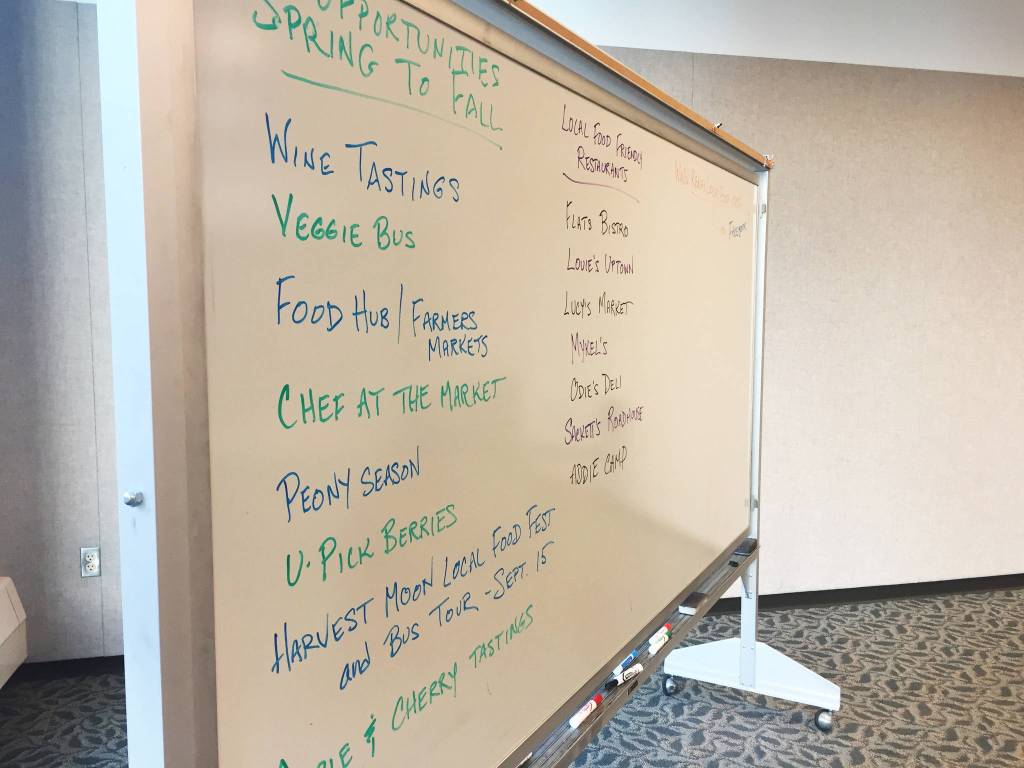
A white board displays ideas for attracting tourists to farms brainstormed by a group of farm operators, local food enthusiasts and restauranteurs at a presentation and workshop on agritourism by Alaska Farm Tours owner Margaret Adsit at the Donald E. Gilman Kenai River Center on Thursday, April 19, 2018 in Soldotna, Alaska. (Photo by Elizabeth Earl/Peninsula Clarion)

A white board displays ideas for attracting tourists to farms brainstormed by a group of farm operators, local food enthusiasts and restauranteurs at a presentation and workshop on agritourism by Alaska Farm Tours owner Margaret Adsit at the Donald E. Gilman Kenai River Center on Thursday, April 19, 2018 in Soldotna, Alaska. (Photo by Elizabeth Earl/Peninsula Clarion)

Farmers look to attract tourists

Farmers in Alaska are looking to tourists to help round out their profit margins.

Agritourism, or farm-based tourism, is already a staple for many farmers in the Lower 48 but is relatively new in Alaska. But with a growing number of farms across Southcentral Alaska, including on the Kenai Peninsula, some are capitalizing on public curiosity about what it’s like to milk a goat or harvest peonies.

That comes with a range of benefits and costs, said Margaret Adsit, the owner of Alaska Farm Tours, a tour company based in Palmer. In a presentation hosted by the Kenai Soil and Water Conservation District on Thursday, she explained that setting up a farm for regular tours can take a variety of forms and levels of complexity. Some farms host events like weddings, while others are as simple as having people walk through and pick their own produce.

“It’s any time you’re trying to bring visitors onto your farm for any reason,” she said. “It doesn’t actually have to have an educational or informational component to it. I always say that you should because you are your own best advocates and marketers, but anybody holding a wedding, that’s not education or information about agriculture but it’s a secondary use and falls within agritourism.”

Farm tourism and interest in local food is a big market, especially among millennials and baby boomers, she said. A November 2017 AARP study analyzing 2018 travel trends among retirees found that the average retiree plans to take five trips this year, with about half interested in eating and touring with locals. Adsit said many of the baby boomers interested in farm tours also have a personal connection to farms.

Millennials, on the other hand, are interested in farm tours for the food and culture aspects, she said. Many travel to experience true local culture and food opportunities, which is great for agritourism, she said. Many operations offer farm-to-table dinners, and Alaska Farm Tours works with restaurants that source their ingredients locally for tourists, she said.

Alaskan farms are typically smaller operations than those in thee Lower 48, and have unique aspects to offer, Adsit said. Unlike large grain farms in the Midwest, which tend to look similar from farm to farm, Alaskan farm operators tend to do things differently, she said.

“Every farm speaks its own language about how they’re producing, all the tricks and trades,” she said. “Alaskan farmers are the most self-reliant farmers I have ever met. That is a story I wanted to tell.”

Some farms keep their tours relatively simple. Kackle Berry Farms on East End Road outside Homer regularly hosts visitors through prescheduled tours, allowing them to pet the animals, see the farm’s greenhouse and try milking some of the farm’s dairy goats. Terry Jones, the owner, said she started doing the tours primarily for kids.

“Being that all of our animals are small, it makes it really great for the little ones,” she said. “(Spring) is a great time to come and see baby goats.”

She said the farm regularly hosts visiting workers through work exchange programs, many of whom are young and interested in farming or food sustainability. They help out with projects and learn how to milk the goats, plant gardens and make cheese, among other skills.

“It’s not necessarily all about the work — it’s a lot about getting to know people and different cultures, and hopefully they learn something,” she said. “We really get to know the people and they get to know us. I like it if I can talk to staying about a month with me, because that way we actually get to know each other. “

Adsit said she encouraged farmers to tell a story to tourists about their farm to help enhance the experience. Many tourists are looking for experiential travel, where they have a unique value-added experience, Adsit said.

“Everybody goes to Alaska and sees Denali,” she said. “It’s a universal Alaskan experience now when you come here. But of the millions of people who come to Alaska, a very small portion have actually stepped foot on an Alaskan farm. That is a unique Alaskan experience, and getting to know and understand Alaskans — not what the History Channel wants you to think of Alaskans, but to actually interact with a real, honest-to-goodness Alaskan, is a huge value-added experience.”

Tourism can help diversify farmers’ revenue streams, both from Outside tourists and in-state visitors, she said. However, there are issues farmers have to consider, including insurance in case of injury and the costs of maintaining visitor facilities. Visitor operations typically take a few years to break even, she said.

The Legislature is considering a bill, House Bill 217, which would include farm tours in state code as an “inherent risk” activity and would define farm touring in state code. The House of Representatives approved the bill on April 12 and forwarded it to the Senate, where it has yet to be heard.

Reach Elizabeth Earl at eearl@peninsulaclarion.com.

A group of farm operators, local food enthusiasts and restauranteurs attend a presentation and workshop on agritourism by Alaska Farm Tours owner Margaret Adsit at the Donald E. Gilman Kenai River Center on Thursday, April 19, 2018 in Soldotna, Alaska. (Photo by Elizabeth Earl/Peninsula Clarion)

A group of farm operators, local food enthusiasts and restauranteurs attend a presentation and workshop on agritourism by Alaska Farm Tours owner Margaret Adsit at the Donald E. Gilman Kenai River Center on Thursday, April 19, 2018 in Soldotna, Alaska. (Photo by Elizabeth Earl/Peninsula Clarion)

More in News

The U.S. Forest Service Porcupine Campground offers gorgeous views of the Kenai Mountains and Turnagain Arm, as seen here on July 20, 2020, near Hope, Alaska. (Photo by Michael Armstrong/Homer News)
Department of Natural Resources seeks public input on proposed Kenai Peninsula State Forest

DNR is gathering community perspectives during several meetings this week.

David Ross is sworn in as Kenai Police Chief on Tuesday, May 31, 2016 at Kenai City Hall. The Alaska Association of Chiefs of Police named Ross the 2025 Police Chief of the Year, recognizing over two decades of service. Photo by Megan Pacer/Peninsula Clarion
Kenai police chief named 2025 Police Chief of the Year

The Alaska Association of Chiefs of Police recognized David Ross for his more than two decades of leadership.

The cast of Nikiski Middle School’s upcoming performance of “Alice in Wonderland” is pictured on Dec. 2, 2025. The upperclassmen-directed play opens on Friday, with additional showtimes Saturday and next weekend. Photo courtesy of Carla Jenness
Nikiski Middle School debuts student-led “Alice in Wonderland”

The show opens on Friday, with additional showtimes this weekend and next.

On Tuesday, the Kenaitze Indian Tribe unveiled Kahtnu Area Transit, a public transportation service open to the entire Peninsula Borough community. Photo courtesy of Kahtnu Area Transit
Kenaitze Indian Tribe unveils Kahtnu Area Transit

The fixed bus route offers 13 stops between Nikiski and Sterling.

The Kenai Chamber of Commerce and Visitor Center hosts the annual Christmas Comes to Kenai on Nov. 28<ins>, 2025</ins>. The beloved event began over 40 years ago, and this year over 1,000 attendees enjoyed hot chocolate, fireworks, pictures with Santa and shopping. Photo courtesy of the Kenai Chamber of Commerce
 Photo courtesy of the Kenai Chamber of Commerce
The Kenai Chamber of Commerce and Visitor Center hosted the annual Christmas Comes to Kenai on Nov. 28. The beloved event began over 40 years ago, and this year over 1,000 attendees enjoyed hot chocolate, fireworks, pictures with Santa and shopping.
Kicking off a month of holiday festivities

Last weekend’s holiday events, including the annual Christmas Comes to Kenai and the Soldotna Turkey Trot, drew folks from all over the Kenai Peninsula.

Starting Dec. 2, Aleutian Airways will offer roundtrip flights between Anchorage and Unalakleet every Tuesday, Friday and Sunday.
Aleutian Airways to offer roundtrip flights between Anchorage and Unalakleet

Starting Dec. 2, Aleutian Airways will offer three roundtrip flights per week.

The Trump administration’s “Big Beautiful Bill” act requires the Bureau of Ocean Energy management to hold at least six offshore oil and gas lease sales in Alaska between 2026-2028 and 2030-2032. The first of these sales — known as “Big Beautiful Cook Inlet 1,” or BBC1— is scheduled for March 2026. Photo courtesy of the Bureau of Ocean Energy Management
Cook Inletkeeper launches petition against federal government

The organization is calling for transparency in Cook Inlet offshore oil and gas sales.

Winter dining has always carried more weight than the menu might suggest. In the off-season, eating out isn’t just about comfort food or convenience; it’s a way of supporting local businesses as they hold steady through the slower months. Photo credit: Canva.
The ripple effect: How local spending builds stronger communities on the Kenai Peninsula

From cozy cafés to fine-dining bistros, purchases made close to home sustain local jobs and services

Courtesy Harvest
On the Kenai Peninsula, a dormant liquefied natural gas export plant could be repurposed to receive cargoes of imported LNG under a plan being studied by Harvest, an affiliate of oil and gas company Hilcorp. The fuel would be transferred from ships to the tanks on the left, still in liquid form, before being converted back into gas and sent into a pipeline.
Utilities say Alaska needs an LNG import terminal. Consumers could end up paying for two.

Planning for two separate projects is currently moving ahead.

Most Read