
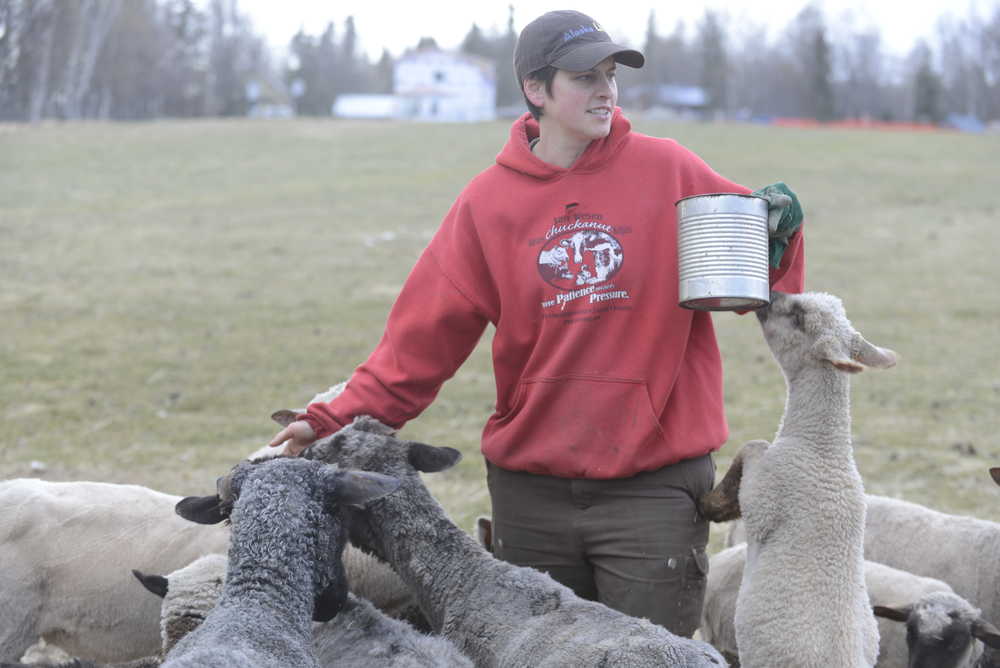
Producers, hobbyists and the curious will converge at the Kenai Peninsula Fairgrounds in Ninilchik this weekend for the third annual Fiber Arts Festival to feel out all things “thread.”
The event will be held Saturday and Sunday, from 10 a.m. to 5 p.m. each day, with 12 different vendors and their unique usages will be present.
The festival is for anyone, said event organizer Lee Coray-Ludden. Final products, a spinning circle and petting zoo will help present the various components of producing and using local wool.
“Whether people are curious about it or serious about it,” Coray-Ludden said. “That’s what makes it fun.”
The purpose of the event is two-fold, Coray-Ludden said: to bring fiber producers and users together, as well as educate the community.
“To be honest it is a developing industry in the state because we’re small in numbers,” Coray-Ludden said. “We’re scattered hither and yon.”
She is also a member of the Fireweed Fiber Guild, which has 100 members across the peninsula, and the president of the Alaska Natural Fiber Business Association, which has 71 members statewide.
The first mill came to the state in North Pole one week ago, Coray-Ludden said. The mill will be specializing in fine fibers, such as Kashmere and Qiviut, which comes from muskoxen, she said.
Most other wools produced in the state will be too coarse and long to be processed at the new mill, Coray-Ludden said. The business association does not have the “concrete assests” to purchase a mill that can handle a wider variety of fibers just yet, but supports importing the equipment into the state, she said.
“We’re building a small industry here,” Coray-Ludden said. “That’s what’s so exciting.”
Nearly half those raising fiber-producing animals in Alaska do not send out their fibers for processing because of the required time or money, Coray-Ludden said.
People can still process their own fibers on a small scale, said Jules Joy, owner of Knitty Stash, a fiber retail store in Homer.
“Most people won’t take on more than five pounds at once,” Joy said.
Joy said any amount of fleece heavier than 10 pounds is usually shipped out of state for processing.
Joy began her long-term relationship with fiber 30 years ago. She opened Knitty Stash in 2009 in a yurt, and is now in a permanent “brick and mortar” establishment. Wool has evolved from what it was 30 years ago, she said.
“Wool used to have the reputation of being scratchy,” Joy said. “It was well deserved.”
Now, there are 22 different breeds of fiber producing animals being raised in Alaska, Coray-Ludden said.
“Fiber has always been a part of agriculture in Alaska,” Coray-Ludden said. “The harvesting and utilizing of fiber goes back to the traditional Alaska Native arts.”
Jane Conway, proprietor of Lancashire Farm Fibers who works on Lancashire Farms in Soldotna with Amy Seitz, said the festival will show the “creative and practical” ways fiber can be used.
“Along with spinning wool and making yarn, people can also make felted soaps and dryer balls with fibers, felted figurines as well as use scrap wool as insulation and even to increase the nutrients and protect garden soils with fibers,” she said.
The demand for final fibrous products is high and can be profitable, Conway said.
Joy purchases her Alaska grown fleece from Lancashire Farms sheep but has to ship out of state for processing. If done at home, it requires extensive labor including washing multiple times, picking out vegetative matter, carding and combing, she said.
Putting that amount of work into it is “the difference between getting out of the shower with dread locks, or getting out with smooth hair,” she said.
“People are craving hand spun, locally grown fibers, they are starving for that kind of thing,” Conway said. “We are awash in loads of fiber, we can’t keep up with the volume we are producing.”
Alaska does not have the infrastructure that’s taken for granted in Lower 48 including creameries, slaughterhouses, and granaries required for a prosperous agricultural industry, Coray-Ludden said. Statewide farmers are looking for ways to support the growing community.
“That’s why the festival is so great,” Coray-Ludden said. “People can see what individuals with fiber in the state. People are coming in from all over south central Alaska for this. It’s a celebration.”
Reach Kelly Sullivan at kelly.sullivan@peninsulaclarion.com.
