
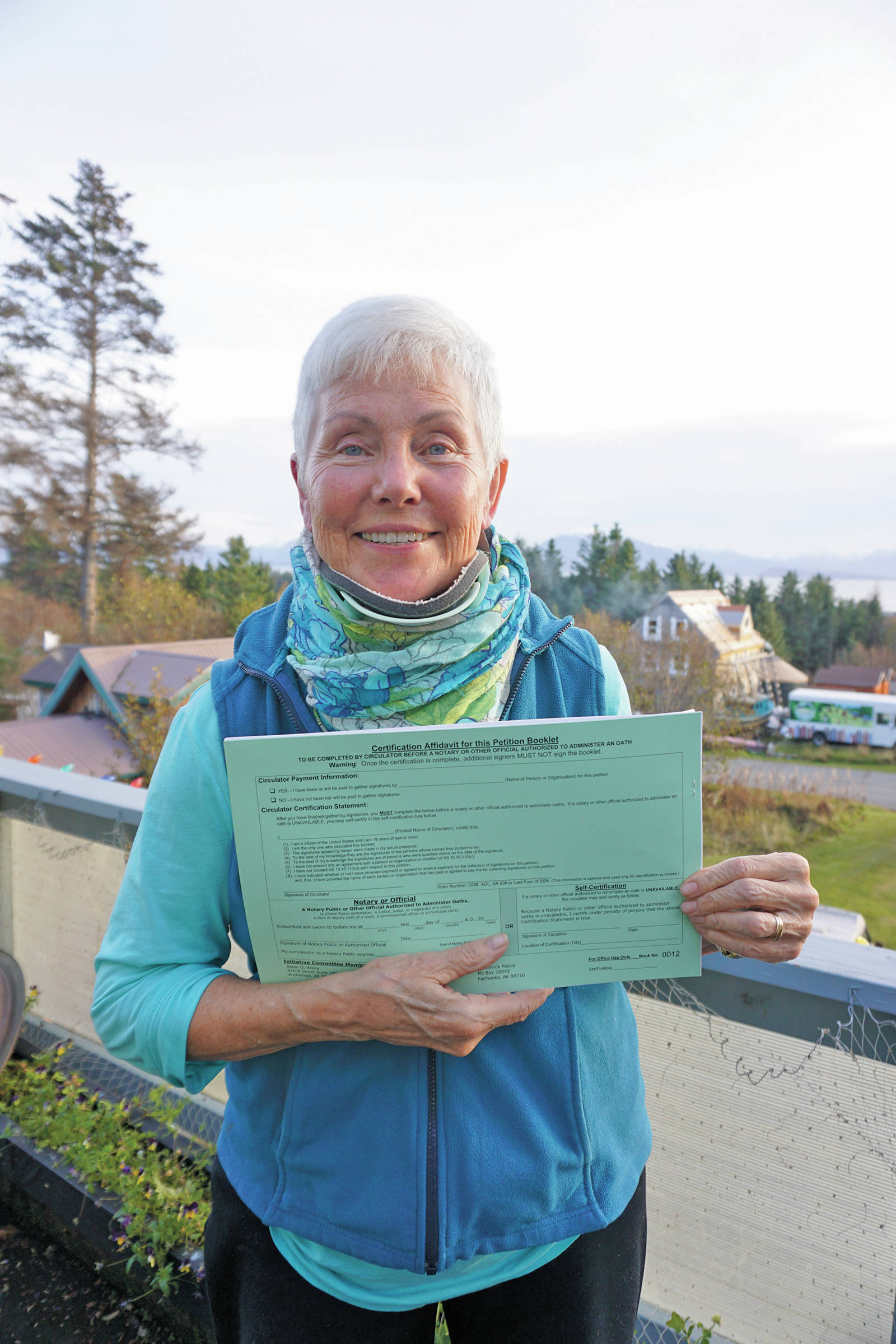
A week after the Homer office of Alaska’s Fair Share campaign opened, volunteers have gathered close to 600 signatures of the 692 needed to put House District 31 in the tally of qualifying districts necessary to put the oil and gas tax reform initiative on the ballot.
Under Alaska’s citizen initiative law, in 30 out 40 districts, sponsors must collect 7% of the last statewide vote in each district and 10% statewide, or 28,502 signatures total. The oil and gas tax reform effort has an office in Homer at 3756 Lake Street, Cabin No. 2. Office hours are 10 a.m. to 1 p.m. and 4-6 p.m. Monday-Saturday. A family-friendly open house is 10 a.m. to 1 p.m. Saturday, Nov. 16.
Fair Share sponsor Jane Angvik delivered signature booklets last month. Angvik, an Anchorage Democrat and former Anchorage Assembly member, sponsored the initiative with Anchorage attorney Robin Brena, an independent and a lawyer and expert in oil and gas tax law, and Merrick Pierce, a Fairbanks Republican. Former Rep. Paul Seaton is one of the local volunteers and a petition book distributor.
“This isn’t a partisan issue,” Brena said in a phone interview on Tuesday. “… It’s an Alaskan issue. … We’ve got an R, a D and an I (Republican, Democrat and Independent).”
If the campaign collects enough signatures to be on the November 2020 ballot, and if it passes, the Fair Share Act would reverse some of the provisions of Senate Bill 21, passed in 2013, but only as they apply to North Slope legacy fields at Prudhoe Bay, Kuparuk and Alpine. The act applies to fields north of 68 degrees latitude that have produced a minimum of 40 thousand barrels of oil in the last year and 400 million barrels of oil cumulatively.
The Fair Share Act has three other components:
■ It increases productions revenues by increasing the gross tax rate, eliminating net tax credits and increasing Alaskan’s share of oil revenues as the price of oil and producers’ profits rise.
■ Called “ring fencing,” it only allows deductions to be done by field and not, as is done now, by applying deductions from other, less-profitable or exploratory fields to profitable fields.
■ The act requires transparency of costs, revenues and profits for the three legacy fields.
In an interview on Oct. 25, Angvik explained that the Fair Share Act seeks to bring Alaskans’ share of oil revenues back to a one-third split as envisioned by the late Gov. Jay Hammond. Alaskans own the subsurface rights to oil that petroleum companies lease, produce and sell.
“We are the JR Ewings of Alaska,” she said, referencing a character in “Dallas,” the 1980s TV show. “We are the owners.”
That one-third deal hasn’t worked out, Angvik said. Before SB 21, the state got from 19% to 25% of gross sales. After SB21 it dropped from 1% to 12%.
Production revenues fell from $4 billion in 2013 to $100 million in 2017. But because oil companies got production credits, when those were applied net revenues dropped as low as minus $400 million in 2017.
Brena said Alaska has cut taxes on the major fields about $1.5 billion a year. The Fair Share Act would get back 26% of the gross or about $1 billion.
“That’s the difference between solving our budget deficit,” he said. “It’s helping fund dividends. It will help fund a capital budget for the first time in years. That will create more jobs in Alaska.”
“If you’re concerned about addressing the fiscal gap of Alaska, it might be a good idea to vote for this initiative,” Angvik said.
In response to the Fair Tax Act, the Alaska Oil and Gas Association said the tax would go too far.
“The proposed ballot measure would dramatically increase taxes on the heart of Alaska’s oil patch,” said Kara Moriarty, president and CEO of AOGA in a statement. “No industry can sustain an increase of this magnitude without causing a disaster for our state’s economy.”
“How can anybody accommodate $1 billion a year?” Angvik asked about AOGA’s assertion. “Oh — that’s us.”
“If the state decides just to give away $1.5 billion, why don’t they give it to the people who do the most for Alaska?” Brena asked.
While the Fair Share Act might seem like “an easy fix to the state’s fiscal situation,” Moriarty wrote in her statement, “the reality is, this is bad policy and it is irresponsible to put forth a major policy proposal like this where impacts have not been properly evaluated. Smart policy should encourage new oil production for all fields in Alaska which puts more oil in the pipeline.”
When he was in the Legislature and voted on SB 21, initially Seaton voted against it. On reconsideration he voted with the majority “thinking I might be able to work with the rest of the people to cure some of the problems of the bill in the following Legislature.”
That didn’t happen, Seaton said.
“It was the worst vote I ever took because it was meaningless,” he said.
SB 21 has had more than five years to prove it could work, Seaton said.
“It’s no longer like it was when we gave people the benefit of the doubt until we see how it works,” he said. “(We have) fewer jobs, less revenue. It’s time to make a change.”
As part of the process to approve the Fair Share Act to proceed as a citizen initiative, Lt. Gov. Kevin Meyer found that the proposed bill met the constitutional and statutory requirements to move forward. Meyer, acting on the advice of Alaska Attorney General Kevin Clarkson, went further, though. Meyer was to also prepare an impartial summary of the initiative that would go on the signature books and on the ballot.
Meyer didn’t do that, Brena said.
“I sent over a red line with corrections to their summary and asked to meet with them to discuss it,” he said. “They refused to meet or return the call.”
The summary included everything from typographical errors to a biased summary, Brena said. For example, in the petition summary, it reads that act would change production taxes for North Slope areas “where the company produced more than 40,000 barrels of oil per day in the prior year and/or more than 400 million barrels total.” In the next sentence it reads, “It is unclear whether the area has to meet both the 40,000 and 400,000 (sic) million thresholds of just one of them.”
“What is 400,000 million?” Brena asked. “That’s not even a number.”
Even though the Fair Share language says “40,000 barrels of oil and 400 million barrels total,” the summary reads “and/or.”
“They intentionally suggest there’s confusion,” Brena said. “What’s confusing about ‘it has to be 40,000 and 400 million?’ … How can ‘and’ mean ‘and/or?’”
Brena said it’s likely the Fair Share Act sponsors will have to sue the state to correct the errors.
“The lieutenant governor’s description is not accurate, is not impartial, and hasn’t even been properly proofread,” he said. “… What do you do when people aren’t trying to get it right and won’t talk to you?”
A lifelong Alaskan raised in Skagway, Brena describes himself as a fiscal conservative and pro development, a pro oil-and-gas attorney.
“I think what’s best for Alaska is to develop our oil resources,” he said. “I just think Alaskans need to get a fair share from the sale of our oil.”
For more information on the Fair Share Act, visit www.voteyesforalasksfairshare.com. For more on the Alaska Oil and Gas Association, visit https://www.aoga.org.
Editor’s note: Editor Michael Armstrong graduated in 1977 with Robin Brena from New College of Florida, Sarasota.
Reach Michael Armstrong at marmstrong@homernews.com.
