
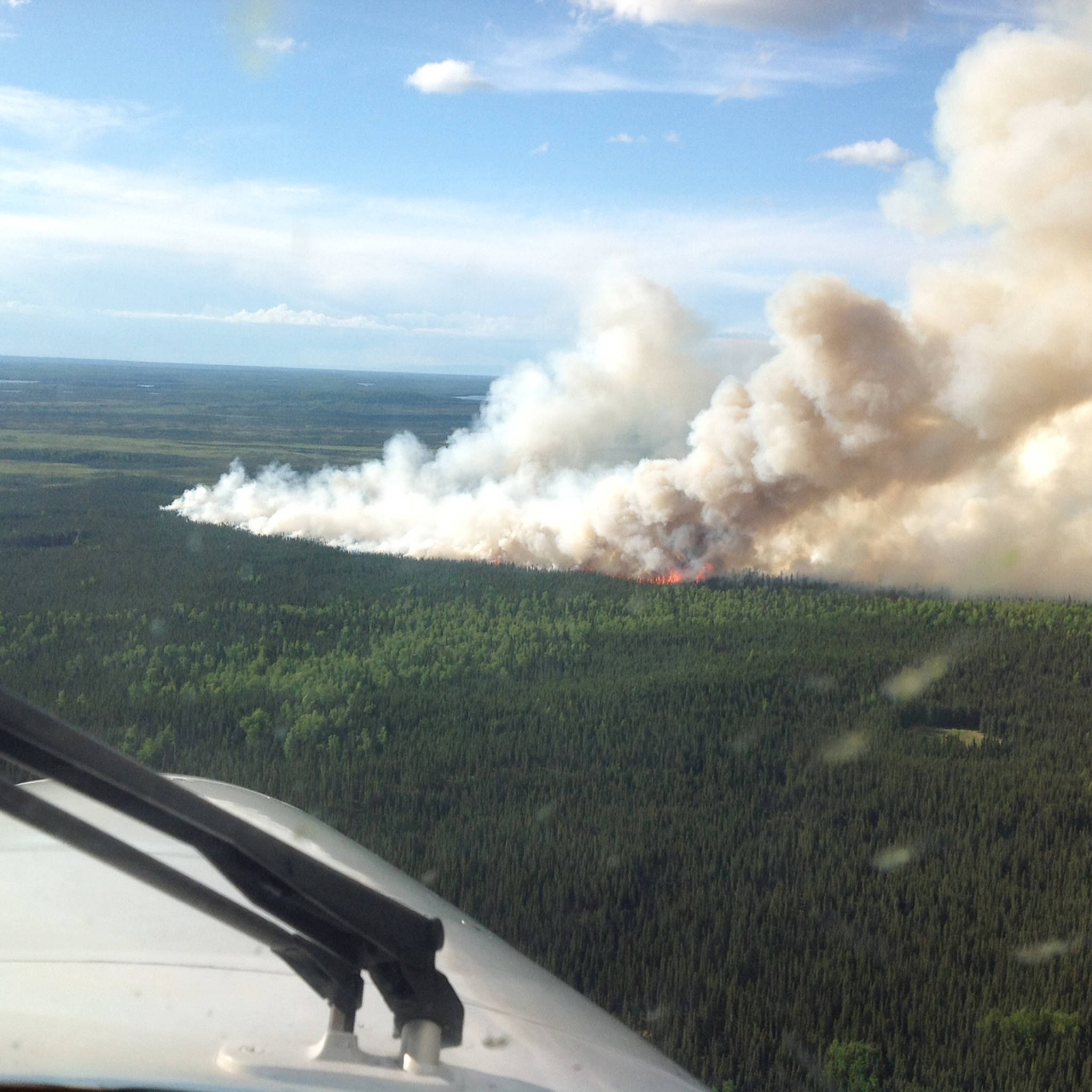
The Swan Lake wildfire burns in the Kenai National Wildlife Refuge as seen from the air June 15, 2017 near Sterling, Alaska. The 1,016-acre fire started by lightning will continue to be monitored, though it is not threatening any residents and has been downgraded in intensity. (Photo courtesy Tim Mowry, Alaska Division of Forestry)

The Swan Lake wildfire burns in the Kenai National Wildlife Refuge as seen from the air June 15, 2017 near Sterling, Alaska. The 1,016-acre fire started by lightning will continue to be monitored, though it is not threatening any residents and has been downgraded in intensity. (Photo courtesy Tim Mowry, Alaska Division of Forestry)

East Fork fire intensity downgraded, firefighters still monitoring

Firefighters are scaling back their work on the East Fork wildland fire burning in the Kenai National Wildlife Refuge as it is not posing any threats, though they will continue to monitor its activity.

Sparked on June 15 by a lightning strike, the blaze is still reported at 1,016 acres in a limited suppression zone of the refuge near Sterling, about 4.5 miles north of the Sterling Highway. The Alaska Division of Forestry has been responding and containing the fire in conjunction with the U.S. Fish and Wildlife Service.

Firefighters have focused on the western and southern borders of the blaze to ensure it doesn’t encroach on the Sterling community or toward the highway. At this point, the East Fork fire has been transitioned to a Type 4 Incident, according to a release posted to the Alaska Wildland Fire Information website. Alaska Division of Forestry Public Information Officer Celeste Prescott said this means the fire has been reclassified as less intense based on its activity.

Complexity analyses are performed on fire incidents throughout their duration, Prescott said. Fires are classified from Type 1, being the most intense or dangerous, to Type 5, the equivalent of an escaped campfire. The East Fork fire began as a Type 3 incident, and now that’s it’s been classified at Type 4, the personnel assigned have been reduced to about 27, she said.

“Although parts of the Kenai Peninsula are receiving significant amounts of rain, the fire area is in a rain shadow, therefore is not expected to receive much rain over the next few days,” the release states. “Fires burning in deep duff and tundra require significant amounts of rain to put them completely out. Therefore, fire activity will likely increase once again when warmer and drier weather returns to the area.”

Crews are still doing a bit more work on the ENSTAR natural gas line easement that’s serving as a fuel break, along with another fuel break that was created from the fire’s southwest corner about 2 1/2 miles south to the pipeline. As fire activity picked up a bit on Tuesday, Prescott said firefighters actually got closer to the fire’s perimeter and are moving around the blaze as needed.

The plan to burn a stand of black spruce between the fire and the highway will only be implemented if the blaze picks back up, Prescott said, and the surrounding residents would get at least 24 hours notice.

“It’s really a strategy or a tactic we have potential to use if the fire becomes a threat, and at this point it’s not threatening the community,” she said.

There is still one helicopter on hand for personnel to fly over and monitor the fire, and to provide food, water and other resources to the firefighters still on the ground, Prescott said. The temporary flight restriction for the area above the wildland fire has been lifted, she said.

Personnel still assigned to the fire will likely reassess their plan after four to five days of monitoring, Prescott said.

Reach Megan Pacer at megan.pacer@peninsulaclarion.com.
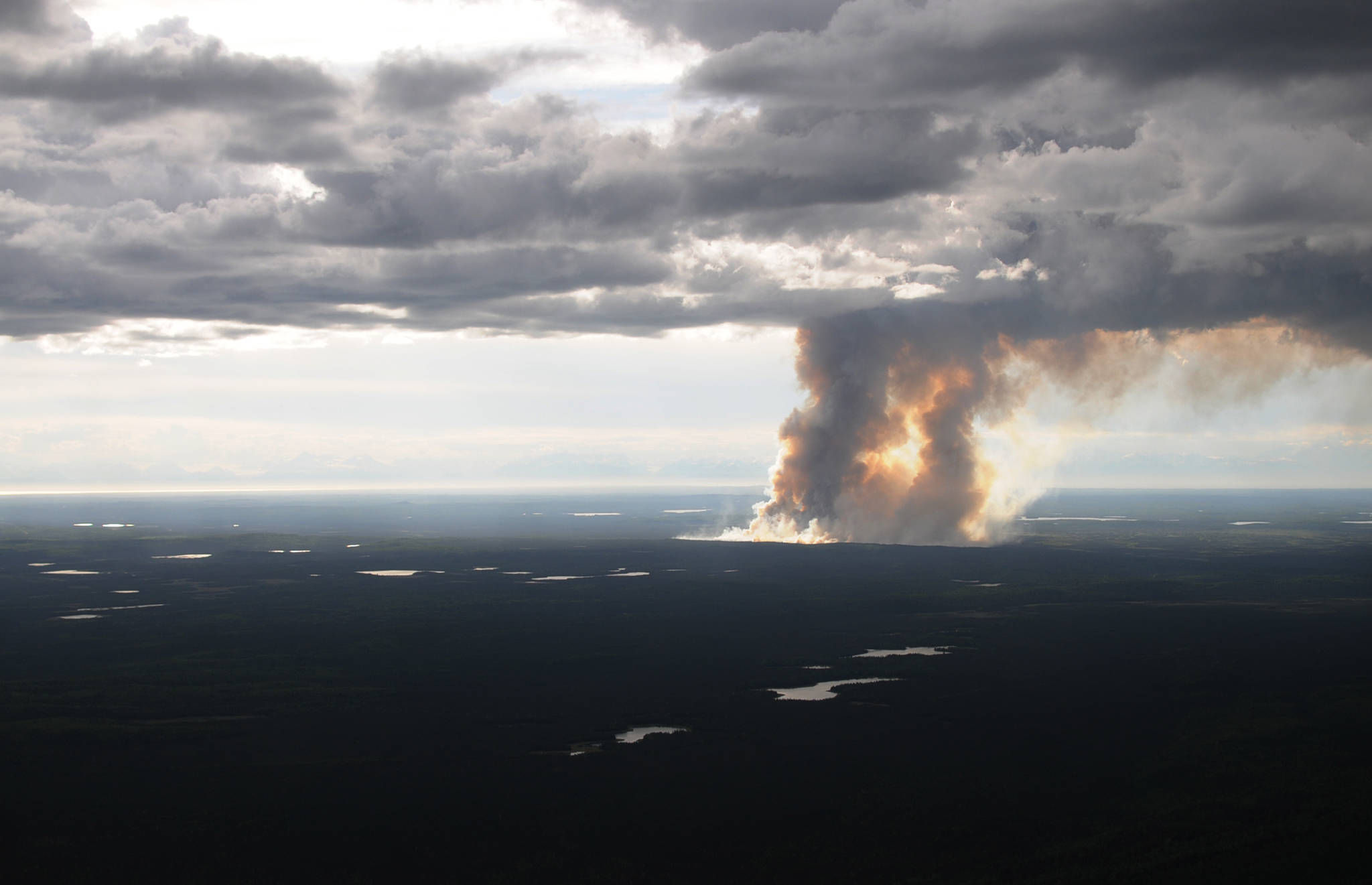
Smoke rises from the burn area of the East Fork Fire on the Kenai National Wildlife Refuge on June 16, 2017 near Sterling, Alaska. The fire, sparked by lightning, rests at 1,016 acres and will be monitored as firefighters pull back their response. (Photo by Elizabeth Earl/Peninsula Clarion)

Smoke rises from the burn area of the East Fork Fire on the Kenai National Wildlife Refuge on June 16, 2017 near Sterling, Alaska. The fire, sparked by lightning, rests at 1,016 acres and will be monitored as firefighters pull back their response. (Photo by Elizabeth Earl/Peninsula Clarion)

More in News

Low clouds hang over Cook Inlet north of Anchor Point on Oct. 23, 2025. (Photo by Yereth Rosen/Alaska Beacon)
Inletkeeper condemns federal management of Cook Inlet oil lease sale

The agency alleges an environmental study by the Bureau of Ocean Energy Management was conducted with a “serious” lack of transparency.

The Kenai Chamber of Commerce announced the winners of the 13th annual gingerbread house competition on Dec. 20, 2025. This creation by Sierra won the 2-5 year old age category. Photo courtesy of the Kenai Chamber of Commerce
Wrapping up the holiday season

The Kenai Chamber of Commerce’s Angel Tree program and gingerbread house competition spread Christmas cheer to hundreds locally.

The Challenger Learning Center is seen here in Kenai<ins>, Alaska,</ins> on Sept. 10, 2020. (Photo by Brian Mazurek/Peninsula Clarion)
Kenai City Council considers possible uses for Challenger Center

One option would assess the facility’s potential as the new public safety building.

A snowmachine rider takes advantage of 2 feet of fresh snow on a field down Murwood Avenue in Soldotna, Alaska, on Monday, Dec. 12, 2022. (Jake Dye/Peninsula Clarion)
Ice fishing opens on some Kenai National Wildlife Refuge lakes

Snowmachines are permitted for ice fishing access on Hidden, Kelly, Petersen, Engineer and Watson lakes.

The waters of Cook Inlet lap against Nikishka Beach in Nikiski, Alaska, where several local fish sites are located, on Friday, March 24, 2023. (Jake Dye/Peninsula Clarion)
Kenai asks for fishery economic disaster declaration

The Kenai City Council requested that Gov. Dunleavy declare a disaster and support a recovery plan for the Upper Cook Inlet East Side Set Net fishery.

The Kenai Peninsula Borough School District logo. (Photo courtesy of Kenai Peninsula Borough School District)
District superintendent dispels rumors about student construction

Superintendent Clayton Holland said student involvement in Seward High School construction is “based on rumor, not fact.”

Anchorage-based singer and songwriter Keeley Boyle is pictured in Anchorage<ins>, Alaska,</ins> on Sept. 26, 2023. Boyle, who was raised on the Kenai Peninsula, will use a $10,000 grant she received from the Rasmuson Foundation to create an album of songs about her grandparents’ home in Nikiski. Photo courtesy of Jovell Rennie
Musician hailing from Kenai receives Rasmuson grant

Keeley Boyle will record an album of songs about her grandparents’ Nikiski home.

Commercial fishing and recreational vessels are docked in the Homer harbor on Oct. 23, 2025. The commercial fishing industry endured a series of challenges over the year, some of them imposed by the new Trump administration. (Photo by Yereth Rosen/Alaska Beacon)
Alaska fisheries in 2025: turmoil, economic and environmental challenges and some bright spots

NOAA cuts, economic headwinds and invasive species pose problems, but there was some recovery in crab stocks and salmon harvests.

Cook Inlet near Clam Gulch is seen on Oct. 23, 2025. (Photo by Yereth Rosen/Alaska Beacon)
Disputed oil lease sale in Alaska’s Cook Inlet upheld in new Trump administration decision

After completing a court-ordered environmental study, the Bureau of Ocean Energy Management said no changes are needed for the 2022 sale that drew just one bid.

Most Read