
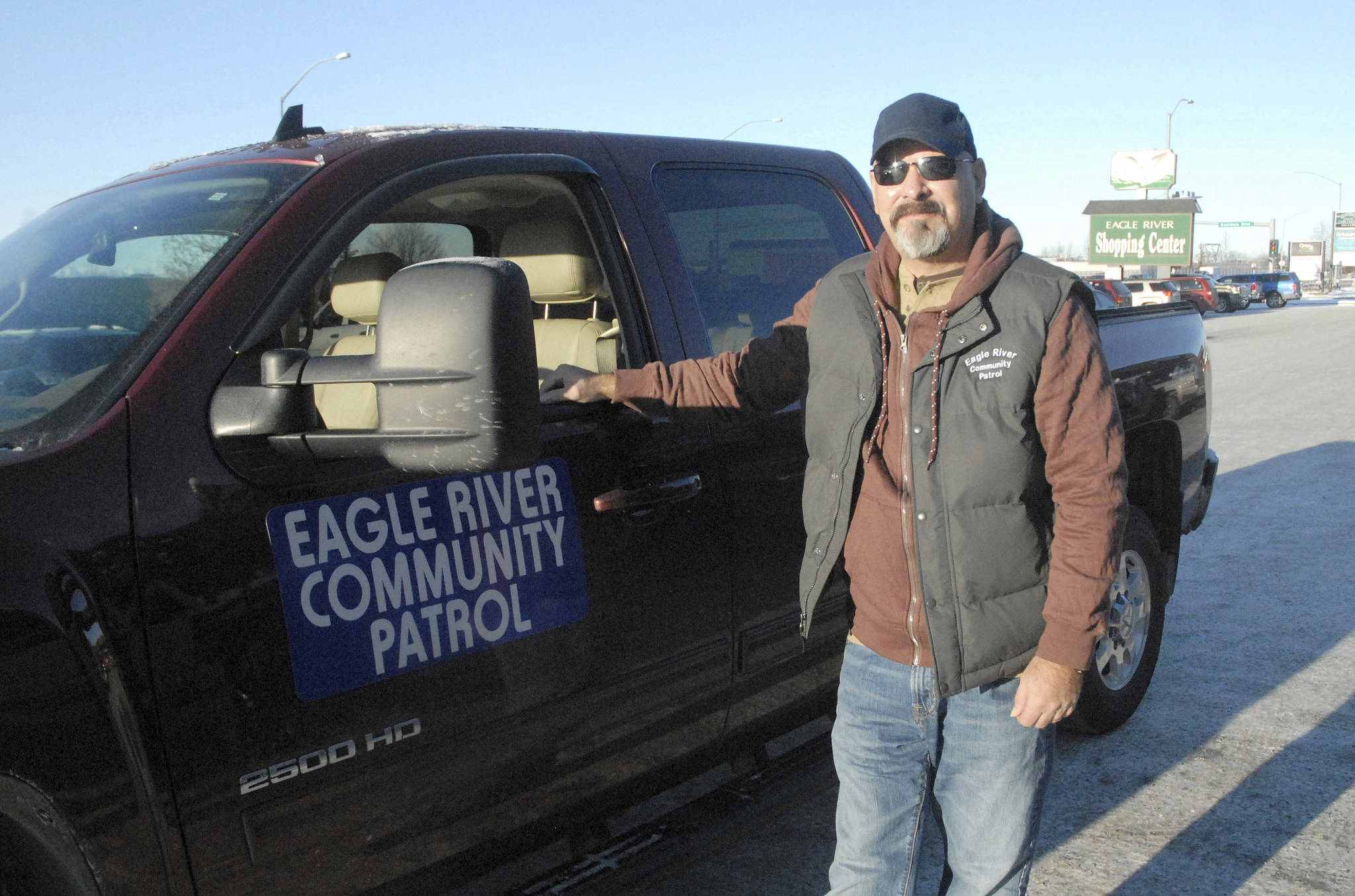
EAGLE RIVER — On his own time and his own dime, an Eagle River man has recently started driving around town as part of a one-man community patrol effort.
Cliff Cook began making the rounds as the new Eagle River Community Patrol Saturday, Nov. 4. Over the course of his first week, Cook said he covered more than 100 miles over 13 hours spread across five days of driving around Eagle River.
The effort is the culmination of several months of often frustrating work on the part of Cook, a retired Air Force veteran who has lived in Eagle River with his wife since taking an assignment at Elmendorf Air Force Base in 1999.
In an interview Monday, Nov. 13, Cook said he believes the time has come for Eagle River to have its own community patrol.
“My main concern is what the community wants, and I think it’s time,” he said. “We’ve been talking about it long enough.”
Cook is working with other community patrols in the municipality for guidance, but he has yet to secure the official sanction of the Eagle River Community Council or other community organizations such as the local chamber of commerce or nonprofits. That could be a problem down the road, said Birchwood Community Patrol captain Jeff Hartley, who founded that area’s patrol in 2008.
“I think it’s critical he gets the support of the council and the community as a whole,” Hartley said.
There are no rules governing community patrols, but the Federation of Community Councils encourages patrols to work through local councils, which advise the Anchorage Assembly on local matters pertaining to 37 communities within the municipality. Through the federation, the Coalition of Community Patrols is the organization that guides existing patrols in the muni, of which there are currently six recognized by the coalition.
Cook has been working with the group to establish the Eagle River patrol as the seventh, and his patrol (along with one planned in Oceanview) are listed on the coalition’s website as “coming soon.” He plans to take first aid and patrol training through the coalition and has been working closely with Hartley to model the Eagle River patrol’s procedures after Birchwood’s. He said the vetting process being done through the coalition should assure skeptics he’s going about things the right way.
“I’m going to complete all the conditions the coalition wants me to,” Cook said. “I want to do this right.”
He said he understands concerns people might have about a lone community member starting his own patrol. That’s why he’s trying to work through the coalition to mirror how things are done with other established patrols.
“It’s more than just a background check, get in your vehicle and drive around,” he said.
Hartley stressed that while he’s giving Cook guidance, the Eagle River Patrol is not affiliated with Birchwood’s.
“It’s mainly an advisory role,” Hartley said.
Hartley said he thinks the time has come for the assembly to pass an ordinance governing patrols, and he’s working to try and bring something forward through local assembly members. Hartley doesn’t want to see a big, onerous municipal code.
“Just some basic rules,” he said.
Glenn Yancha with the Bayshore/Klatt Community Patrol said the idea behind community patrols is not for people to become vigilantes, but for informed community members to keep an active eye out for suspicious activity.
“That’s what APD wants us to do is be the eyes and kind of report in,” Yancha said.
Patrol members work closely with the Anchorage Police Department to report suspicious activity, but both he and Hartley said patrol members are taught not to engage criminals.
Cook said he’ll follow the same procedures.
“If I see something doing something illegal I’m absolutely going to call,” he said.
He said he’s still mostly patrolling during daylight hours in order to get people familiar with the maroon extended-cab Chevy Silverado emblazoned with blue-and-white community patrol signs. Simply being a visible presence is probably the patrol’s biggest function, he said.
“Let ‘em see the signs and they’ll usually drive off,” he said.
Cook has spoken to the Eagle River Community Council several times in regard to backing the patrol, but the council has not yet passed any resolutions either way about the issue. So with property crime rates on the rise, Cook said he finally got tired of waiting for approval and decided to go it alone.
“I’m going to let the politicians hash it out whether it’s legitimate,” he said.
After making his first patrols, Cook posted his driving statistics to the Eagle River Crime Watch Facebook page. He said his post quickly garnered more than 400 likes and didn’t have a single negative comment — ample evidence, he said, the people of Eagle River support his efforts to start a community patrol.
“It seems like the community wants it,” he said.
But response at the community council level has been tepid. Former council member Brian Fay said the group wanted to see more “checks and balances” in place before moving forward. Fay also said he’s not sure the community is as overwhelmingly supportive of the patrol as implied on social media.
“The response we’ve had from the community has been kind of mixed,” he said.
Fay pointed out that the issue is currently an open item on the council’s agenda.
Cook said he welcomes more participation and comments at council meetings, which he said would go a long way toward convincing the council to give its blessing to the patrol.
“Numbers at a meeting would matter,” he said.
In the meantime, Cook said he plans to continue making the rounds in Eagle River. People are fed up with crime, he said.
“It just seems like it’s getting worse,” he said.
Until he completes his training and establishes a working relationship with APD, Cook said he plans to limit his patrol to himself. He’s paying the bills (gas, signs, an embroidered jacket) out of his own pocket, and doesn’t want to expand the patrol until he’s become more established.
“Right now it’s just me,” he said.
