
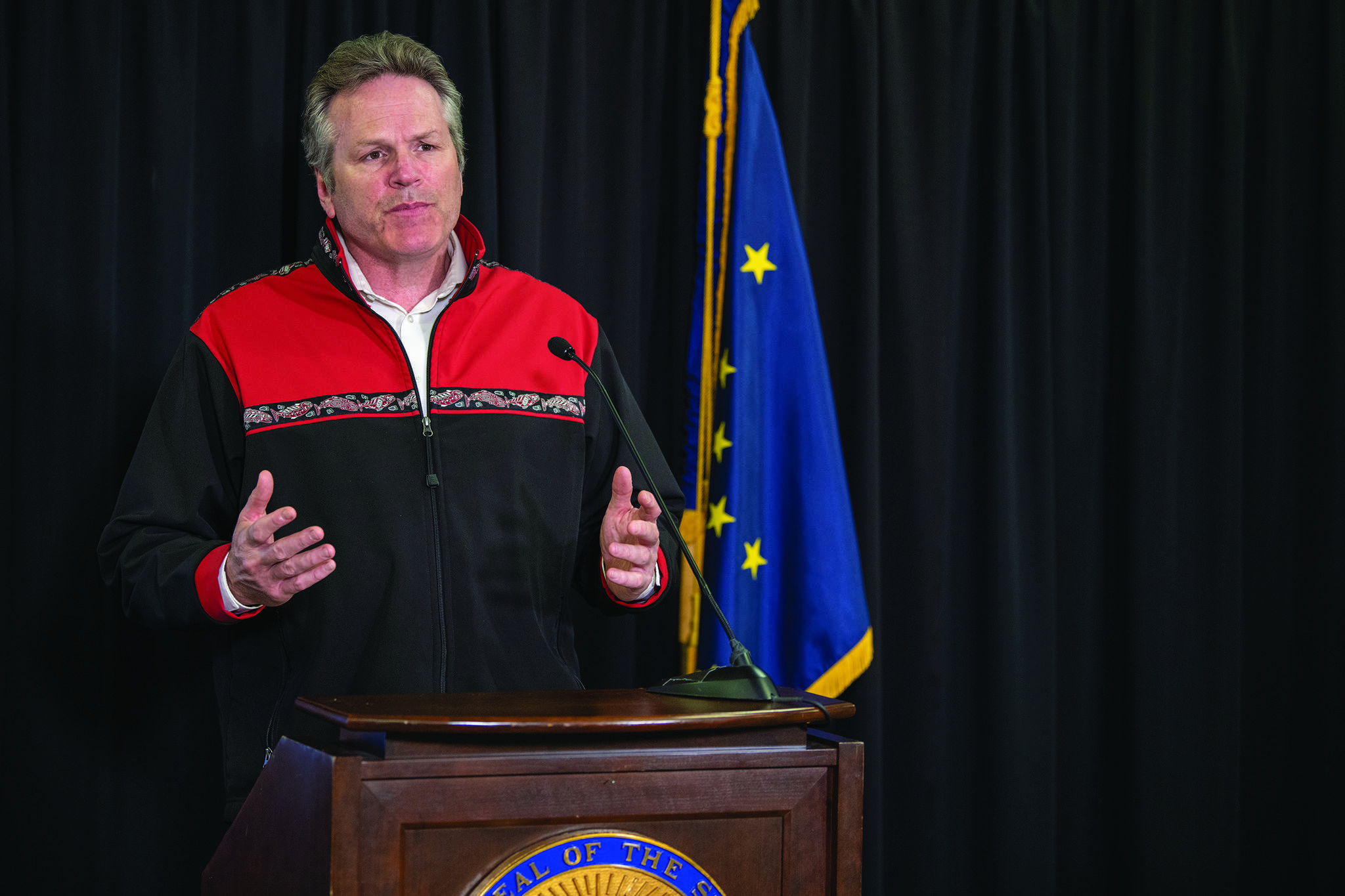
Alaskans should wear masks in public settings and practice social distancing as much as possible, Gov. Mike Dunleavy and several members of his COVID-19 response team said in a press conference Wednesday night.
Dunleavy declined to commit to a statewide mask mandate, saying that a targeted approach will be more effective in slowing the current infection rate than broad proclamations or mandates.
“We’re going to take the appropriate actions based upon the data,” Dunleavy said on Wednesday. “There’ll be politics all across the spectrum saying ‘you’re doing too much’ or ‘you’re not doing enough.’ We get that. But we’re going to stay focused, as a team, to work our way through this. …
“We need the help of individual Alaskans. Not statewide mandates, but individual Alaskans. So when you wake up in the morning, put a mask in your pocket. If you’re going to come to a state building, throw the mask on if you can’t be 6 feet or more away from others. If you’re going to the store, throw the mask on as you’re in the store.”
While there will be no statewide mask mandates unless the situation in Alaska changes drastically, Dunleavy did encourage individual communities that are experiencing outbreaks to consider requiring face coverings in their area. Dunleavy also noted that state employees, contractors and anyone entering state facilities will be required to wear a face covering starting on July 22.
Dunleavy was asked how this decision regarding state employees came about, given that Attorney General Kevin Clarkson sent a memo to state employees on June 29 saying that they were exempt from Anchorage’s mask mandate.
“It’s really us looking at the metrics and seeing how we can contribute here in our state buildings and with our state workforce, and we want to do everything we can to keep our state workers safe and those constituents coming in to do business,” Dunleavy said. “So we don’t think it’s a big leap. I know that some folks want to politicize any action, any and all actions, that there is some reason other than medical reasons for doing it, and there really isn’t.”
Dunleavy asked the state’s Chief Epidemiologist Dr. Joe McLaughlin as well as epidemiologists Anna Frick and Kim Spink to reiterate when masks are effective, what they are meant to do and what the difference is between types of masks.
Frick explained that only respirator masks, such as N95 masks, actually filter air as you take it in in order to prevent you from inhaling whatever is in the area. Surgical masks and homemade cloth face coverings, on the other hand, are meant to prevent physical droplets of saliva or mucus from escaping your mouth and nose and traveling through the air to reach other people.
Current research indicates that COVID-19 spreads primarily through these kinds of droplets, so wearing any kind of face covering is an effective way to mitigate any potential spread of the virus when a distance of 6 feet or more cannot be maintained in social situations.
McLaughlin explained that these droplets usually hit the ground after about 5 or 6 feet, which is why that distance is important in mitigating the spread of the virus. Outdoor interactions are less likely to cause infection because there is more air circulation than inside a building, so the droplets have less of a chance of reaching the people with whom you’re interacting.
Several women representing business interests in Alaska also spoke at the press conference to say that hotels, restaurants, bars and other venues want to be able to stay open, but people have to start wearing masks in order to make that happen.
Sarah Oates is the president and CEO of Alaska CHARR, which represents more than 800 different restaurant and hospitality businesses across the state. She said that her organization conducted a survey among industry members of what added mitigation measures would be welcomed by these businesses in order to prevent shutdowns. Oates said the survey showed that business owners were in favor of things like sanitation stations at entrances, guest logs and mask requirements for employees.
“We support Governor Dunleavy’s recommendations to the public regarding wearing face masks if you can’t keep socially distanced or physically distanced from others,” Oates said. “And we hope that consumers will continue to help your local bars and restaurants by following all mandates, recommendations and house policies at establishments, which are in place to both prevent transmission and help keep businesses open to serve you.”
A mandate set to go into effect in Anchorage Friday, Oates said, will once again limit the number of people who can be inside bars and restaurants, but will not close them entirely. Oates said she hopes that this form of “dialing back” is what will happen elsewhere, rather than “flipping the switch and turning it off entirely.”
“I sincerely hope that Alaskans will continue to take those steps, even if they’re uncomfortable, for a short period of time in order to support Alaskan businesses,” Oates said. “Check with your local business before you show up so that you know in advance what the local mandates or house policies require. And please do your part to support them so that they may continue to serve you.”
The press conference can be viewed in its entirety on Dunleavy’s official Facebook Page.
Reach reporter Brian Mazurek at bmazurek@peninsulaclarion.com.
