
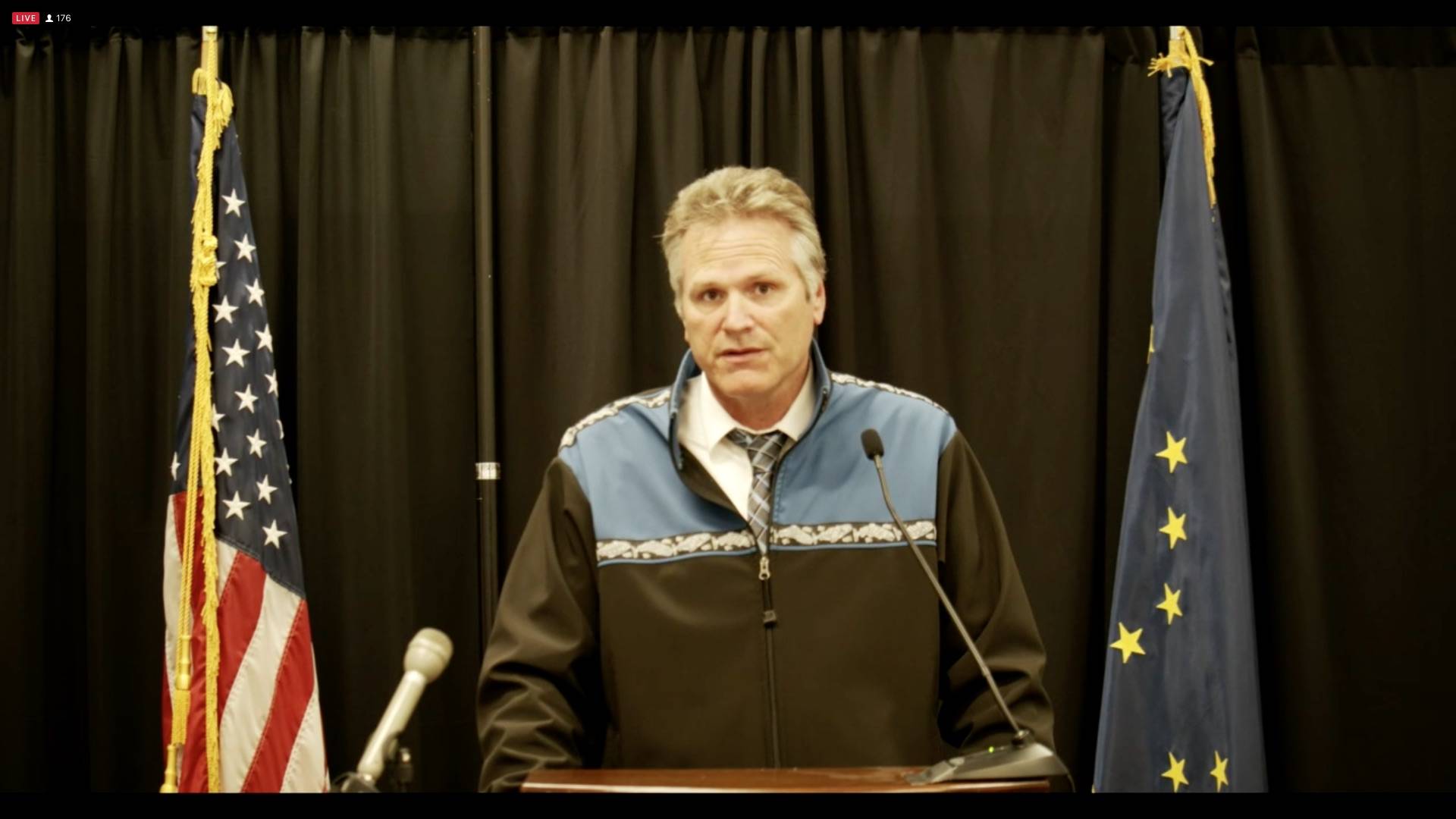
Gov. Mike Dunleavy speaks at a press conference about the COVID-19 pandemic on Thursday, Aug. 26, 2021 from Anchorage, Alaska. (Ashlyn O’Hara/Peninsula Clarion)

Gov. Mike Dunleavy speaks at a press conference about the COVID-19 pandemic on Thursday, Aug. 26, 2021 from Anchorage, Alaska. (Ashlyn O’Hara/Peninsula Clarion)

Dunleavy urges Alaskans to help mitigate hospital strain

The strain isn’t necessarily due to a shortage of hospital beds or ventilators, but a shortage of hospital staff.

Gov. Mike Dunleavy on Thursday night pleaded with Alaskans to help mitigate the state’s strained hospital system.

“The hospital capacity has become very, very constrained here in the state of Alaska, as it has in many other states and across the world,” Dunleavy said during a press conference held at the Atwood Building in Anchorage.

The strain isn’t necessarily due to a shortage of hospital beds or ventilators, Dunleavy said, but rather a shortage of hospital staff that is being exacerbated by the spread of the delta variant and a general increase in the number of people seeking treatment, among other things.

Alaskans can help, Dunleavy said, by being mindful of that strain when participating in dangerous outdoor activities and scheduling elective surgeries with their doctor.

“What we’re finding is that it’s making it difficult for the hospitals to serve everybody in a timely manner, or in the manner that you had once thought the service would be available at a hospital,” Dunleavy said.

The high transmissibility of the delta variant, however, poses its own challenges.

Alaska Chief Medical Officer Dr. Anne Zink said that, for comparison, if someone has influenza, they may spread it to one to two people. If someone has the original strain of COVID-19, they may spread the virus to two and a half people. If someone has the delta variant, they may spread it to between five and eight people. That, Zink said, is making it harder for public health workers to do their job.

“We are all running behind and it is becoming harder as this variant moves more quickly,” Zink said.

In addition to expecting longer wait times and a potentially different care regimen, Zink encouraged Alaskans to think critically about whether they should go to the emergency room over a minor injury that could be treated elsewhere.

“If you have a minor injury, consider going to an urgent care or going to your primary care doctor, rather than going to the emergency department (or) into the hospital,” Zink said.

To help offset the loss of staff, the state has reinstated weekly conversations with state hospitals to gauge need and is working with federal partners to recruit staff from a pool created by the Federal Emergency Management Association and the General Services Administration, Director of Public Health Heidi Hedberg said.

Dunleavy, Zink and Hedberg all emphasized the resources available to Alaskans to help mitigate the spread of the virus and subsequent strain on the state’s health care system, including vaccines and a layered mitigation strategy. The most consequential tool available, they said, is the COVID-19 vaccine. As of Aug. 10, DHSS reported that, in Alaska, people who are unvaccinated account for 94% of all COVID-19 hospitalizations and 96% of all COVID-19 deaths.

The statewide percentage of Alaskans 12 and older who were fully vaccinated was about 54.1%, with variability across individual regions. The Kenai Peninsula Borough continues to rank tenth out of 11 regions, with about 45.9% of residents 12 and older fully vaccinated.

Dunleavy reiterated his opposition to vaccine and mask mandates for the state Thursday.

“You’ve crossed the line, in my opinion, once you start to force a population of a state to undergo certain medical processes,” Dunleavy said. “Personally, I’m not ready to cross that line. I don’t know if I ever will be ready to cross the line (or) to force people to get vaccinations when we know that the vaccinations do work (and) they help mitigate this virus. Everyone knows that.”

Those tools, Dunleavy said, are why the state is better positioned to respond to a surge in cases than it was last year.

“More than a year and a half ago, when this virus first landed on our shores, we weren’t sure what we were facing,” Dunleavy said. “We have a pretty good idea now as to what we’re facing, and we know what the tools are.”

Zink echoed those comments.

“We’re really not powerless in this,” Zink said. “Together, we determine where this pandemic goes and how much we can care for each other and how much Alaskans we can help protect. If you haven’t been vaccinated, consider getting vaccinated.”

Thursday’s full press conference can be viewed on the governor’s Facebook page.

Reach reporter Ashlyn O’Hara at ashlyn.ohara@peninsulaclarion.com.

More in News

File.
Soldotna aims to change short-term rental tax and permitting

Public hearings for two ordinances addressing existing short-term rental regulations will occur during the next city council meeting on Jan. 14.

Low clouds hang over Cook Inlet north of Anchor Point on Oct. 23, 2025. (Photo by Yereth Rosen/Alaska Beacon)
Inletkeeper condemns federal management of Cook Inlet oil lease sale

The agency alleges an environmental study by the Bureau of Ocean Energy Management was conducted with a “serious” lack of transparency.

The Kenai Chamber of Commerce announced the winners of the 13th annual gingerbread house competition on Dec. 20, 2025. This creation by Sierra won the 2-5 year old age category. Photo courtesy of the Kenai Chamber of Commerce
Wrapping up the holiday season

The Kenai Chamber of Commerce’s Angel Tree program and gingerbread house competition spread Christmas cheer to hundreds locally.

The Challenger Learning Center is seen here in Kenai<ins>, Alaska,</ins> on Sept. 10, 2020. (Photo by Brian Mazurek/Peninsula Clarion)
Kenai City Council considers possible uses for Challenger Center

One option would assess the facility’s potential as the new public safety building.

A snowmachine rider takes advantage of 2 feet of fresh snow on a field down Murwood Avenue in Soldotna, Alaska, on Monday, Dec. 12, 2022. (Jake Dye/Peninsula Clarion)
Ice fishing opens on some Kenai National Wildlife Refuge lakes

Snowmachines are permitted for ice fishing access on Hidden, Kelly, Petersen, Engineer and Watson lakes.

The waters of Cook Inlet lap against Nikishka Beach in Nikiski, Alaska, where several local fish sites are located, on Friday, March 24, 2023. (Jake Dye/Peninsula Clarion)
Kenai asks for fishery economic disaster declaration

The Kenai City Council requested that Gov. Dunleavy declare a disaster and support a recovery plan for the Upper Cook Inlet East Side Set Net fishery.

The Kenai Peninsula Borough School District logo. (Photo courtesy of Kenai Peninsula Borough School District)
District superintendent dispels rumors about student construction

Superintendent Clayton Holland said student involvement in Seward High School construction is “based on rumor, not fact.”

Anchorage-based singer and songwriter Keeley Boyle is pictured in Anchorage<ins>, Alaska,</ins> on Sept. 26, 2023. Boyle, who was raised on the Kenai Peninsula, will use a $10,000 grant she received from the Rasmuson Foundation to create an album of songs about her grandparents’ home in Nikiski. Photo courtesy of Jovell Rennie
Musician hailing from Kenai receives Rasmuson grant

Keeley Boyle will record an album of songs about her grandparents’ Nikiski home.

Commercial fishing and recreational vessels are docked in the Homer harbor on Oct. 23, 2025. The commercial fishing industry endured a series of challenges over the year, some of them imposed by the new Trump administration. (Photo by Yereth Rosen/Alaska Beacon)
Alaska fisheries in 2025: turmoil, economic and environmental challenges and some bright spots

NOAA cuts, economic headwinds and invasive species pose problems, but there was some recovery in crab stocks and salmon harvests.

Cook Inlet near Clam Gulch is seen on Oct. 23, 2025. (Photo by Yereth Rosen/Alaska Beacon)
Disputed oil lease sale in Alaska’s Cook Inlet upheld in new Trump administration decision

After completing a court-ordered environmental study, the Bureau of Ocean Energy Management said no changes are needed for the 2022 sale that drew just one bid.

The Kenai Peninsula Borough School District logo.
School district projects $7.5 million budget deficit for fiscal year 2027

Decreased enrollment and increased property values mean less local and state funding.

The sign in front of the Homer Electric Association building in Kenai, Alaska as seen on April 1, 2020. (Photo by Brian Mazurek/Peninsula Clarion)
Homer Electric Association announces rate increase

The proposed increase, if approved by the Regulatory Commission of Alaska, will go into effect Jan. 1.