
Gov. Mike Dunleavy said Tuesday he will veto an education bill sent to him by the Alaska Legislature this week unless lawmakers approve additional legislation strengthening support for charter schools, providing year-end teacher bonuses and addressing other policy priorities of his within the next two weeks.
The legislation was sent to the governor Monday after passing in the House last Thursday by a 38-2 vote, and in the Senate on Monday with an 18-1 vote. Transmittal of the legislation Monday to Dunleavy’s desk started a 15-day countdown during which he must either sign the bill, veto it or allow it to become law without his signature.
The version of the bill currently being considered is the product of multiple days of stalemate and closed-door negotiations in the House, where lawmakers considered a dozen amendments before passing a wide-ranging education package. However, despite passing the Legislature by a combined vote of 56-4, it is not certain there would be the 40 votes necessary to override a veto by the governor.
The bill includes a $680 increase to the amount of money the state gives school districts per student, called the base student allocation, as well as extra money for student transportation and reading intervention for K-3 students. The same bill expands state support for charter schools and funds students enrolled in correspondence programs — such as home-schools — at the same level as students enrolled at brick-and-mortar schools.
Speaking from Anchorage on Tuesday, Dunleavy said the bill “falls short” of what he’s willing to sign.
“I think we got half of a package,” he said.
A key sticking point was Dunleavy’s proposal for teacher bonuses, which carries a price tag of around $60 million. The proposed three-year program would pay annual bonuses of $5,000, $10,000 and $15,000 to teachers working in urban, rural and remote school districts around Alaska. The House failed to add that program to the education bill on a 20-20 vote last week.
The Kenai Peninsula Borough School District is in the same category as the Anchorage and Juneau school districts, as part of which teachers would receive $5,000 per year for their first three years working with the district.
Dunleavy suggested that even though 56 lawmakers across both chambers voted in support of the bill, they only did so because they felt it was the best they would get. If lawmakers want an increase in school funding, Dunleavy said, they need to advance some of his initiatives.
“If people really want the BSA they’re going to want to help to get these items across the finish line over the next 14 days,” he said.
Dunleavy spoke Tuesday from Anchorage, but said he plans to travel to Juneau next week to discuss the legislation with lawmakers. He maintained that he’s been in “constant contact” while the legislation was being written.
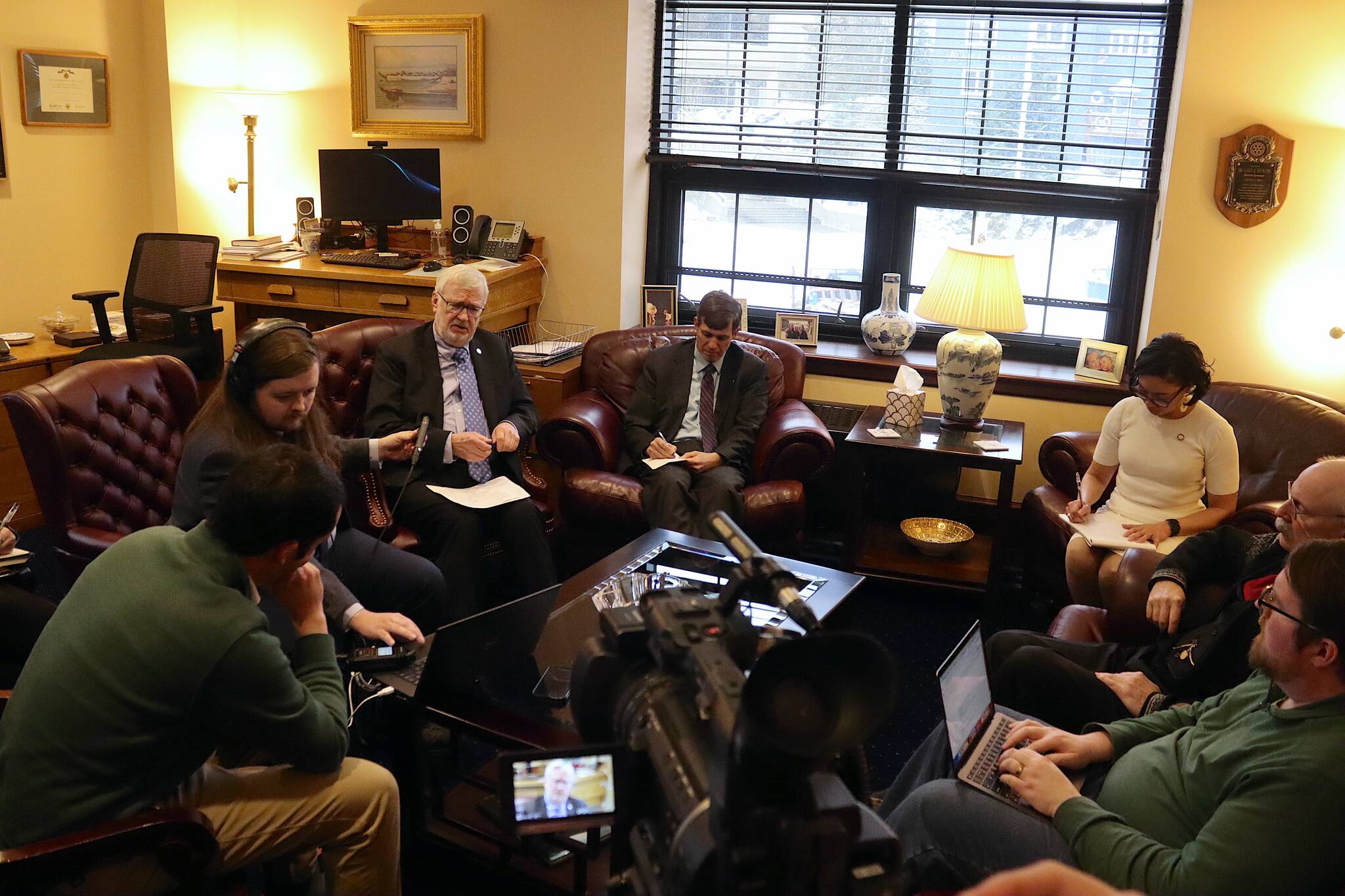
Senate leadership said after Tuesday’s press conference that they’re unclear about the governor’s specific demands, aren’t sure whether starting the process over is realistic within the short window and questioned whether sufficient state funds exist to pay for everything the governor and lawmakers want in the bill.
“I’m really, honestly not sure what the governor’s demands are,” Senate President Gary Stevens, R-Kodiak, said. “Is he willing to compromise or is he saying, ‘I get everything I want and you have to accept that’?”
Dunleavy, they said, had a lot of “wins” in the bill, including funding for correspondence programs, changes to the ways charter schools are administered, a BSA increase that public education advocates felt wasn’t enough money and language that urges school districts to use some of the additional funding received through the bill for teacher recruitment and retention incentives.
Sen. Bill Wielechowski, a Democrat from Anchorage, said Dunleavy got a lot of what he wanted in the bill, as evidenced by the fact that 56 lawmakers voted in favor.
“I just don’t know that there’s a whole lot of room there for much movement because everybody’s given a lot already,” Wielechowski said. “Once you start pushing it a little bit further in any direction, you start to lose people in the other direction.”
Sen. Bert Stedman, R-Stika, co-chairs the Senate Finance Committee and said people haven’t talked enough about whether the state can pay for everything Dunleavy and lawmakers want in the bill. Based on Alaska’s latest revenue forecast, Stedman said the state isn’t expecting a large bump in revenue, and lawmakers need to ensure that whatever they pass is affordable.
“Nobody’s looking at the entire financial package and that is a concern because there’s a lot of competing needs across the state,” Stedman said.
The bill before Dunleavy carries a $246 million price tag that includes $174.6 million in direct funding to schools, $10 million for K-3 reading intervention programs and $7 million for student transportation.
There’s also the issue of timing. Wielechowski said there are multiple bills lawmakers could work from if they wanted to start crafting a new piece of legislation more palatable to Dunleavy, but it will be difficult to get the legislation a hearing for next week.
“I’m not saying it’s impossible to do, but it’s a heavy lift on a pretty substantial bill for which the Legislature has been unable to achieve consensus on in the last month,” he said.
Lawmakers had previously expressed concern about the underlying bill, Senate Bill 140, which allows eligible Alaska school districts to apply for federal funding to improve the quality and speed of internet in their schools. Dunleavy said Tuesday that while it was previously thought those applications must be submitted by the end of the month, it’s his understanding that districts have two more weeks to submit them.
Senators reiterated Tuesday that time spent on trying to solve the problem of education spending is time not spent on other issues facing Alaska, such as an impending natural gas shortage in Southcentral. Stevens noted also that, while lawmakers and Dunleavy go back and forth over the issue, school districts are denied the ability to build their budgets with any certainty about how much money they’ll be getting from the state.
“It does put the districts in a tough spot,” he said. “They may know what we agreed to in terms of the (base student allocation) and now they have their plans. So it really tells them don’t plan. Don’t plan for more money at this point. You’ve got to deal with what you have.”
As reported by the Alaska Beacon, it was not clear Monday whether there were enough votes to overturn Dunleavy’s veto.
Reach reporter Ashlyn O’Hara at ashlyn.ohara@peninsulaclarion.com.
This reporting from the State Capitol was made possible by the Alaska Center for Excellence in Journalism’s Legislative Reporter Exchange. Alaska news outlets, please contact Erin Thompson at editor@peninsulaclarion.com. to republish this story.
