
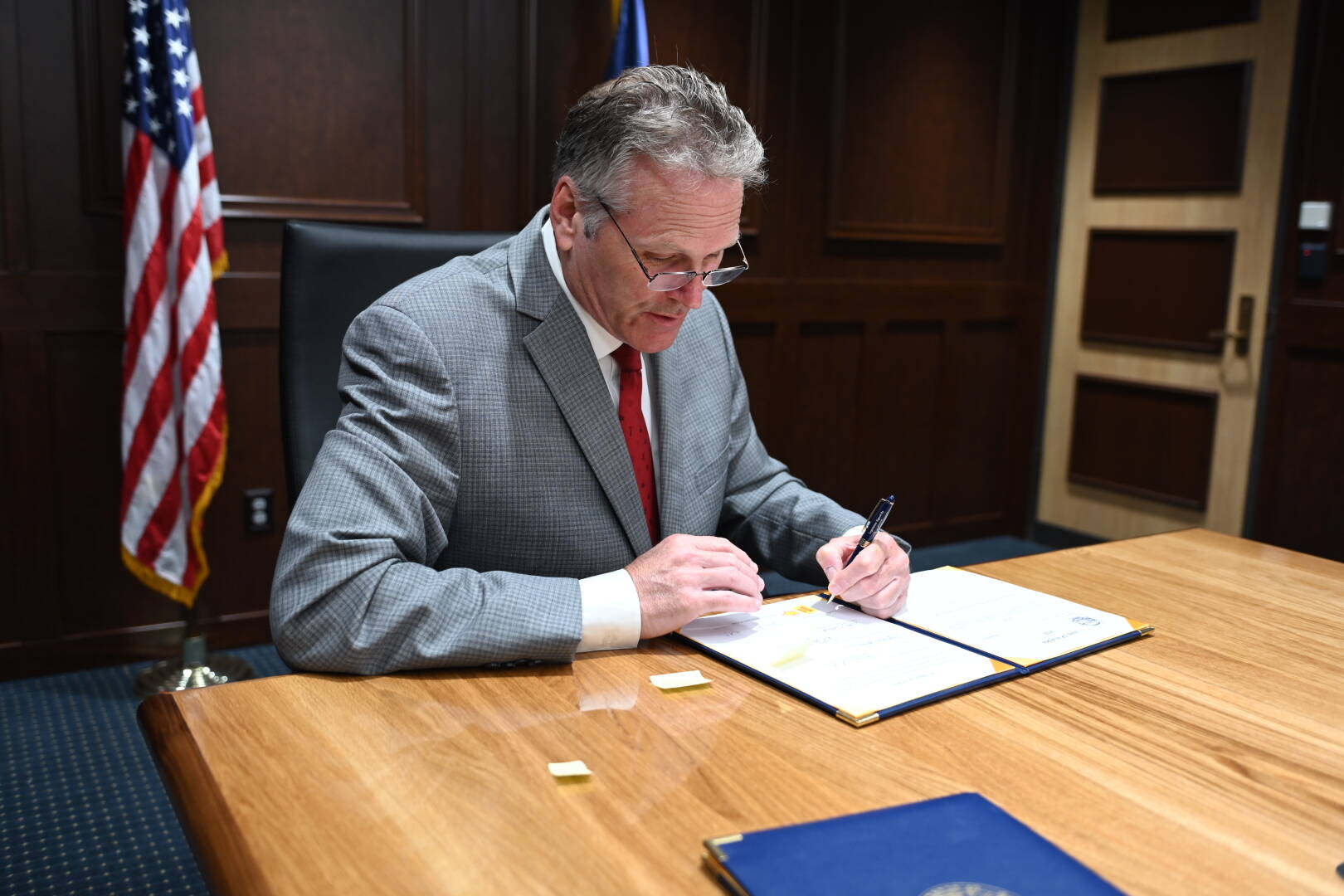
Billions of dollars in savings, the largest Alaska Permanent Fund dividend in Alaska’s history and money for local projects are all components of the operating and capital budgets Gov. Mike Duneavy signed into law Tuesday in Anchorage.
The move comes about a month after the 32nd Alaska Legislature’s 2nd Regular Session ended. The governor has already said he does not anticipate a need for any special sessions.
“Our view is that this is a responsible budget given our current situation with our funding from our revenue from oil,” Dunleavy said. “All in all, I think it hits all of the major points that a budget should hit.”
Speaking from the 17th floor of the Atwood Building, Dunleavy celebrated what he said was a revenue “windfall” stemming from high oil prices. The State of Alaska this fiscal year will put about $3.6 billion into savings, Dunleavy said, including $1.6 million into the Constitutional Budget Reserve, sometimes called the state’s rainy day fund, and $1.2 billion into the state’s K-12 education fund.
“We’re saving enough money, and we’re endowing enough and forward funding education, that if the price of oil dropped dramatically, … it’s our estimate that we could actually … fund our budget for another year,” Dunleavy said.
Included in the budget are payments of roughly $3,200 for Alaskans, including dividend payments of roughly $2,600, plus a one-time energy relief payment of $650. Lawmakers settled on that figure after clashes between the House and Senate. The final payment amount will ultimately depend on how many residents applied for a PFD this year.
Dunleavy on Tuesday also celebrated progress made on some of his public safety initiatives. The state’s budget authorizes 10 new Alaska State and Wildlife troopers, higher salaries for public safety employees and new housing for officers in rural communities.
The budget also includes almost $60 million for Alaska’s juvenile justice system, including about $2.23 million for the Kenai Peninsula Youth Facility. It also includes $860 million for the University of Alaska System, including $16.3 million for Kenai Peninsula College.
Also included in the document is $6.5 million to address Kenai bluff erosion. The City of Kenai has said it plans to use the funds to cover their local match for a project that’s been decades in the making. The Kenai Bluff Stabilization Project aims to stabilize roughly 5,000 feet of bluff on the north shore of the Kenai River, starting from the mouth of the river and ending near Pacific Star Seafoods.
Rolled into an omnibus education bill, S.B.9, was a $30 per student increase to Alaska’s Base Student Allocation. The increase falls short of what leaders at the Kenai Peninsula Borough School District had hoped for, but will still bring in an extra $500,000 to the district. That additional allocation starts in fiscal year 2024, which begins on July 1, 2023, and ends on June 30, 2024.
Dunleavy took time during Tuesday’s press conference to celebrate the passage of S.B. 9, which he called a “landmark” piece of legislation.
“We join the rest of the states in this country that believe that reading has to be a priority for our kids,” Dunleavy said of the bill’s passage.
In all, Dunleavy announced about $761 million in vetoes, however $360 million of that reflects money that Dunleavy is moving from one fund to another. The remaining $401 million in cuts is spread across multiple state departments.
Among Dunleavy’s miscellaneous cuts to the budget, many of which he said are to “preserve general funds for savings,” is a $62.5 million cut to major maintenance in schools and a $22.5 million cut to deferred maintenance projects across the state. Also cut by Dunleavy was a $1.5 million cut from state grants to rural radio stations and millions of dollars worth of retention bonuses.
A full copy of Alaska’s budget as well as a spreadsheet of line item vetoes can be found on the Office of Management and Budget website at omb.alaska.gov.
Reach reporter Ashlyn O’Hara at ashlyn.ohara@peninsulaclarion.com.
