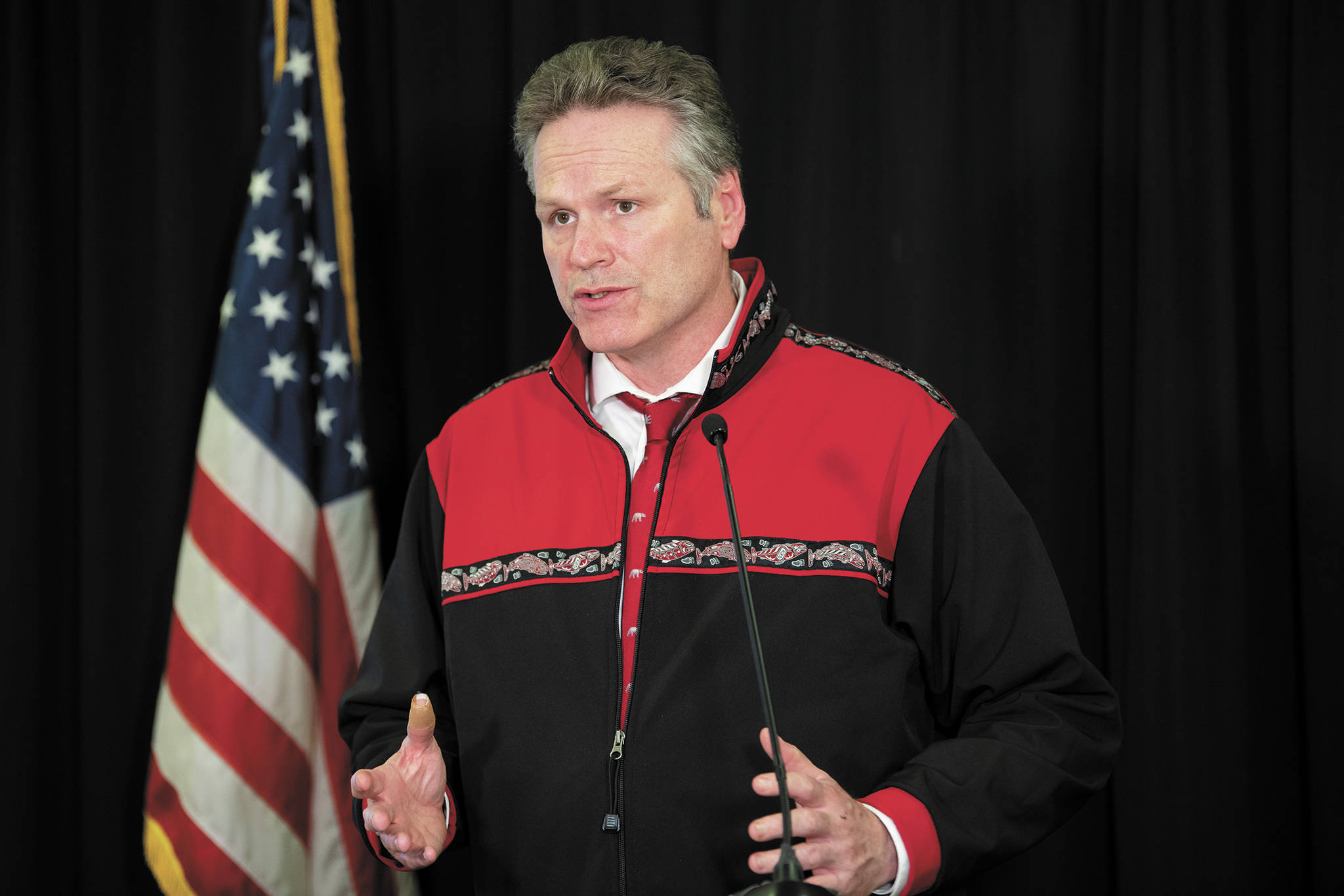
Those pushing for Alaska’s economic sector to reopen don’t have long to wait. Gov. Mike Dunleavy announced Monday that his administration is working on a phased plan to reopen parts of Alaska society — a plan he said will be unveiled in detail on Tuesday.
Dunleavy said during Monday’s state press conference he is meeting with mayors from around the state via telephone on Tuesday, and that the first phase in a plan to open up parts of the state’s economy will be announced during Tuesday’s press conference. This will include specific dates and a timeline, Dunleavy said.
Reopening the state’s economy is possible because of work Alaskans have done thus far to socially distance themselves and keep the number of COVID-19 cases in the state from rising too high, said Dunleavy, Department of Health and Social Services Commissioner Adam Crum and Chief Medical Officer Dr. Anne Zink.
It’s also possible at this time, they said, because Alaska has a low number of COVID-19 cases compared to other states. DHSS reported two new cases on Monday, bringing the total number of COVID-19 cases in Alaska to 321. One of the new cases is in Palmer and the other is in Chugiak, according to a DHSS press release.
There have been no new deaths and no new hospitalizations. Dunleavy said Monday that, of the 36 total cumulative hospitalizations the state had reported, only eight people are currently in the hospital. Additionally, DHSS reports that 161 Alaskans have recovered from the illness so far.
Of the two new cases announced Monday, one is male and one is female. One is between the ages of 30-39, while the other is aged 60-69.
After walking back a state mandate last week to allow health care providers to return to providing elective procedures again, Dunleavy is looking to reopen other sectors of Alaska’s economy because his administration believes it’s possible to do at this time without threatening the health and safety of Alaskans.
“We’re going to be looking at a phase one of opening our economy, which is good news,” Dunleavy said. “… I’m going to be meeting with mayors tomorrow, (Tuesday) on the phone, of various communities throughout the state to have a discussion with them as to the plan that we’re going to roll out. And then within the following week, we will be able to start to partake in … things such as barber shops, nail salons, restaurants.”
Dunleavy said the state hopes certain restaurants that have the capacity to achieve social distancing will be able to reopen for dine-in service. He said this would be available for families of people living under one roof to be able to call in a reservation to eat inside a restaurant.
“Again, if we see a spike in cases, a cluster of cases, we’re going to go and investigate that very quickly, We may have to suspend the operations of a certain establishment, or locale, and then deal with it in that manner. But it’s our hope, it’s our plan, not to have to go back to where we were where a lot of things were suspended.”
The state is constantly evaluating a number of “metrics,” Dunleavy and Zink said, in order to decide whether Alaska should move toward reopening movement and the economy, and how fast. They include things like hospital bed capacity, whether the number of new cases is continuing to trend downward, and whether the state can quickly monitor and contain new cases.
Zink said broad testing will be a large factor in being able to continue Alaska moving forward toward reopening.
“We know this virus is going to be with us for some time,” Zink said. “But at some point we have to kind of slowly venture out of the more protective waters.”
Dunleavy said that small, rural communities that are more isolated and without robust health care systems will retain the option to keep more strict restrictions in place in order to prevent the disease from taking hold there.
Locally, South Peninsula Hospital had sent 184 samples off for testing as of Monday morning. Of those tests, 167 have come back negative and 16 are still pending. South Peninsula Hospital has had only one positive test to date.
The total number of positive COVID-19 cases affecting Kenai Peninsula residents is 19. The cases are spread out among Soldotna (six), Kenai (four), Seward (three), Sterling (three), Homer (two) and Anchor Point (one). The case attributed to Anchor Point is that of a man in his 30s who died outside of Alaska, and one of the two Homer cases was a person who was tested and isolated in Anchorage.
Reach Megan Pacer at mpacer@homernews.com.
