
As the personal use fishery at the Kasilof River grows, the locals and the land managers are debating the best way to accommodate use without damaging the estuary or causing too much trouble for the neighbors.
The Alaska Department of Natural Resources’ Division of Mining, Land and Water is working on plans to develop a parking area and public facilities on the north side of the Kasilof River, targeted mostly at the dipnet fishery on the river from June through August. Excessive traffic, visitors parking on the wetlands and dunes and cars obstructing the roads have caused consternation among the residents. The Division of Mining, Land and Water wants to put in a beach access, parking areas, dune fencing and spaces for portable toilets for the fishery.
The original plans, released in October, showed a gravel parking lot with approximately 315 spaces for vehicles as well as temporary restrooms and Dumpsters. Though no public meeting was scheduled, neighbors objected through public comments, saying building additional spaces would only attract more people to the fishery.
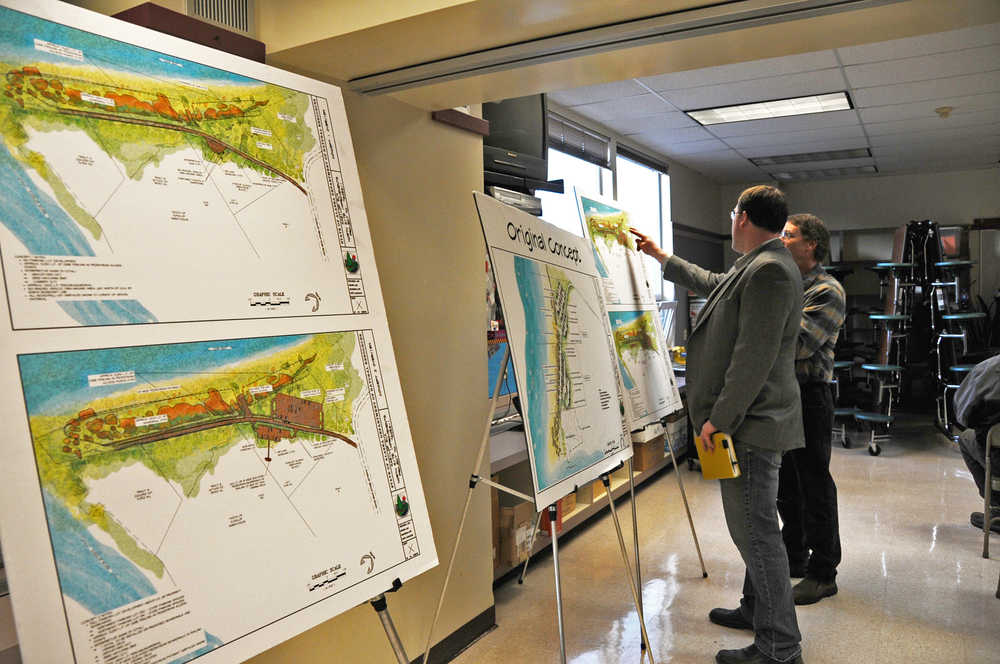
After reconsideration, the Division of Mining, Land and Water approached the public with four redrafted concepts at Kasilof’s Tustumena Elementary School Tuesday night.
“We’re here because there is a problem,” said Clark Cox, the Southcentral Alaska regional manager for the Division of Mining, Land and Water at the meeting. “We’ve heard about the problem, and this is our attempt to address it.”
The four concepts begin with the most basic — an access road with a pullout space and portable toilets, but no parking spaces — and gradually adding elements such as more parking, a bird-viewing platform in the wetlands and a turnaround further down the road. All of the concepts include protective dune fencing. Cox said the land managers have selected a preferred concept — Concept 4, the one with the most improvements — but will listen to public feedback.
Christy Colles, one of the natural resource managers working on the project, said one of the reasons for adding parking would be to draw the cars away from stopping along the road.
“We do realize it’s not going to be perfect, but we’re trying to build areas that are sustainable for people to park on and try to keep them in designated areas and out of areas we want to keep them out of,” Colles said.
The Division of Mining, Land and Water has already received $2.8 million from the Legislature in two installments to execute the plans for the development. However, there is a time limit for using those funds — capital improvement funds have to be used within five years of appropriation.
The first $1.4 million installment was appropriated in fiscal year 2014, leaving only two years left for half the funds. The Division of Mining, Land and Water hopes to finalize a concept by April and begin construction in the fall, Colles said.
Multiple attendees at the open house Tuesday supported the dune fencing, but the other elements were contested. Some supported the proposed parking lots, which would accommodate 171 cars, but with the addendum that there be hard fencing around the lot to keep people from driving into the dunes or wetlands; others worried about long-term campers in the lots.
Tracy Miller, who lives on the south side of the Kasilof River, said she supports the permanent dune fences going up on the north side. Permanent fences have already been installed on the south side of the river to protect the wetlands and dunes, and she said she has seen them work firsthand.
“That’s something that needs to get done,” Miller said.
Others expressed concerns about the lack of fees in the parking lot. The Kenai River dipnet fishery costs $20 to park for the day and $25 to camp, with an additional $35 to launch a boat and park. The Kasilof River dipnet fishery has been free to park, which could incentivize more people to drive the distance to the Kasilof, according to several attendees.
The Division of Mining, Land and Water does not have the authority to collect fees, and even if it established regulations to collect fees, it costs something to keep a toll booth and pay a person to collect fees at the toll booth, said Adam Smith, one of the natural resource managers who has been working on the Kasilof River dipnet fishery for several years.
Lack of enforcement was far and away the most frequent complaint, however. The Kasilof River Special Use Area, which was formed in 2011 to establish some ground rules for what is legal activity in the area, does not come with funding for its own enforcement. The division has no dedicated staff to the Kasilof River Special Use Area, and without that staff, the current employees are divided between their duties, Smith said.
“I’m not whining, but I’m painting reality,” Smith said. “You have a special use area, you have regulations … but we’re lacking some serious tools in the toolbox, and that’s a challenge.”
The Division of Mining, Land and Water has enforcement officers, but they are all stationed in the state’s skiing areas, Cox said.
“We’re not like the Division of Parks (and Outdoor Recreation), which has park rangers for the river,” Cox said.
However, the situation has inspired frustration, voiced by many of the Kasilof residents who attended the meeting Tuesday. Several expressed concerns for shorebirds, which could be disturbed by placing a platform out into the wetlands; others said the site needed a disposal site because many visitors leave trash and fish waste along the beaches, causing contamination along the waterfront and dunes.
Patti Curry, who owns property facing the beach on Coastline Street, threatened to sue the state if the rules were not enforced this year to stop parking along the road and illegal use of the area.
“If there’s a fire at our house, that thing’s gonna burn to the ground because we cannot get a fire truck in there,” Curry said during the meeting.
Reach Elizabeth Earl at elizabeth.earl@peninsulaclarion.com.
