
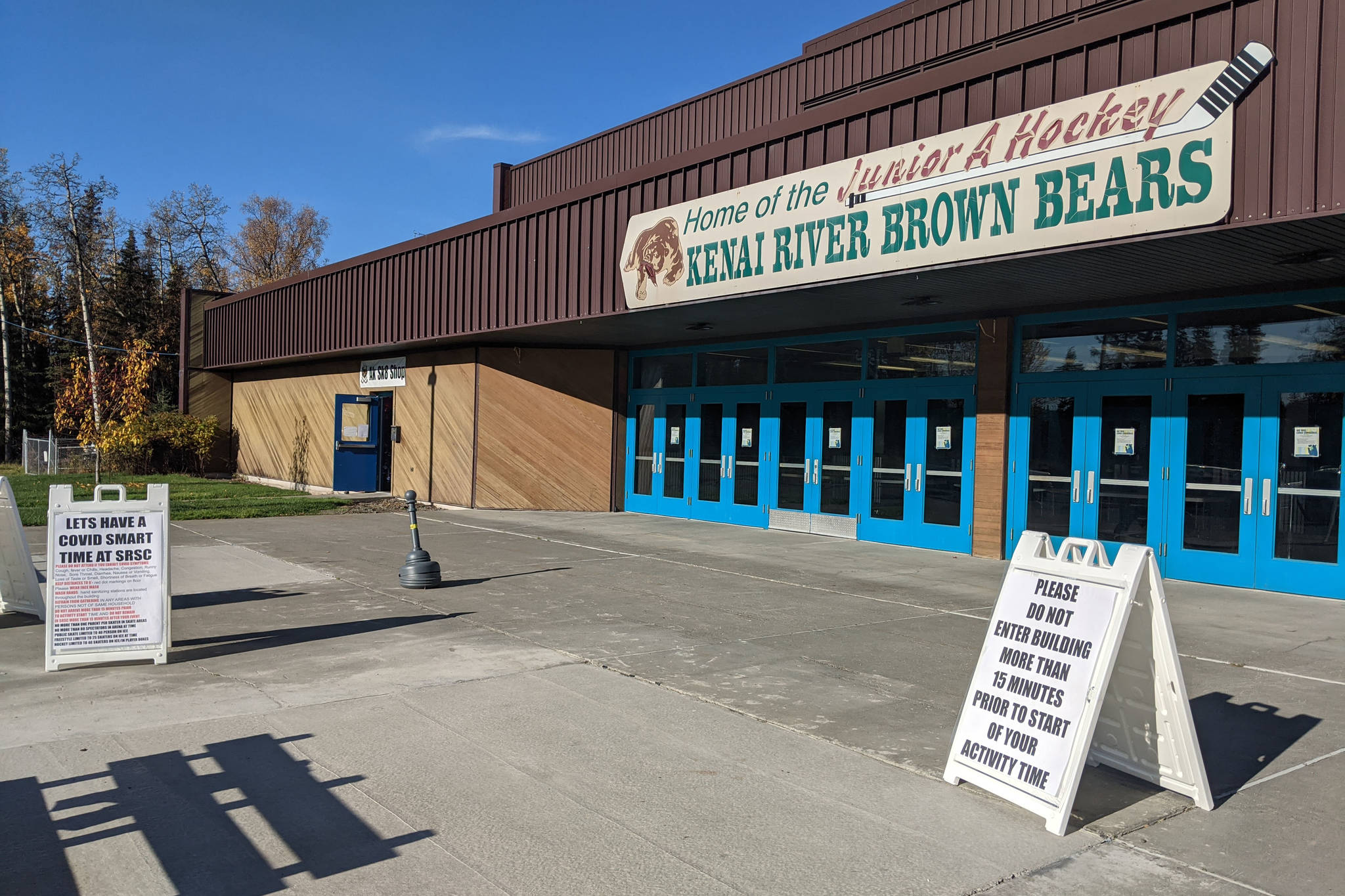
The Soldotna City Council clashed over how to best loosen COVID-19 mitigation measures at the Soldotna Regional Sports Complex during their Wednesday night meeting before approving changes that will allow more spectators, more people on the ice and new mask protocols, effective immediately.
The new operations, which were presented to the council by council member Justin Ruffridge, will allow games and scrimmages to resume, public skate to resume and for more spectators in the building, among other things.
The sports complex has gone through various phases of being partially open over the last few months. It reopened in September with COVID-19 mitigation protocols, but closed in November following Gov. Mike Dunleavy’s statewide emergency alert. When it reopened on Dec. 18, it was with even stricter restrictions than what had been in place prior to the alert.
The changes approved on Wednesday are more lenient than those in place on Dec. 18, but are still comprehensive.
“I know this is something that we had talked about at the end of last year and I think that there was some support on the council to maybe take a look at what policies were in place prior to the sports center closing after the governor’s announcement,” Ruffridge said. “This resolution gets us to basically that point with a couple of changes.”
Tamara Miller who said she was speaking both as a parent member of the Kenai Peninsula Hockey Association (KPHA) and as a Soldotna resident, said that while the guidelines are “much better,” they are also being asked to follow mitigation plans put out by KPHA, the Alaska State Hockey Association and USA Hockey.
“We’re following quite a few lists and it’s really frustrating … to have the city come in and micromanage more,” Miller said. “We feel like we should be able to run our programs — we’re doing what we need to be doing.”
Desi Baker, who said she was speaking as a representative of the Kenai Peninsula Hockey Club Executive Board, thanked the council for considering eliminating the wearing of masks by athletes on the ice but said that the proposed limit of 32 people on the ice for some hockey events may be a challenge when there are two teams on the complex’s Olympic-size rink.
Kenai River Brown Bears President Nate Kiel said that they want to bring the team back to the peninsula, but that “it has to make sense” and the factors that impacted the team’s decision to begin their season in Minnesota are still relevant. Kiel said that the team has successfully implemented North American Hockey League mitigation protocols but that they are still monitoring other factors such as travel restrictions in and out of Alaska and availability at the sports complex.
“We’re hopeful — we’ve had a goal all along of trying to play some games in the second half of the season at the sports center,” Kiel said. “I guess time will tell if that can really happen.”
In all, six amendments were proposed to the resolution, four of which were approved and two of which failed. Three of the amendments required a tie-breaker vote by Mayor Whitney.
An amendment offered by council member Dave Carey, which passed, raised the on-ice capacity for some hockey events to 50 and the on-ice capacity for public skate to 50. The on-ice capacity for U6 and U8 remains at 44 and the capacity for freestyle skate remains 25, which was the limit before COVID protocols were implemented.
An amendment offered by council member Pamela Parker, which passed, changed who is required to wear a face mask so that athletes on the ice and officials on the ice do not have to wear masks. Coaches must still wear a mask at all times, even when on the ice.
An amendment offered by Ruffridge added a definition of “on the ice” to include penalty benches and team benches, where people are coming in and out quickly.
An amendment offered by council member Dave Carey raised the spectator limit to 250 people. Soldotna Parks and Recreation Director Andrew Carmichael and Soldotna Public Works Director Kyle Kornelis said that enforcing social distancing would require “judgment calls” on the part of staff, especially when it comes to people mingling with those in or outside of their household, but that they would do so to the best of their ability.
An amendment offered by Pamela Parker, which failed due to lack of a second, would have increased the spectator limit to 25% of the complex’s capacity, or to 800. With social distancing observed, however, Carmichael said the maximum number of spectators that could fit would be 311 people.
Council member Jordan Chilson voted in opposition to the spectator increase, saying that the pandemic is a marathon and not a sprint. Specifically, Chilson raised concerns about social distancing being enforced.
Ultimately, the debate was cut short due to a call by Vice Mayor Lisa Parker for “the question,” which ends debate immediately following a vote in support by the council.
The resolution as amended passed unanimously.
Reach reporter Ashlyn O’Hara at ashlyn.ohara@peninsulaclarion.com.
