
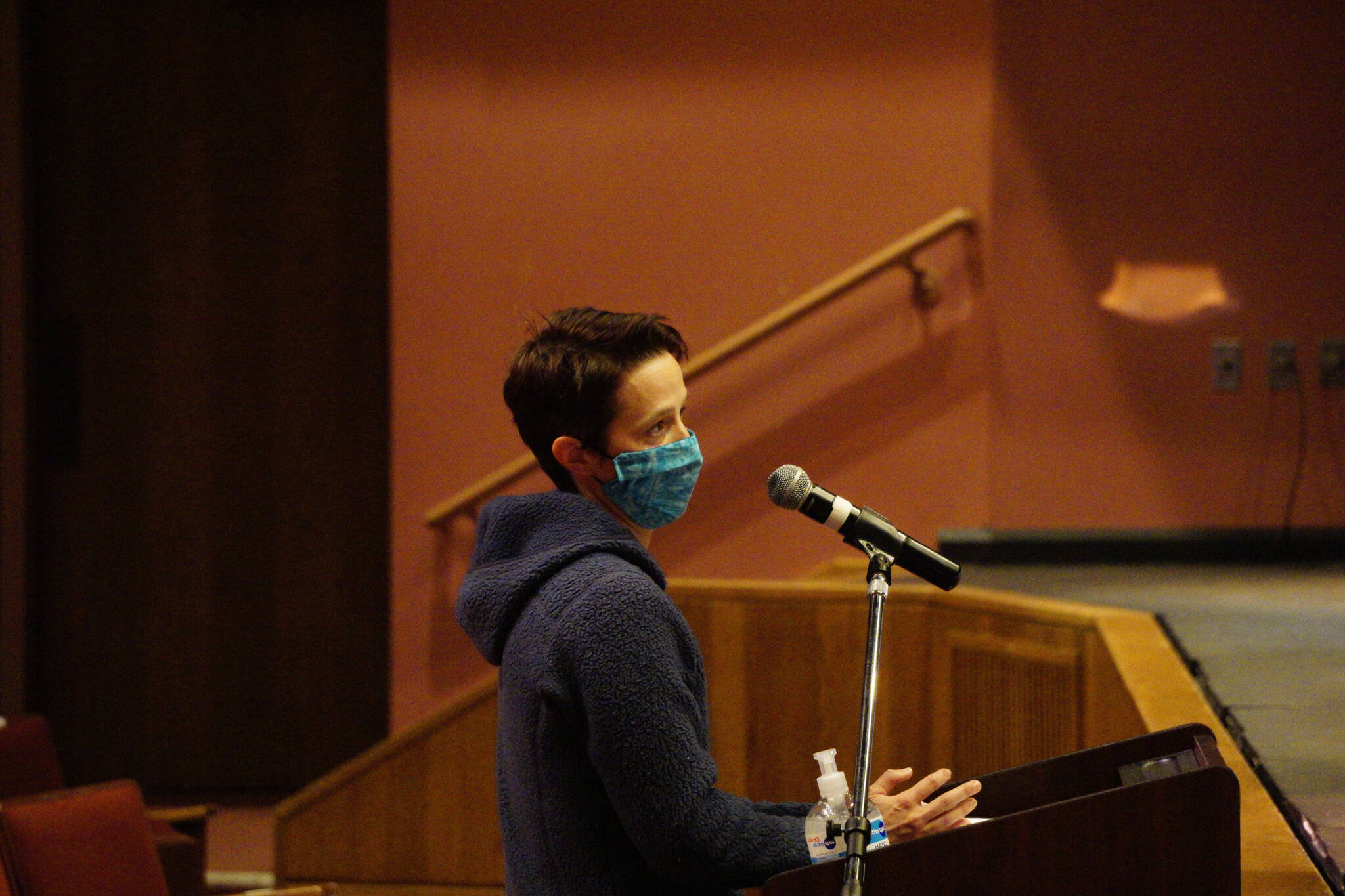
Masking protocols in physical education classes, criteria for determining when a school should move in or out of universal indoor masking requirements and the discontinuation of screening testing for student athletes are all revisions to the Kenai Peninsula Borough School District’s COVID-19 mitigation plan formally presented at a Board of Education work session on Monday afternoon.
The revisions come as COVID-19 cases continue to surge in Alaska and on the Kenai Peninsula and more than a third of the district’s 42 schools are operating with universal indoor masking for students and staff or are operating remotely. The discussion among board members Monday paralleled community divisions as it relates to COVID-19 in schools. Some board members said requiring universal masking would make some students stay home, while others said not requiring universal masking would do the same thing.
The district’s COVID-19 mitigation plan for the 2021-2022 school year, first shared this summer, emphasized flexibility and a site-based approach. Unlike during the 2020-2021 school year, the board of education does not vote on the district’s mitigation plan this year, with decisions made by district administrators in consultation with their medical advisory team.
The revised plan outlines, among other things, how the district determines whether or not a school should shift to universal masking and what conditions a school must meet in order to come out of universal masking. A “conversation” between district administrators and school site administrators is triggered when a school district meets four out of five criteria outlined in the plan.
Factors considered include a school community positivity rate of 3% or higher, a student absenteeism rate of 25% or higher, local and regional hospital and ICU capacity, a community’s COVID-19 case count per 100,000 people and the impact of a schools staff absenteeism rate.
KPBSD Assistant Superintendent Kari Dendurent said Monday that other factors considered include bus routes, noting that, for example, River City Academy students and Skyview Middle School students share a bus, spreader events outside of school such as barbecues or other events, and the ability of people to social distance at a school site.
If it is determined that a school will move to a two-week universal masking policy, more conditions are considered. To come out of universal masking, that school’s positivity rate must be less than 1% and student absenteeism must be less than 25%, with regional hospital capacity, staff absenteeism and community COVID-19 spread also considered. If a school does not meet those criteria, universal masking is extended for another two weeks.
Other changes outlined in the updates presented Monday include clearer mask guidelines for district physical education, or PE, classes. According to the plan, masks are required for indoor PE classes, where social distancing should be observed and non-rigorous activities performed. Masks are not required for outdoor PE classes or during recess.
As of Monday, 17 of the district’s 42 schools were operating with some form of enhanced COVID-19 mitigation protocols in place; 15 schools were operating with universal masking in place and two were operating 100% remotely. In schools where universal masking is in place, fewer students are required to quarantine after being identified as close contacts.
Kenai Middle School, Homer Flex School, Homer Middle School, Homer High School, Paul Banks Elementary School, Sterling Elementary School and West Homer Elementary School will all operate with universal masking until at least Sept. 21, when the policy will be reevaluated. Seward Elementary School, Seward Middle School, Seward High School and Moose Pass School will all operate with universal masking in place until at least Sept. 24, when the policy will be reevaluated. River City Academy will operate with universal masking until Sept. 17, when the policy will be reevaluated. An end date for universal masking policies at Fireweed Academy, Port Graham School, Susan B. English School and Tebughna School have not been identified. Additionally, Kachemak-Selo School and Nanwalek School were operating 100% remotely as of Monday.
Since Aug. 23, when KPBSD began formally tracking COVID-19 cases among school populations, 42 staff and 276 students have tested positive for COVID-19. That’s in addition to 133 staff and 1,593 students who have been identified as close contacts since Aug. 23.
Weekly antigen testing for student athletes was discontinued on Aug. 18 in response to a shortage of testing materials. As of Monday, student athletes are only tested for the purposes of travel or contact tracing. According to the district’s revised mitigation plan, a similar policy is also in place in the Anchorage School District, the Fairbanks North Star Borough School District and the Matanuska-Susitna Borough School District.
Struggles with testing are partially exacerbated by a shortage of school nurses in the school district, KPBSD Nurse Melisa Miller said Monday. Miller said that the district currently employs 21 school nurses for 42 schools, and is actively trying to recruit more nurses. KPBSD’s job portal showed that, as of Monday, the district was looking to hire 12 new nurses.
The district also shared the identities of the district’s medical advisory team during Monday’s work session, with whom some district administrators meet every Wednesday from 12 p.m. to 1 p.m. The identities of members of the KPBSD medical advisory team were not shared during the 2020-2021 school year out of concern for members’ safety and their children or private medical practices.
Dendurent said that the purpose of the district’s medical advisory team is to “provide input” to district leadership to help determine COVID risk levels and risk thresholds for mitigation levels and to provide real-time information related to community transmission trends, hospitalization trends and data.
KPBSD Superintendent Clayton Holland has said that in shifting the responsibility he wants to shift some of the animosity away from the board, but said Monday that he’s taking heat for the play. Holland said during Monday’s work session that he has received “life threatening” emails in response to the mitigation plan and that he is working to balance multiple interest groups. He reiterated that everyone’s goal is to keep students in school, but that the best way to do that depends on the community.
“I can tell you since we’ve done this, I’ve gotten threatening emails,” Holland said. “I’ve never experienced this before. (They’re) demeaning (and) I’d say even life threatening. It’s not fun.”
An element of the plan that continues to spark debate is the use of face masks in schools. The district maintained throughout the summer that it was their intent to keep masks optional during the 2020-2021 school year, but board members and Holland said Monday that no promises were made.
Holland, for example, said during Monday’s work session that the district never said masks would never be required this school year, but rather that the intent was to let masks be optional.
“I go back to my notes from our last meeting and even what was in our mitigation plan from that time is that we were going to pivot and make changes as needed and look at the data, and that’s what we’re doing,” Holland said. “There was never a promise about anything.”
“It was never promised that they would never bring back the masks,” said board member Mike Illg, who represents Homer. All KPBSD schools in Homer were operating with universal masking as of Monday.
“I listened to Clayton Holland very, very closely leading up to the start of the school year,” said Board of Education President Zen Kelly. “Never once did I hear him say that masking will never be implemented at a school.”
Those who support the mitigation plan allowing for universal masking in certain schools cited high COVID-19 transmission and recommendations from the U.S. Centers for Disease Control and Prevention, while those in opposition cited community opposition to universal masking and negative impacts of masking on some student learning.
Board member Jason Tauriainen said Monday that while he doesn’t support masking in schools at all, he is glad that the current masking policy isn’t automatically triggered by any one metric and is approached as a conversation.
“While overall I don’t support masking for school — I believe it’s a detriment to education and that the risk is much greater to education than the risks that kids could get from COVID,” Tauriainen said. “If we have to do it, I’m thankful you’re doing what you’re doing.”
Matt Morse, who represents Kenai, said in his own surveys of Kenai-area schools, students who voluntarily wear face masks are in the minority and that in previous community surveys, many people opposed masking in schools.
“I would bet $100 there’s not one school in our district where over half of the kids mask voluntarily,” Morse said. “That’s a problem because that means we’re making operational decisions and edicts for what the minority wants, and that’s not how this system works.”
Mike Illg, who represents Homer, said that he will rely on doctors and nurses as opposed to the wishes of the community and said the situation the district is in is both “biological and ethical.” Illg said, for example, that the district wouldn’t allow smoking in schools if a community survey showed that people were OK with it.
“Our purpose is to get kids in the schools and to keep them safe,” Illg said. “It’s an ethical situation, not a political one. We’re making it a political one and it doesn’t need to be.”
Ultimately, Holland described trying to put together a mitigation plan that balances the desires of the district and the community and keeps students in school and healthy as threading a needle, and that no plan will make everyone happy.
“Trying to make this all work for the most unique district in the entire state of Alaska, possibly the nation, is what I’m trying to do (and) what we’re trying to do,” Holland said.
KPBSD quarantine protocols
Unvaccinated, asymptomatic close contacts of someone who is COVID-positive must immediately quarantine. They can return to school one to two weeks after exposure once cleared by public health.
Unvaccinated, symptomatic close contacts of someone who is COVID-positive must immediately isolate. If that person tests positive, they must keep isolating. If they test negative, they must stay home while symptomatic or until finished with seven- to 14-day quarantine, whichever is longer, then talk to a health care provider and consider testing again before returning to school.
Vaccinated, asymptomatic close contacts of someone who is COVID-positive do not need to quarantine. They must get tested within three to five days of exposure, must wear a mask for 14 days and should carefully monitor for symptoms over the next two weeks.
Vaccinated, symptomatic close contacts of someone who is COVID-positive must get tested and immediately isolate. If that person tests positive, they must keep isolating. If they test negative, they must stay home while symptomatic, then talk to a health care provider and consider testing again before returning to school.
Regardless of vaccination status, symptomatic individuals with no known contact should immediately get tested and stay home. A positive test means that person must isolate for 10 days. A negative test means that person should stay home while symptomatic, then talk to a health care provider and consider testing again before returning to school.
The CDC distinguishes between quarantine and isolation. Isolation separates sick people with a contagious disease from people who are not sick, while quarantine restricts people who were exposed to a contagious disease to see if they become sick.
KPBSD’s full COVID-19 mitigation plan, as well as community case numbers and quarantine protocols for vaccinated and unvaccinated students is available on the district’s COVID-19 website at covid19.kpbsd.org.
Reach reporter Ashlyn O’Hara at ashlyn.ohara@peninsulaclarion.com.
Correction: A previous version of this story incorrectly spelled Jason Tauriainen’s name.
