

Attendees seek out endangered Cook Inlet belugas during Belugas Count! on the bluff above the Kenai River in Kenai, Alaska, on Saturday, Sept. 21, 2024. (Jake Dye/Peninsula Clarion)

Attendees seek out endangered Cook Inlet belugas during Belugas Count! on the bluff above the Kenai River in Kenai, Alaska, on Saturday, Sept. 21, 2024. (Jake Dye/Peninsula Clarion)

Counting the belugas in our backyard

Endangered Cook Inlet species the center of annual monitoring event

Across 22 Cook Inlet viewing stations, 88 beluga whales were seen by more than 1,800 participants in this year’s Belugas Count! event on Saturday.

At one viewing station on Kenai’s bluff overlook by the Kenai Senior Center, dozens of camera and binocular lenses were aimed at the waters of the Kenai River as people viewed a group of four to six belugas that spent over an hour moving back and forth from the mouth of the river to right in front of the station.

Students and staff from the Semester by the Bay program of Kenai Peninsula College’s Kachemak Bay Campus eagerly guided attendees in spotting the belugas as they regularly broke the water’s surface while moving up and downstream. They also shared information about Cook Inlet’s beluga whales, a genetically distinct and endangered population of the species.

According to the National Oceanic and Atmospheric Administration, there are five populations of beluga whales in Alaska. The Cook Inlet population is the smallest, and the only one to be registered as endangered. Cook Inlet belugas were identified as endangered in 2008 and have been designated by the agency as a “Species in the Spotlight” since 2015. Around 300 are estimated to remain in the inlet.

The annual Belugas Count! is a celebration intended to foster pride and stewardship of the endangered population, with stations across Cook Inlet. In Anchorage, the event also includes a festival and educational presentations.

KPC Professor of Biology Dr. Debbie Boege-Tobin said on Saturday that the Kenai station was jointly hosted by KPC and the Alaska Wildlife Alliance. During the event, her students were looking to collect photos to identify each of the belugas seen, while also recording details like other nearby wildlife, human-made sounds like planes or helicopters, and collecting water and genetic samples.

They were also working to educate people about the endangered species in their backyards.

“Most people, I would say … they’re not as aware of all the marine organisms that are out there,” Boege-Tobin said.

The data collected, she said, is part of an ongoing effort to understand the remaining population of Cook Inlet beluga whales and the challenges they face. Belugas rely heavily on echolocation, so may be uniquely susceptible to noise disturbance, but researchers are also looking to understand water quality, abundance of prey and other factors.

There are lots of questions surrounding the species, Boege-Tobin said, like why the beluga whales don’t spend much time in Kenai River during the salmon runs, when their prey is clearly abundant.

“When a lot of us are out there dipnetting and fishing, both commercial and for subsistence, we don’t see the belugas,” she said. “Maybe its because there’s so much human activity, they avoid it. We don’t really know.”

Another question that the group is considering this year is why the belugas are so often seen around and in the Kenai River, but very rarely in Kachemak Bay, part of their “critical habitat.” The students this year will work to create a habitat characteristic comparison to explore what differences, if any, there are between the two areas.

This year they’ll also be able to complete some genomic sequencing of DNA samples taken from the water. Usually, Boege-Tobin said, that process can be prohibitively expensive, but they’ve arranged to piggyback this year’s samples with another project. There’s still an archive of years of samples that she hopes to eventually secure grant funding to sequence.

The students will share some of their findings at a presentation on Dec. 10 at Kachemak Bay Campus.

The monitoring effort stretches beyond Belugas Count! to the broader Alaska Beluga Monitoring Program, which since 2019 has conducted community science assessment of the beluga population at six viewing stations around the inlet. The students completed an AKBMP monitoring session while manning the Belugas Count! station in Kenai on Saturday. For more information, or to enroll as a volunteer monitor, visit akbmp.org.

For more information about Belugas Count!, find “Belugas Count” on Facebook.

Reach reporter Jake Dye at jacob.dye@peninsulaclarion.com.

Attendees seek out endangered Cook Inlet belugas during Belugas Count! on the bluff above the Kenai River in Kenai, Alaska, on Saturday, Sept. 21, 2024. (Jake Dye/Peninsula Clarion)
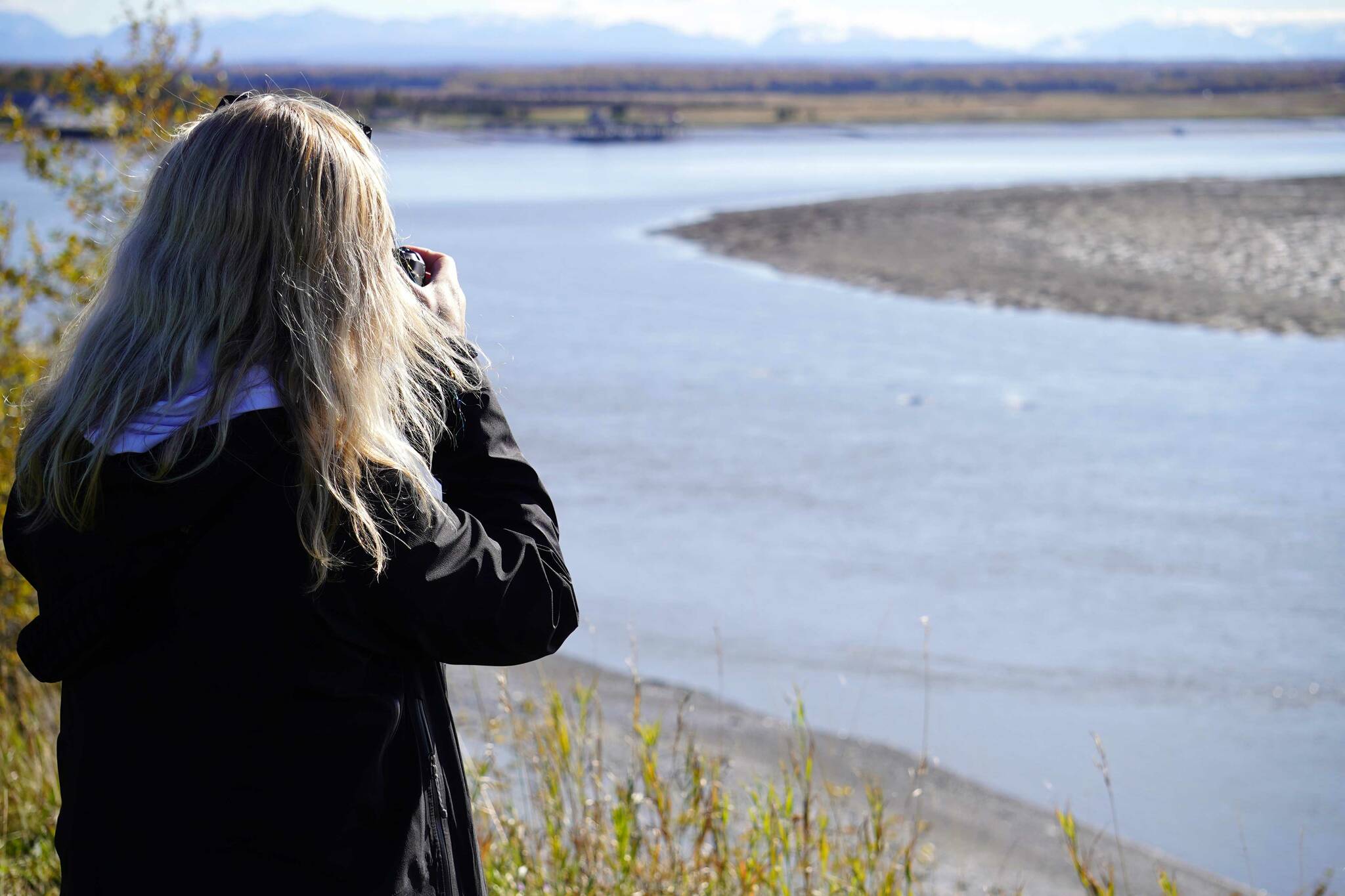
Attendees seek out endangered Cook Inlet belugas during Belugas Count! on the bluff above the Kenai River in Kenai, Alaska, on Saturday, Sept. 21, 2024. (Jake Dye/Peninsula Clarion)

Attendees seek out endangered Cook Inlet belugas during Belugas Count! on the bluff above the Kenai River in Kenai, Alaska, on Saturday, Sept. 21, 2024. (Jake Dye/Peninsula Clarion)

Attendees seek out endangered Cook Inlet belugas during Belugas Count! on the bluff above the Kenai River in Kenai, Alaska, on Saturday, Sept. 21, 2024. (Jake Dye/Peninsula Clarion)

Attendees seek out endangered Cook Inlet belugas during Belugas Count! on the bluff above the Kenai River in Kenai, Alaska, on Saturday, Sept. 21, 2024. (Jake Dye/Peninsula Clarion)

Attendees seek out endangered Cook Inlet belugas during Belugas Count! on the bluff above the Kenai River in Kenai, Alaska, on Saturday, Sept. 21, 2024. (Jake Dye/Peninsula Clarion)

More in News

David Ross is sworn in as Kenai Police Chief on Tuesday, May 31, 2016 at Kenai City Hall. The Alaska Association of Chiefs of Police named Ross the 2025 Police Chief of the Year, recognizing over two decades of service. Photo by Megan Pacer/Peninsula Clarion
Kenai police chief named 2025 Police Chief of the Year

The Alaska Association of Chiefs of Police recognized David Ross for his more than two decades of leadership.

The cast of Nikiski Middle School’s upcoming performance of “Alice in Wonderland” is pictured on Dec. 2, 2025. The upperclassmen-directed play opens on Friday, with additional showtimes Saturday and next weekend. Photo courtesy of Carla Jenness
Nikiski Middle School debuts student-led “Alice in Wonderland”

The show opens on Friday, with additional showtimes this weekend and next.

On Tuesday, the Kenaitze Indian Tribe unveiled Kahtnu Area Transit, a public transportation service open to the entire Peninsula Borough community. Photo courtesy of Kahtnu Area Transit
Kenaitze Indian Tribe unveils Kahtnu Area Transit

The fixed bus route offers 13 stops between Nikiski and Sterling.

The Kenai Chamber of Commerce and Visitor Center hosts the annual Christmas Comes to Kenai on Nov. 28<ins>, 2025</ins>. The beloved event began over 40 years ago, and this year over 1,000 attendees enjoyed hot chocolate, fireworks, pictures with Santa and shopping. Photo courtesy of the Kenai Chamber of Commerce
 Photo courtesy of the Kenai Chamber of Commerce
The Kenai Chamber of Commerce and Visitor Center hosted the annual Christmas Comes to Kenai on Nov. 28. The beloved event began over 40 years ago, and this year over 1,000 attendees enjoyed hot chocolate, fireworks, pictures with Santa and shopping.
Kicking off a month of holiday festivities

Last weekend’s holiday events, including the annual Christmas Comes to Kenai and the Soldotna Turkey Trot, drew folks from all over the Kenai Peninsula.

Starting Dec. 2, Aleutian Airways will offer roundtrip flights between Anchorage and Unalakleet every Tuesday, Friday and Sunday.
Aleutian Airways to offer roundtrip flights between Anchorage and Unalakleet

Starting Dec. 2, Aleutian Airways will offer three roundtrip flights per week.

The Trump administration’s “Big Beautiful Bill” act requires the Bureau of Ocean Energy management to hold at least six offshore oil and gas lease sales in Alaska between 2026-2028 and 2030-2032. The first of these sales — known as “Big Beautiful Cook Inlet 1,” or BBC1— is scheduled for March 2026. Photo courtesy of the Bureau of Ocean Energy Management
Cook Inletkeeper launches petition against federal government

The organization is calling for transparency in Cook Inlet offshore oil and gas sales.

Winter dining has always carried more weight than the menu might suggest. In the off-season, eating out isn’t just about comfort food or convenience; it’s a way of supporting local businesses as they hold steady through the slower months. Photo credit: Canva.
The ripple effect: How local spending builds stronger communities on the Kenai Peninsula

From cozy cafés to fine-dining bistros, purchases made close to home sustain local jobs and services

Courtesy Harvest
On the Kenai Peninsula, a dormant liquefied natural gas export plant could be repurposed to receive cargoes of imported LNG under a plan being studied by Harvest, an affiliate of oil and gas company Hilcorp. The fuel would be transferred from ships to the tanks on the left, still in liquid form, before being converted back into gas and sent into a pipeline.
Utilities say Alaska needs an LNG import terminal. Consumers could end up paying for two.

Planning for two separate projects is currently moving ahead.

A map shows the locations of the 21 Alaska federal offshore oil and gas lease sales proposed by the Trump administration. (Map provided by the U.S. Bureau of Ocean Energy Management)
Trump administration proposes offshore leasing in almost all Alaska waters

A new five-year offshore oil and gas leasing plan proposes 21 sales in Alaska, from the Gulf of Alaska to the High Arctic, and 13 more off the U.S. West Coast and in the Gulf of Mexico.

Most Read