
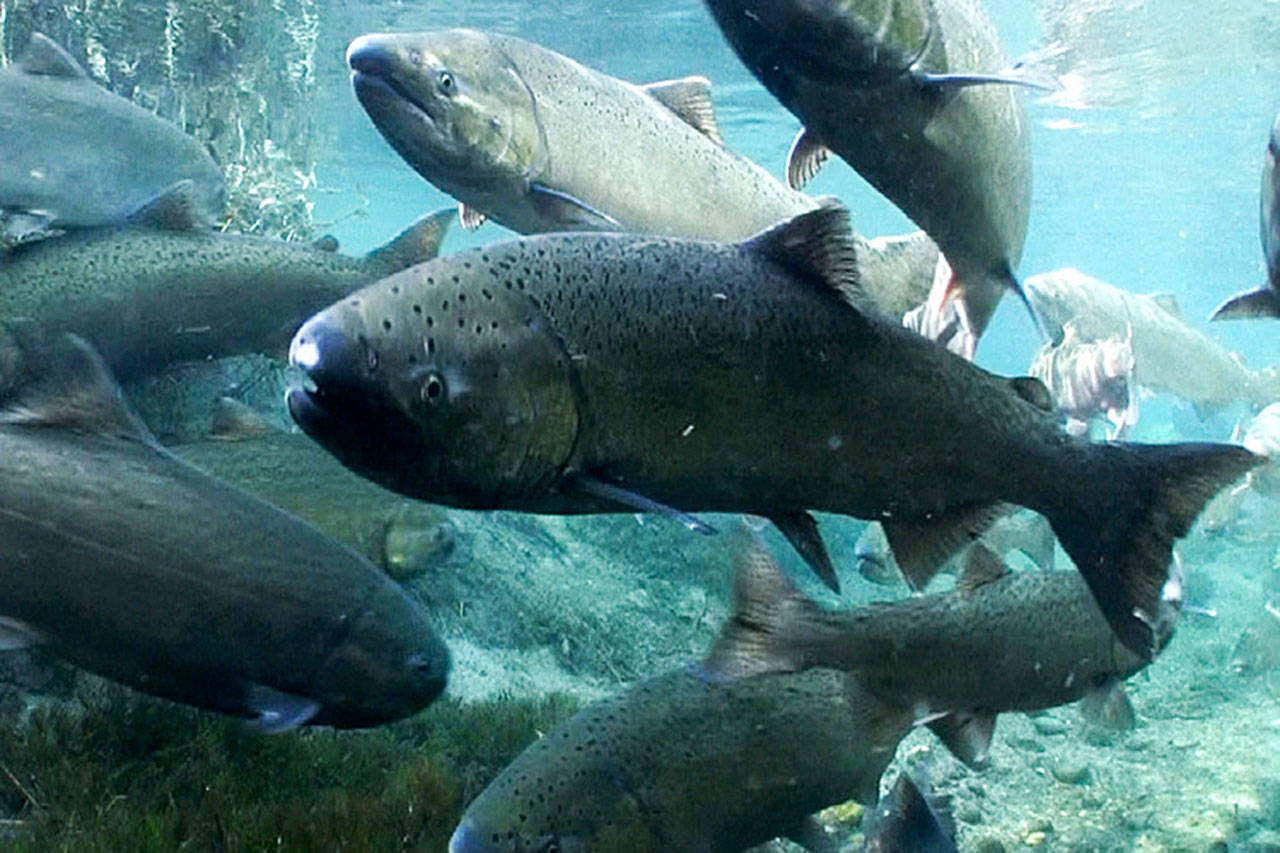
It will likely be another year of disappointing returns for the wild king salmon populations on the Kenai Peninsula, with the reasons for their consistently low returns still unclear.
Below-average salmon returns
Colton Lipka, an Alaska Department of Fish and Game area management biologist, manages the sport fisheries surrounding the Upper Cook Inlet — monitoring fish counts as the kings return to their spawning grounds and implementing restrictions on the fisheries to ensure the counts are high enough for a sustainable population.
Lipka said via email that the wild king salmon runs for Deep Creek as well the Kenai, Kasilof, Ninilchik and Anchor Rivers have all shown below-average returns this year. The hatchery runs, on the other hand, have been doing better and have presented good opportunities for sport fishing on the Kasilof and Ninilchik Rivers, Lipka said.
Many factors can contribute to low salmon returns, but this year’s disappointing numbers are likely a consequence of low escapement numbers from 2014, which led to smaller brood sizes that year. The runs for this year are comprised primarily of fish that were spawned in the 2013, 2014 and 2015 runs. The 2013 and 2014 early runs represented the lowest returns on record for the Kenai River, Lipka said.
Early-run totals for the Kenai River have been below average since 2008, when, Lipka said, the state first noted a decline in the region’s king salmon populations. The runs for 2016 and 2017 showed improvement over previous years, but began to decline again in 2018, according to ADF&G’s annual fish count totals.
King salmon included in state counts are typically five, six and seven years old and must be at least 75 cm long, or about 34 inches, from mid-eye to tail fork. King salmon spend about two years in fresh water before migrating to the ocean, and they return to the streams where they were born after at least two years in the ocean.
Lipka noted that in the last few years, the oldest age classes of king salmon have shown low returns, suggesting that something has made it tougher to survive in the ocean. No kings counted in the 2017 and 2018 runs were over 6 years old. The cause of reduced ocean survival is currently unknown, but Lipka said that changes in water temperature, availability of food and predation could all be factors. The Gulf of Alaska has experienced warming temperatures in the last few years, but Lipka said that the effect this has on king salmon populations is unknown. Government agencies and universities have been researching the issue of declining king salmon populations, but Lipka said he was unaware of any conclusive results from that research. One study, conducted by scientists at the University of Washington in 2018, suggested that there could be a correlation to an increasing population of killer whales that are hunting large king salmon in greater numbers, but the study did not formally test this hypothesis and made no conclusions to that effect.
Kenai River early run closed, late run restricted
The Kenai early run has a sustainable escapement goal of 2,800-5,600 large king salmon and an optimal escapement goal of 3,900-6,600 large king salmon. The inseason estimate as of June 17 for this run is 1,419 fish, well below the preaseason forecast of 4,800 large fish. The current inseason projection is between 2,000 and 2,200 large fish depending on the timing of the run, which means the sustainable escapement goal will likely not be met this year for the early run. As a result, the early-run sport fishery on the Kenai River was closed on June 10.
“These numbers are lower than the forecasted amount and do not speak well for production of large kings, but the department will follow the management plan and closely monitor the run to provide the most likely opportunity to achieve the escapement goal,” Lipka said in a June 12 email.
On July 1, the late-run sport fishery will open, but it will have several restrictions. Anglers will be prohibited from using bait, will only be able to fish from the mouth of the river to the ADF&G regulatory marker located 300 feet downstream from Slikok Creek and will be restricted to 1 king salmon per day of less than 34 inches in length. The rest of the Kenai River, from Slikok Creek to Skilak Lake, will remained closed to king salmon fishing through July 31.
Although the king salmon populations on the Kenai Peninsula continue to decline, Lipka said that population numbers have not dipped to a point from which they would not be able to bounce back. Since the current optimal escapement goal for the Kenai River was established by the Board of Fisheries in 2017, the sustainable escapement goal has been achieved each year and exceeded once, and the optimal escapement goal has been achieved once and exceeded once.
“It would take multiple years of escapements below the lower end of the goal to raise concerns about sustainability,” Lipka said. “And at that point the department has designations that can be enacted to apply further protections.”
The runs in 2016 and 2017 showed improvement over previous years, which could mean good news five, six and seven years after those runs. Higher escapement means more fish reach the spawning grounds, but Lipka said that many factors can affect the number of fish that return from any one brood year, so nothing is guaranteed.
Anglers are advised to consult the ADF&G regulation book and review any emergency orders to ensure they are using legal gear and know the bag and possession limit. Sport fishing for king salmon anywhere in Alaska requires both a sport fishing license and a king stamp.
For the latest fish counts, including king salmon runs on the Kenai Peninsula, visit adfg.alaska.gov/sf/fishcounts.
Reach reporter Brian Mazurek at bmazurek@peninsulaclarion.com.
