
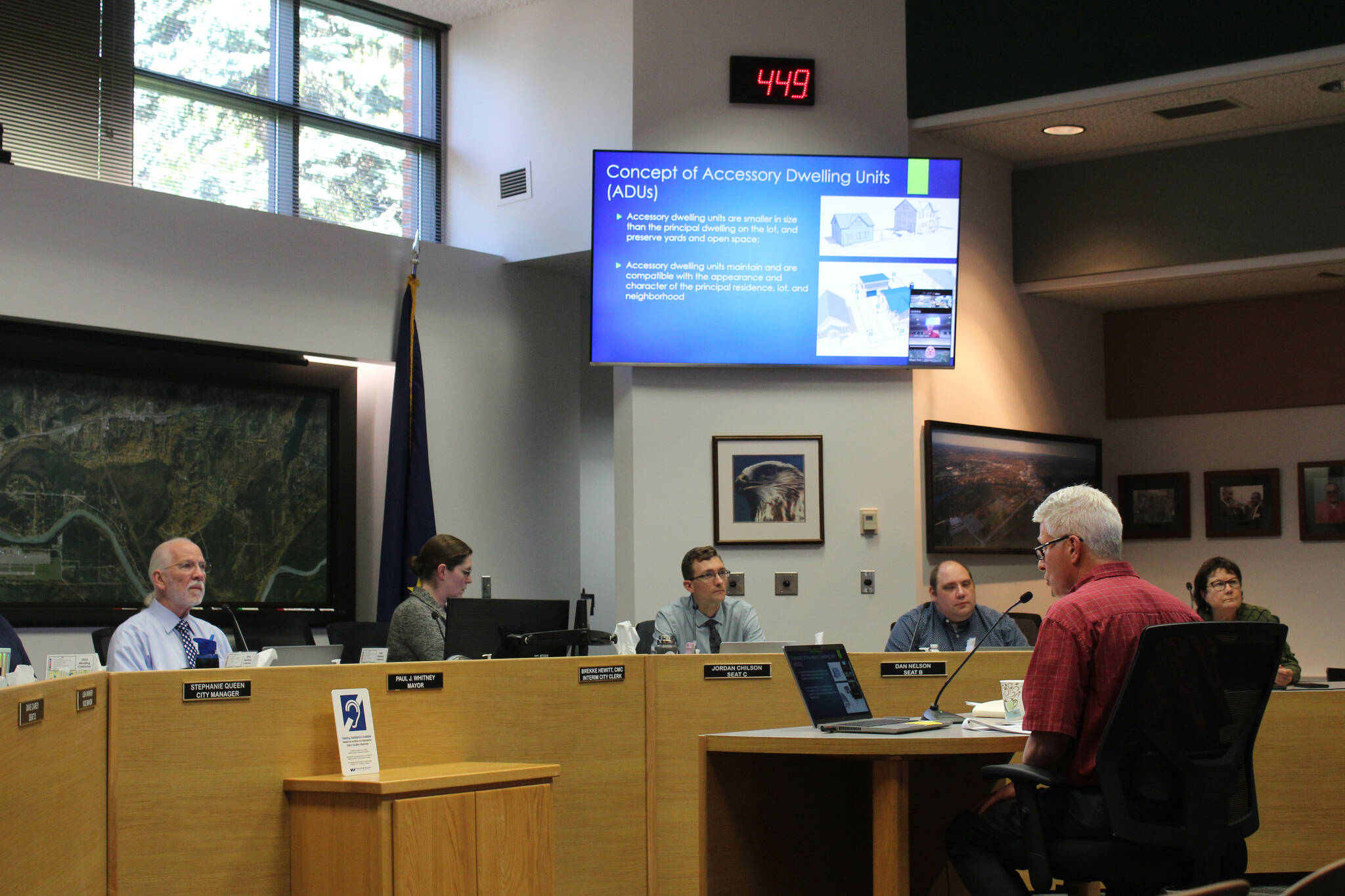
A new type of residential housing would come to Soldotna under a section of city code that will soon be up for consideration by members of the Soldotna City Council.
The new section of city code would allow for accessory dwelling units, or ADUs, in the city, potentially expanding the number of residential living spaces in Soldotna. The proposed code defines ADUs as subordinate, detached units that provide “basic requirements” for living, sleeping, cooking and sanitation and are located on a lot or parcel with an existing residence.
Those units were the subject of an hourlong Soldotna City Council work session last week, during which Soldotna Director of Economic Development and Planning John Czarnezki walked council members through the proposed additions to city code and further articulated the demand for that type of housing.
“There’s an interest — and we’ve heard it from a number of individuals — either in things like tiny houses, accessory dwelling units, mother-in-law apartments, you know, they go by a number of different names,” Czarnezki said. “ … We knew we had to take a look at this and provide some options for our planning commission and council to consider.”
Czarnezki said Monday that the proposed addition of ADUs to Soldotna’s code aligns with the city’s stated goal of providing different types of housing, as outlined in the city’s comprehensive plan, Envision Soldotna 2030. The changes were initiated by the City of Soldotna, he said, and presented to the Soldotna Planning & Zoning commission for consideration, which voted in August to recommend approval.
“Allowing for accessory dwelling units is a proactive and rational response to changing family community demographics and needs,” a resolution passed by the Planning & Zoning Commission says.
The City of Soldotna already allows accessory dwelling units in a limited capacity. In Soldotna’s single-family and single-family/two-family residential districts, a single detached building that provides housing for relatives or temporary guests is allowed. The owners of the additional unit may not charge people to stay in the unit, and the unit can only have one bedroom.
The new section of city code would require that an accessory dwelling unit be located on the same parcel of land as a primary dwelling unit — to which it would be an “accessory.” Under the proposed policy change, owners of the primary dwelling unit would be allowed to charge rent on the accessory units.
Anyone interested in establishing an accessory dwelling unit would be required to submit a site plan to and obtain a zoning and building permit from the City of Soldotna, under the proposed code change. ADUs would need to be built to the city’s building code standards and shall be no more than 750 square feet, Czarnezki’s presentation to council members says.
Accessory dwelling units would not be allowed within the Kenai River Overlay District, would need to have at least one off-street parking space and would be connected to the utilities of the parcel’s principal dwelling unit. The unit would also need its own address and could not be sold independent of the principal residence.
Council members during last week’s work session were generally supportive of the proposed addition, however, some voiced concerns about how the change would affect residents.
Council member Jordan Chilson, for example, asked whether or not the city would allow ADUs to be used as short-term rentals, such as those listed on AirBNB and VRBO. Those types of listings can further strain an already tight housing inventory in the Soldotna area where, according to previous Clarion reporting, the price of two-bedroom units has jumped by about 27% over the past 15 years.
Analysis by Juneau Economist Gunnar Schultz, published in the September issue of Alaska Economic Trends, found that the Kenai Peninsula has a comparable number of short-term rental housing units to Anchorage, despite having about a quarter of the amount of total housing units.
“I think the goal here is to make housing more accessible and more abundant in the city and my fear is that if we don’t address this from the beginning, we’re just gonna see an abundance of ADUs pop up,” Chilson said of the short-term rental concern. “Now they’re on VRBO and Airbnb and we’ve done nothing to address housing in the city other than we have a lot more short-term rentals all over the place.”
Czarnezki said Monday that Chilson’s concern is a legitimate one, but that “there’s a place” for short-term rentals in Soldotna, whether it’s to provide additional lodging opportunities or provide an extra income source for property owners.
“There’s definitely a place for it and, you know, I think that tough question is, yeah, how much is enough?” he said.
The policy as currently proposed says that, if there are two dwelling units on a single parcel, one of those units must be a long-term primary dwelling residence. That differentiates ADUs from short-term rentals, because short-term rentals can stand alone on a parcel.
Council members will have the opportunity to amend the legislation prior to voting on it. Czarnezki said Monday that the city’s plan is to introduce the ordinance adding ADUs to city code during the Soldotna City Council’s Sept. 28 meeting. That timeline would put the legislation up for a public hearing in October. It would take effect immediately if passed by council members.
The Soldotna City Council’s full Sept. 14 work session can be streamed on the city’s website at soldotna.org.
Reach reporter Ashlyn O’Hara at ashlyn.ohara@peninsulaclarion.com.
