
Questions surrounding education funding, state budgeting, and social issues dominated a virtual town hall with Alaska House Rep. Sarah Vance.
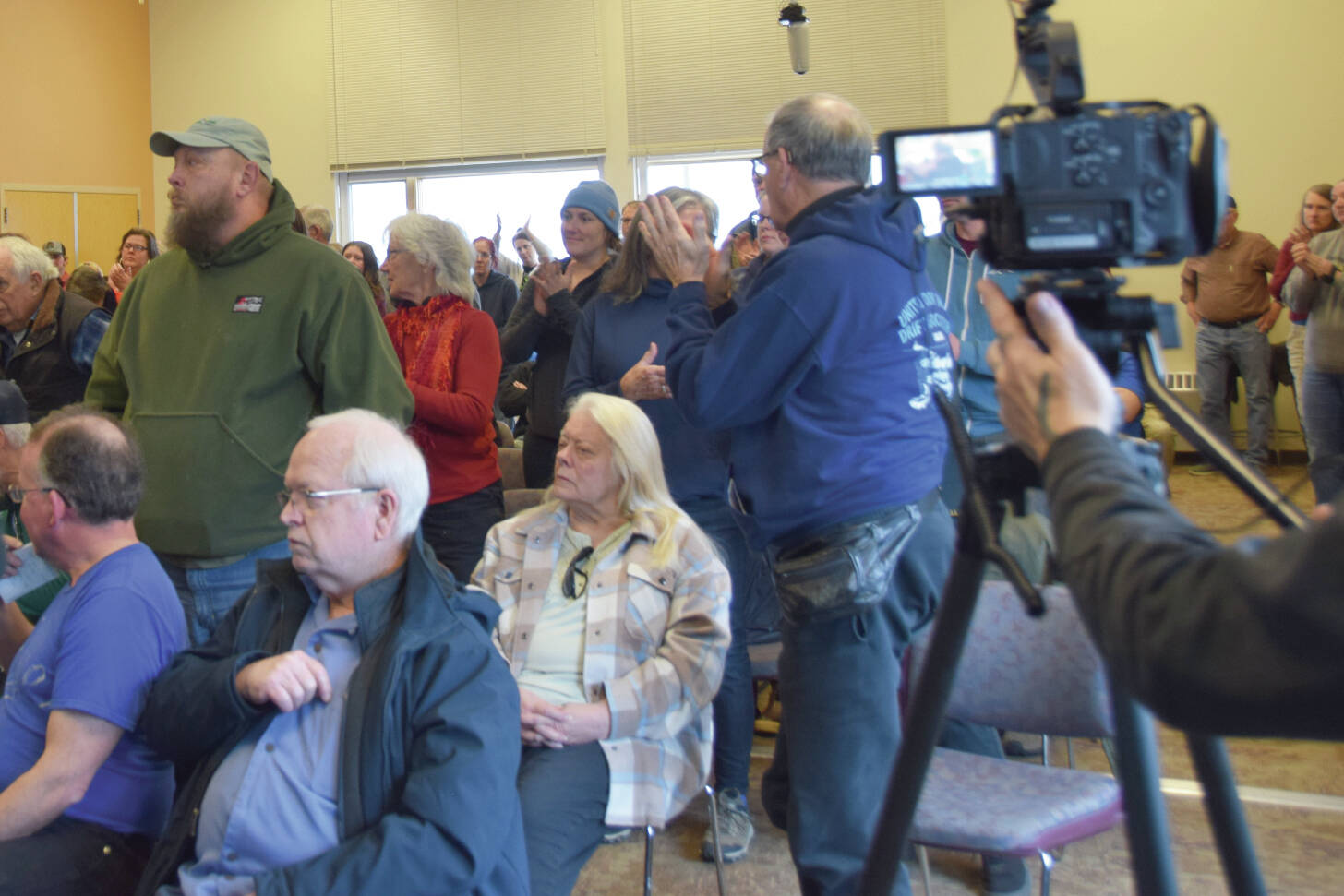
The town hall, which was originally scheduled as an in-person event, was hosted Saturday via livestream at Kachemak Bay Campus’s Pioneer Hall. The conference room in Homer was packed with concerned constituents, many of whom overflowed into the hallway. Around 22 people attended remotely via the provided Microsoft Teams link.
Vance said last-minute work on House Bill 69 caused her to miss her scheduled afternoon flight from Juneau on Friday afternoon. The bill, which would provide a $1,000 increase to per-student funding provided by the state, was passed in 11-9 in the state Senate. Vance voted against the bill, which Gov. Mike Dunleavy has promised to veto.
Vance began the town hall with a presentation prepared by Rep. DeLena Johnson, R-Palmer, outlining some of the financial dilemmas the Alaska Legislature faces.
She also spoke about her interest in pursuing policies that restrict student use of cellphones in schools and a bill she hopes to introduce that would expand state health care to include school district employees. A large chunk of school district funding goes toward employee benefits, the cost of which tends to increase yearly, along with inflation and other market metrics.
On the subject of per-student funding, also known as the base student allocation, Vance said she wanted to be very clear about her stance.
“My policy on education has always been consistent — that I’m willing to add funding inside the formula as long as there are meaningful reforms that treat all students equally.”
She also raised concerns about the sustainability of funding increases given the current volatility in oil prices.
Constituents raise education concerns
About 45 minutes after the event began, Vance opened the floor to questions from her constituents.
The first question asked what Vance’s plan was for potential solutions to the budget crisis, specifically regarding revenue streams.
Vance replied that the “revenue streams” she’s in support of are “long-term fiscal plan.” The statement was met with laughter from some audience members in the room.
“People have clearly said to me, vote ‘no’ on a state income tax. It’s been very, very clear,” she said. “The burden of it, and, you know, taxing oil companies, it makes me uncomfortable.”
Vance said she’s looked at other areas of revenue that are not being collected, although she did not specify what those areas of potential revenue would be.
“Our greatest strength is building our economy, and I want to get regulations and things out of the way to do that, because the more money that we have coming into our economy will help fill those revenues and help people not have to rely on government services.”
A constituent named Wes asked Vance about the potential for increasing state revenue and school funding through the addition of a statewide, one-time paycheck deduction, similar to the education head tax that was repealed in 1980.
Vance said she was not in support of an income tax, while constituents in the room shouted out that the idea of an educational head tax was not an income tax, in the traditional sense, even if it is a tax that comes out of income.
The conversation also touched on the issue of age-appropriate content in schools — specifically related to gender dysphoria and books with sexual themes — and how those concerns have affected the discussion around school funding.
Kate Finn said she recently had a conversation with one of Vance’s supporters who claimed that “transgender is actually being encouraged in the school district” and that “even in the lower grades that sexual positions are being educated to small children.” Finn said that Vance’s supporter believed this to be true and therefore was in support of cutting education funding.
Vance replied that she wanted to openly acknowledge that “our school district has not prohibited the type of books that would encourage transgender dysphoria, or gender dysphoria, and also sexually explicit books,” which she does not feel is something age-appropriate for children.
She also said parents sometimes approach her with concerns their child has brought to them, but that she’s not the “right person to ask exactly what’s being taught in schools.”
Vance suggested that concerned parents reference and communicate with their school principals, school district and school board for proper knowledge of what is being taught in schools.
“If there’s any miscommunication, I apologize for that, but I have a very firm stance that when it comes to sexuality … that is responsibility belongs to the parents, not with the schools.”
Heidi Stokes, principal of Chapman Elementary School in Anchor Point, asked Vance if she would vote in favor of an override if the governor vetoes House Bill 69. Stokes also asked Vance to describe “the specific implications of your decision if you vote against an increase in the base student allocation, that is specific to the schools in your area.”
Vance reiterated that she will only vote for a BSA increase with meaningful policy reforms.
“I want all students treated equally, and I want more accountability and changes to help improve the outcome of our students. Throwing money continually without making positive reforms to help our students achieve is not the only solution. I’m not ignoring the physical challenges that the students are facing. However, we cannot continue to ignore that our students are not meeting, they’re not continuing to prove in reading, writing and math. That is the priority, and we can’t lose sight of that.”
Vance said that if Dunleavy vetoed the education bill, she would not vote to override him. Last year, the override to an education funding bill that would have raised the BSA failed by one vote.
Laura Anderson, a fifth grade teacher at Chapman Elementary, became emotional when addressing Vance. She said that talk of the Alaska Permanent Fund dividend and school funding is frustrating for a teacher, as she often spends her PFD on school supplies for her classroom and students.
“You know, I emailed you last year about raising our BSA, and you started a conversation about my retirement and my health insurance, and I’m not here to discuss that,” said Anderson. “I’m here to stand for my 19 students that I have on a daily basis, and my 170 at Chapman School, and for every student on the peninsula, because you say you hear us and you understand us, but you haven’t visited my school or my classroom, and you don’t know what it’s like for us on a daily basis.”
Both Anderson and Stokes implored Vance to visit Chapman.
“Please come and see what it’s like for us on a daily basis. You talk about our failing scores and all the ways that they fail, but I want to set the record straight, ma’am. You need to understand that we may not be where the other states are, but our growth has been insane over the last few years,” Anderson said.
Without funding, Anderson said, “our students are not going to continue to make the growth.”
Tariff turmoil
Shannon McBride-Morin is a local business owner. She asked Vance about her support for the Trump administration’s tariff policies.
“You make it clear that you have fully supported the Trump agenda. You posted online ‘Liberation Day!’ on the day that Trump tariffs went into effect. I’m a small business owner. This badly hurts my business and my husband’s small business. There’s a lot of uncertainty and fear in our district. This badly hurts us and it puts us all at risk with higher prices and huge loss of local jobs.”
Regarding her “Liberation Day” comment, Vance defended Trump’s tariffs as an effort to fight for fair treatment of American businesses. She said tariffs were aimed at ensuring reciprocity in international trade, something that will particularly benefit certain aspects of the Alaska seafood industry. Vance said she supports “long-term policies that put America first and help Alaska build its economy,” and that while the process isn’t perfect, she believes in fighting for Alaska businesses and families.
Making policy decisions
A constituent named Greta asked Vance about her staff member, former Arkansas state Sen. Bob Ballinger.
Vance hired Ballinger in 2023, after he lost his reelection campaign in 2022. Both Ballinger and Vance are members of the National Association of Christian Lawmakers, an organization that works to elect Christian conservatives to public office and pass faith-based laws across the country. Ballinger is the director of law and policy for the organization. He is also known for helping pass one of the strictest abortion laws in the country.
Vance said her constituents should know that it is her — not the staffers she hires or the associations she associates with — who make the policy decisions she promotes.
“I want to make it very clear, I am the only policy decision-maker in my office, nothing is moved without my approval. I’m the one who gives the direction on what is going to be forwarded as an amendment or as a policy that comes from me. I’m quite capable of determining what should be the priority based upon what you tell me should be the priority. (Ballinger) benefits the state because of his great legal mind, his experience in being able to research and work on things, but I’m the representative, and I determine the policy.”
When asked whether she represents all of her constituency, Vance said the people who voted for her are her “first priority,” regardless of their party affiliation. When directly asked by constituent Carla Stanley if she represents everybody in her district or just Republicans, Vance emphasized that she tries to represent everyone, but those who voted for her are her primary focus.
The town hall ended after about an hour and a half, with several attendees’ concerns unheard.
Vance said she hopes to hold another town hall meeting near the end of the legislative session, although she also said the potential for a special session is likely. She did not provide a concrete date for future public meetings with constituents.
Reach reporter Chloe Pleznac at chloe.pleznac@homernews.com.

A concerned community member and former educator asks Rep. Sarah Vance a question during her town hall meeting at Kachemak Bay Campus on Saturday, April 12, 2025. Vance attended the meeting remotely from Juneau. (Chloe Pleznac/Homer News)
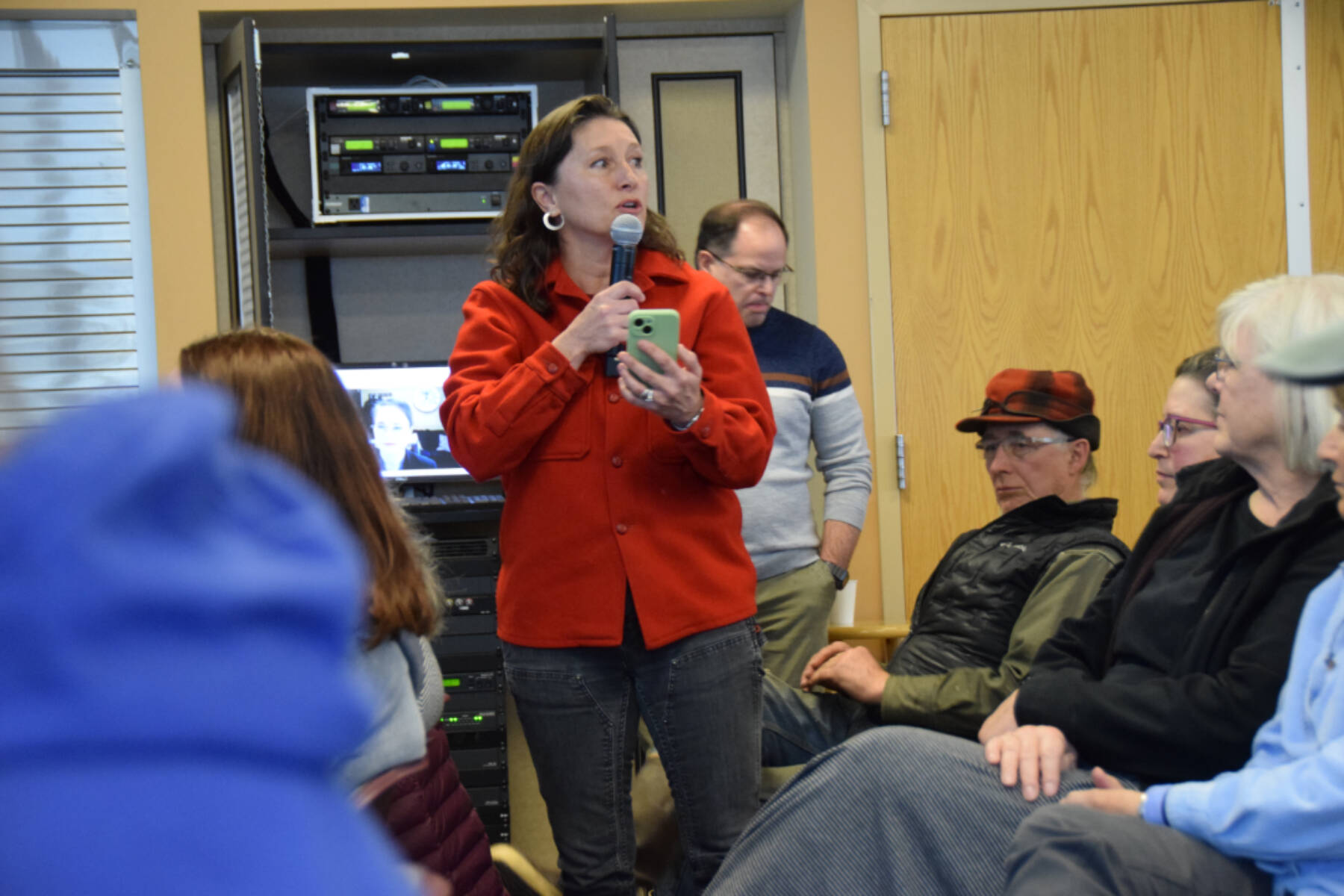
Local business owner Shannon McBride-Morin addresses the crowd and Rep. Sarah Vance on Saturday, April 12, 2025. (Chloe Pleznac/Homer News)
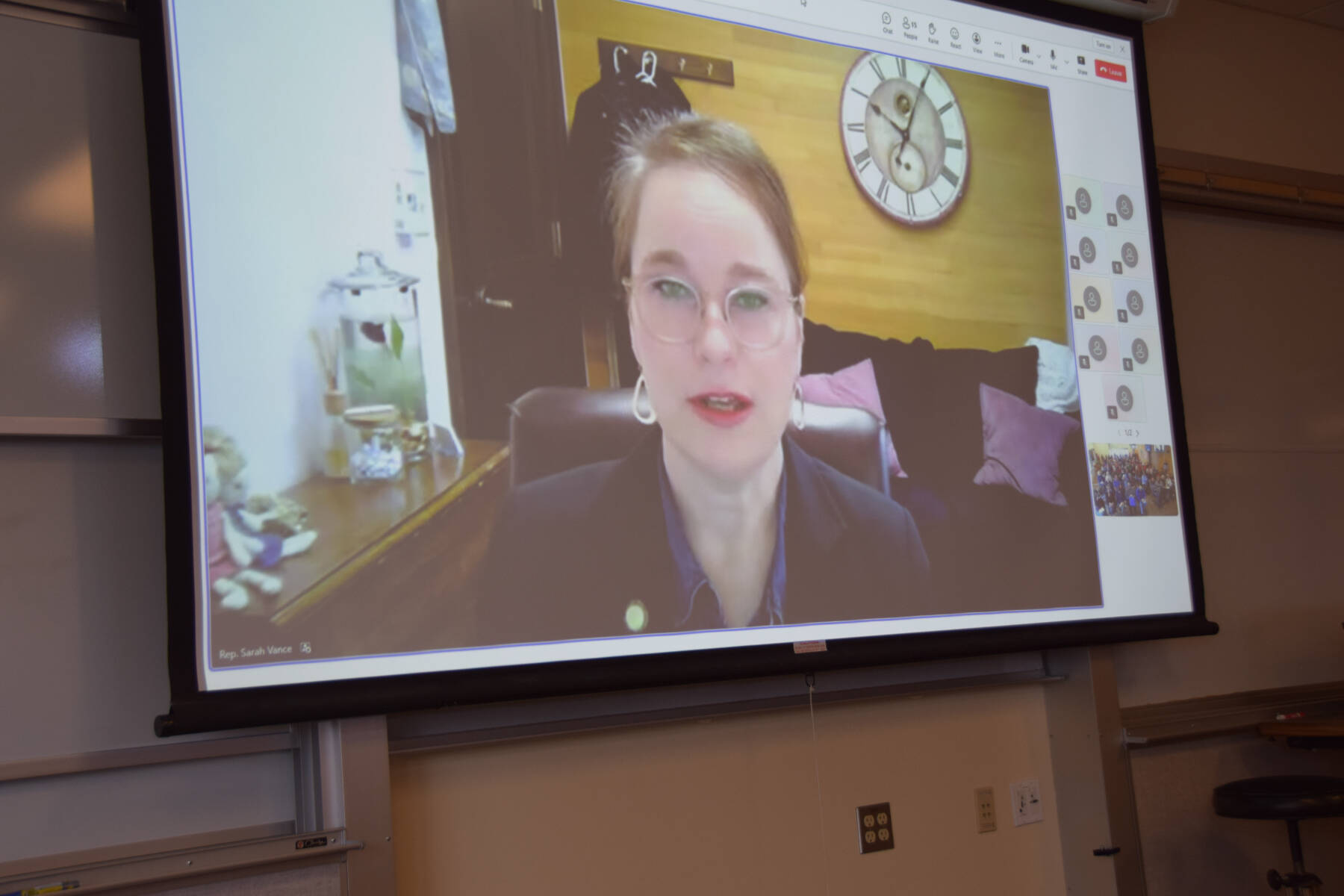
House District 6 Rep. Sarah Vance attended her town hall meeting via Microsoft Teams video on Saturday, April 12, 2025. A screening was still held for in-person attendees at Pioneer Hall on Kachemak Bay Campus. (Chloe Pleznac/Homer News)
