
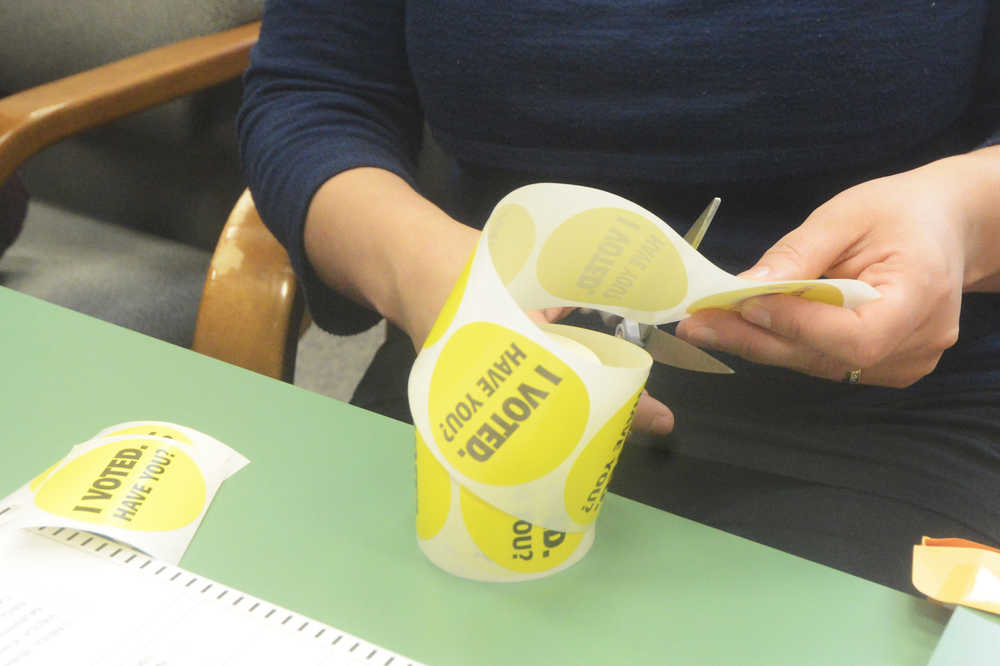
Photo by Megan Pacer/Peninsula Clarion Election Board member Kim Macdonald cuts out enough stickers to keep up with voters during a special election Tuesday, May 10, 2016 at Soldotna City Hall in Soldotna, Alaska. The election held to decide if the city would form a charter commission saw a steady stream of voters during lunchtime hours.

Photo by Megan Pacer/Peninsula Clarion Election Board member Kim Macdonald cuts out enough stickers to keep up with voters during a special election Tuesday, May 10, 2016 at Soldotna City Hall in Soldotna, Alaska. The election held to decide if the city would form a charter commission saw a steady stream of voters during lunchtime hours.

Commission accomplished

A seven-member charter commission will likely spend the next year working on a home-rule charter for Soldotna.

In a special election Tuesday, Soldotna voters approved a proposition that asked “Shall a Charter Commission be Elected to Prepare a Proposed Charter?” Unofficial results Tuesday night showed they approved the commission formation by a vote of 243 to 162, said City Manager Mark Dixson.

If the approximately 115 absentee ballots come in at roughly the same percentage, the commission will be formed, he said.

The commission now has a year to come up with a charter to make the city home rule, which will also go before the city’s voters. If the charter is voted down, the commission has another year to come up with another charter. If that charter were also voted down, it would end the home-rule process at that point.

Running for the seven seats that make up the commission were Roberta O’Neill, Penny Vadla, Scott Davis, Jerry Farrington, RoseMary Reeder, Linda Hutchings, Kenai Peninsula Borough Assembly member Dale Bagley and Soldotna City Council members Linda Murphy and Tim Cashman.

Of those nine, Farrington and O’Neill received the fewest votes. There were 42 write-ins, Dixson said.

“I think everybody worked very, very hard on educating the public,” Hutchings said.

The next step will be for the commission members to start looking through the home-rule charters of other Alaska cities, which Hutchings said they have already asked to be sent to them. She said work on the charter should begin “very soon.”

Residents came to vote in a steady stream that picked up around lunchtime, said Election Board Member Carol Freas. By about 1 p.m. Tuesday, 154 people had placed their vote. Dixson said the turnout appears to be about the same or a little less than last year’s special election on the same issue.

Marlene Lewis said she voted in favor of forming a charter commission because she thinks “it’s a good move for everyone.” In terms of what could happen with the city’s sales tax, she said it would be more beneficial to have it year-round.

“It’s really going to hurt all the community members if they don’t have it because their taxes will come in harder in other areas and it will be limited to a few,” Lewis said. “Otherwise it’ll affect others too and it’ll be more well rounded to benefit everybody. … I think it’s a more fair distribution for everyone.”

Lin Kennedy also voted in favor of forming the commission.

“Personally, having lived in Soldotna for 30 years, I think the residents, the citizens of Soldotna, should be the ones that dictate what we can and can’t do,” Kennedy said. “And I don’t appreciate people outside the city trying to tell our city council what they can and can’t do, so I think (a) home-rule charter in the long run is going to be best for the residents of Soldotna.”

A handful of voters coming and going Tuesday afternoon said they had voted against forming the commission. John Lansing Sr. has lived in Soldotna for 38 years, and said he voted against the proposition because he doesn’t believe in home rule. He has seen special interest groups come forward and dictate how things are run too often, he said.

The issue of forming a charter commission was put back before Soldotna voters in part because the city’s year-round sales tax on nonprepared food items was repealed during the last October general election. Several candidates have said the most logical way to make up for the projected $1.2 million loss in sales tax revenue is to make Soldotna a home-rule city, since that would give it the power to set its own tax rates.

Home-rule cities have other powers not afforded to first and second class cities. In a previous Clarion interview, Murphy said she would be interested in looking at the makeup of the Soldotna City Council. As it is, Mayor Pete Sprague is not a voting member, but has veto power, unlike in other home-rule communities.

Without home rule as an option, Soldotna administrators had suggested raising the city’s property taxes. Soldotna’s proposed budget currently includes a mill rate increase from 0.5 to 2 mills, a fourfold increase. Cashman and council members Paul Whitney and Keith Baxter all said they would not be comfortable raising the mill rate that high at a May 3 budget work session. The city council will vote on the budget June 8.

During the same budget work session, Dixson said annexation is another way Soldotna could make up for lost revenue by annexing areas on the city’s borders where businesses have been cropping up.

Of the election, Bagley said it’s now time for the commission members to roll up their sleeves and get to work on the charter.

“I think the yes votes will prevail,” he said.


Reach Megan Pacer at megan.pacer@peninsulaclarion.com.
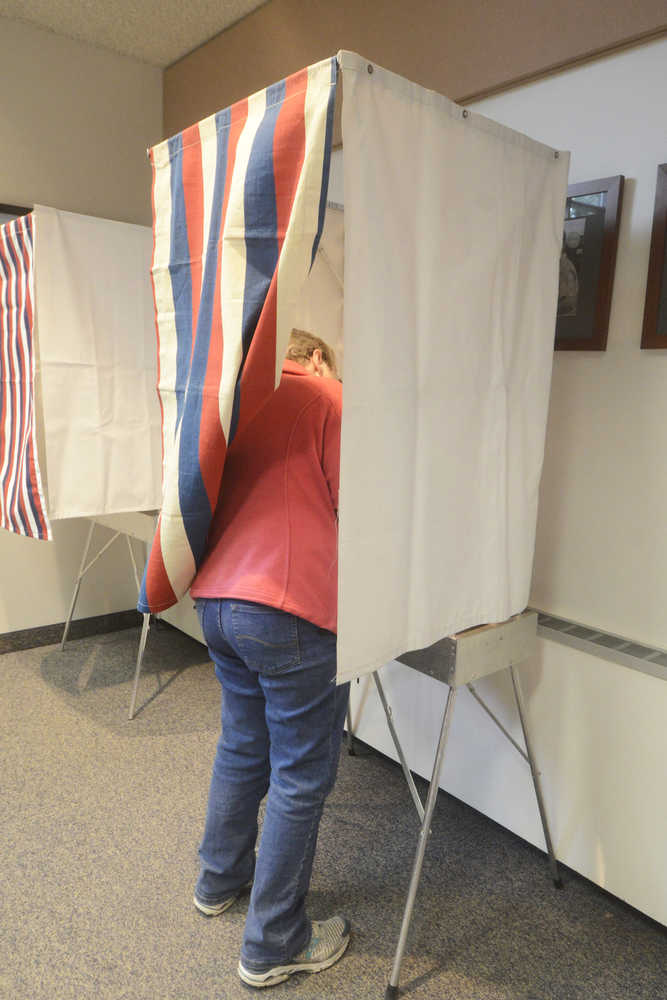
Photo by Megan Pacer/Peninsula Clarion A voter fills out her ballot during a special election Tuesday, May 10, 2016 at Soldotna City Hall in Soldotna, Alaska. The election held to decide if the city would form a charter commission saw a steady stream of voters during lunchtime hours.

Photo by Megan Pacer/Peninsula Clarion A voter fills out her ballot during a special election Tuesday, May 10, 2016 at Soldotna City Hall in Soldotna, Alaska. The election held to decide if the city would form a charter commission saw a steady stream of voters during lunchtime hours.

More in News

File.
Soldotna aims to change short-term rental tax and permitting

Public hearings for two ordinances addressing existing short-term rental regulations will occur during the next city council meeting on Jan. 14.

Low clouds hang over Cook Inlet north of Anchor Point on Oct. 23, 2025. (Photo by Yereth Rosen/Alaska Beacon)
Inletkeeper condemns federal management of Cook Inlet oil lease sale

The agency alleges an environmental study by the Bureau of Ocean Energy Management was conducted with a “serious” lack of transparency.

The Kenai Chamber of Commerce announced the winners of the 13th annual gingerbread house competition on Dec. 20, 2025. This creation by Sierra won the 2-5 year old age category. Photo courtesy of the Kenai Chamber of Commerce
Wrapping up the holiday season

The Kenai Chamber of Commerce’s Angel Tree program and gingerbread house competition spread Christmas cheer to hundreds locally.

The Challenger Learning Center is seen here in Kenai<ins>, Alaska,</ins> on Sept. 10, 2020. (Photo by Brian Mazurek/Peninsula Clarion)
Kenai City Council considers possible uses for Challenger Center

One option would assess the facility’s potential as the new public safety building.

A snowmachine rider takes advantage of 2 feet of fresh snow on a field down Murwood Avenue in Soldotna, Alaska, on Monday, Dec. 12, 2022. (Jake Dye/Peninsula Clarion)
Ice fishing opens on some Kenai National Wildlife Refuge lakes

Snowmachines are permitted for ice fishing access on Hidden, Kelly, Petersen, Engineer and Watson lakes.

The waters of Cook Inlet lap against Nikishka Beach in Nikiski, Alaska, where several local fish sites are located, on Friday, March 24, 2023. (Jake Dye/Peninsula Clarion)
Kenai asks for fishery economic disaster declaration

The Kenai City Council requested that Gov. Dunleavy declare a disaster and support a recovery plan for the Upper Cook Inlet East Side Set Net fishery.

The Kenai Peninsula Borough School District logo. (Photo courtesy of Kenai Peninsula Borough School District)
District superintendent dispels rumors about student construction

Superintendent Clayton Holland said student involvement in Seward High School construction is “based on rumor, not fact.”

Anchorage-based singer and songwriter Keeley Boyle is pictured in Anchorage<ins>, Alaska,</ins> on Sept. 26, 2023. Boyle, who was raised on the Kenai Peninsula, will use a $10,000 grant she received from the Rasmuson Foundation to create an album of songs about her grandparents’ home in Nikiski. Photo courtesy of Jovell Rennie
Musician hailing from Kenai receives Rasmuson grant

Keeley Boyle will record an album of songs about her grandparents’ Nikiski home.

Commercial fishing and recreational vessels are docked in the Homer harbor on Oct. 23, 2025. The commercial fishing industry endured a series of challenges over the year, some of them imposed by the new Trump administration. (Photo by Yereth Rosen/Alaska Beacon)
Alaska fisheries in 2025: turmoil, economic and environmental challenges and some bright spots

NOAA cuts, economic headwinds and invasive species pose problems, but there was some recovery in crab stocks and salmon harvests.

Cook Inlet near Clam Gulch is seen on Oct. 23, 2025. (Photo by Yereth Rosen/Alaska Beacon)
Disputed oil lease sale in Alaska’s Cook Inlet upheld in new Trump administration decision

After completing a court-ordered environmental study, the Bureau of Ocean Energy Management said no changes are needed for the 2022 sale that drew just one bid.

The Kenai Peninsula Borough School District logo.
School district projects $7.5 million budget deficit for fiscal year 2027

Decreased enrollment and increased property values mean less local and state funding.

The sign in front of the Homer Electric Association building in Kenai, Alaska as seen on April 1, 2020. (Photo by Brian Mazurek/Peninsula Clarion)
Homer Electric Association announces rate increase

The proposed increase, if approved by the Regulatory Commission of Alaska, will go into effect Jan. 1.