
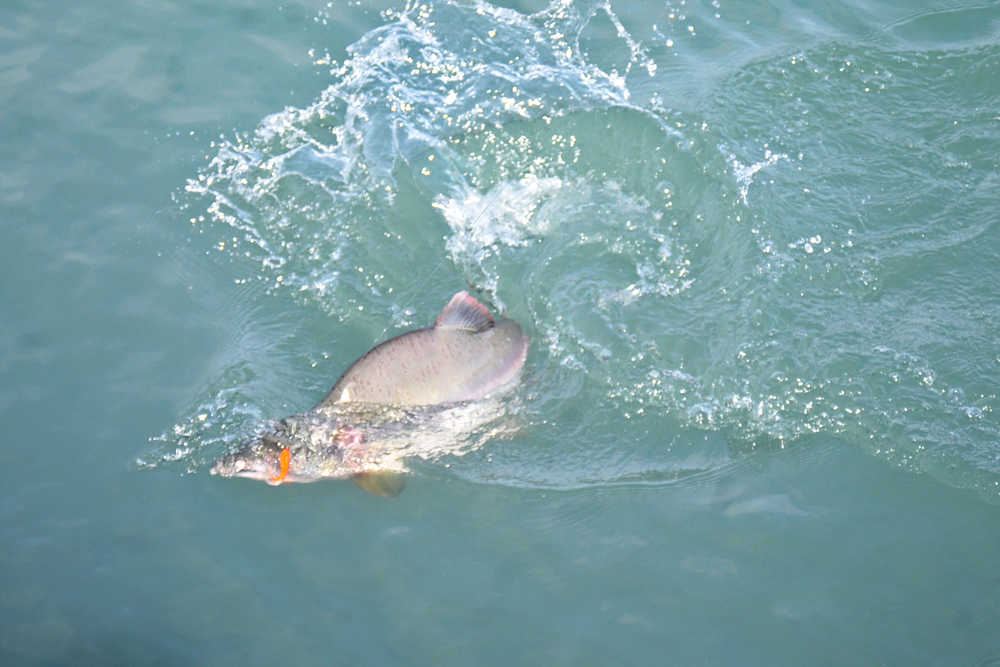
Alaskans know the climate is changing, ushering in warmer winters and summers and possibly changing the behaviors of fish and wildlife.
Fishermen know the salmon have been behaving differently in the last decade than they did before. For the last two years, Cook Inlet drift gillnet fishermen have been frustrated that sockeye salmon seem to be running deeper and more spread out than they have in the past, making big catches more difficult. Sport fishermen have theorized that temperature-sensitive silver salmon are coming in late because of warmer water temperatures.
Observations have been hard to link together, though. Many agencies are doing research on climate change and its potential ramifications for Alaska’s ecosystems, but getting a broad view of what is happening has been challenging.
A group of researchers worked to synthesize research specifically on climate change’s effects on freshwater fish in North America, published in the July 2016 issue of the journal Fisheries. Representatives from the American Fisheries Society approached the U.S. Geological Survey’s Climate Change and Wildlife Science Center about collaborating on the project because there was a lot of research coming out on the topic, but the lack of synthesis made the research hard to access, said Abigail Lynch, a research biologist with the USGS who worked on the project.
One of the challenges was how to approach such a large topic, given its wide range of effects on different ecosystems, she said.
“(The effects are) very different by region and by species,” Lynch said. “Fish like salmon, that have a very dynamic and specific sort of life history, are going to be different than something like a smallmouth bass, which has a pretty generalist way of handling things.”
In an economy like Alaska’s, where many jobs depend directly or indirectly on fish, changes to the fish population could mean a shift in a how industries work. Although the Fisheries studies specifically address changes in freshwater fish, which are targeted mostly by recreational fishermen, they impact both recreational and commercial fisheries in Alaska because salmon, one of the most significant target species in the state, are anadromous, moving from saltwater to freshwater.
Managers will have to consider the effects on fish, too. With changing habitat conditions — ranging from the obvious, like degraded habitat, to the chemical, like the amount of dissolved oxygen in the water — fish ranges may contract or expand by species. For example, smallmouth bass have now colonized freshwater systems further north than they have in the past, adapting to stream systems that remain open for longer and have more dissolved oxygen in the winter, allowing for overwintering. Many populations of Pacific salmon have been observed outmigrating earlier, lining up with warmer spring temperatures. Some fall spawners in southeast Alaska have also been observed returning to freshwater earlier, according to the journal Fisheries.
Some freshwater fish are also already showing genetic changes, according to a handful of studies examined as part of the Fisheries journal synthesis. A changing climate means natural selection weeds out the fish that cannot survive in new conditions, shifting populations in another direction. Different populations of salmon have responded in a variety of ways to changing habitats and temperatures.
“As a result of changing temperature regimes, they’ve changed their migration pattern to where the fish that are migrating at certain times are selected,” Lynch said. “So when you have fish that are running at later times and they’re being pummeled by winter storms or whatever, those fish are going to be selected against.”
The synthesis project did not actually conduct any original research — it only meshed together existing research to provide more context, but pointed out areas where additional research might be necessary. Other agencies are working on similar attempts to comprehensively research the effects of climate change. The National Oceanic and Atmospheric Administration drafted a climate science strategy, released in August 2015, which outlines seven objectives for research on climate change to fulfill.
The U.S. Global Change Research Program is also in the process of gathering information for its fourth National Climate Assessment, an update to the last National Climate Assessment completed in 2014, which gathers research on climate impacts from across the U.S.
Other agencies have reviewed conditions on a smaller level, like the U.S. Forest Service’s review of climate change effects on the Chugach National Forest, released in December 2015. It includes a number of topics, ranging from vegetation to water levels. A section on fish reviews studies theorizing that warmer air temperatures throughout the freshwater ecosystem will likely increase pink salmon abundance, while changes in sockeye populations are less certain. The effects on the economy would also be less certain. Commercial fishermen have experience adapting to both gradual and abrupt changes, but the sport fishery is more dependent on sockeye as a species and a decrease in the abundance would cause difficulty, according to the study.
“The sport fish industry would likely have a more difficult time dealing with a major decline in sockeye salmon habitat and abundance simply because it is more focused on one species and each fish is associated with significant spending and employment,” the study states. “However, reduced spending by Alaska residents on sport fishing would likely shift to other activities but remain within the regional economy.”
Lynch said a further step she’d like to see researchers take is to examine the implications of changing migration and fish assemblages, such as how the presence of smallmouth bass could affect fish already existing there. Fisheries managers likely cannot reverse the effects of climate change, and part of the challenge is that some of the effects will mean that certain fish may not be available in some areas, or they will be fewer, she said.
“There are certain areas where there are ‘winners and losers,’ but as those systems change, it’s really about managing the expectations of the fishermen and the other user groups,” she said. “Really, a lot of the tools that we have in our fisheries management tool box, all the existing techniques and tools we use in fisheries management, completely apply in issues of climate change.”
Reach Elizabeth Earl at elizabeth.earl@peninsulaclarion.com.
