
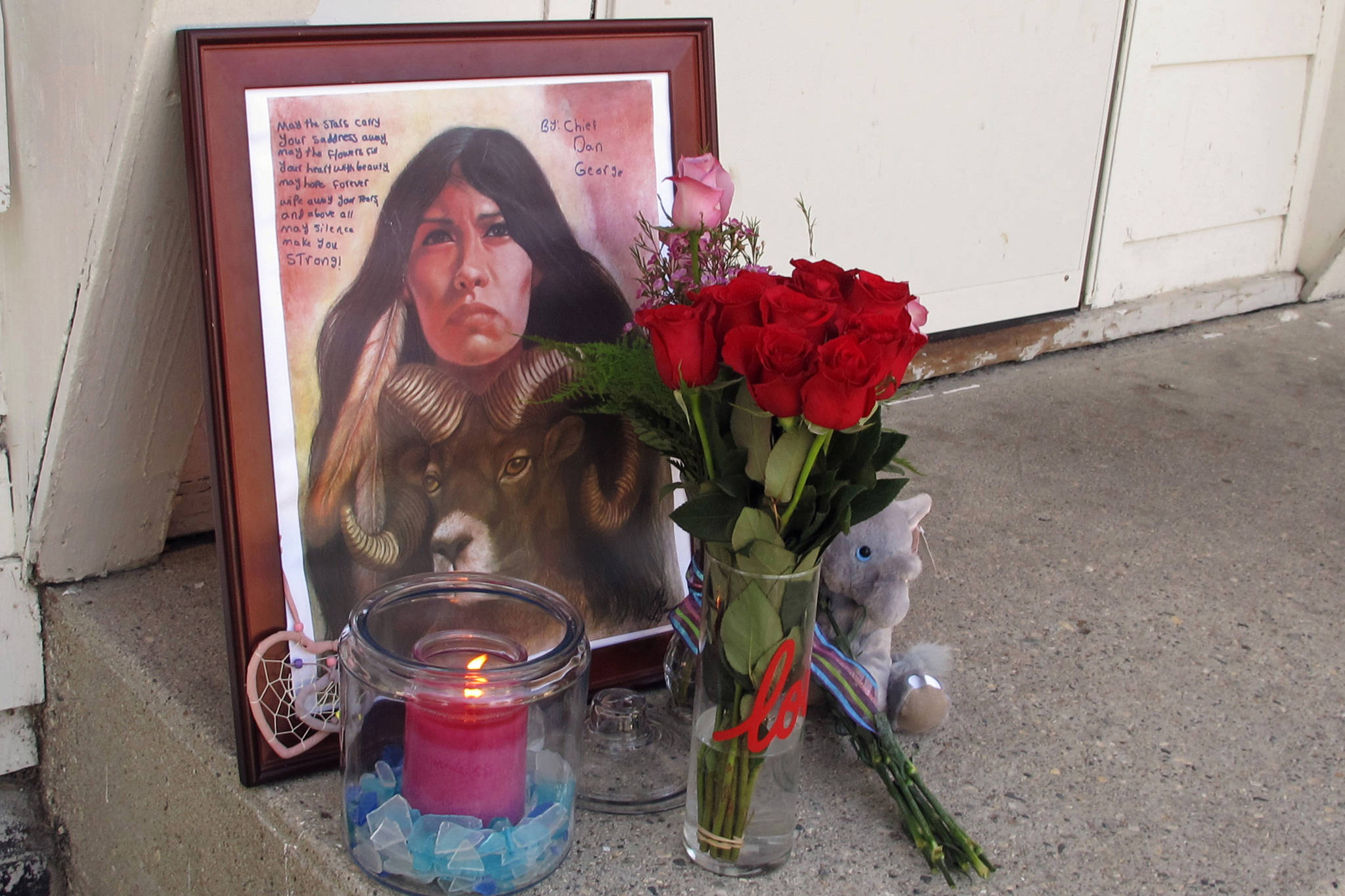
A makeshift memorial to Savanna Greywind featuring a painting, flowers, candle and a stuffed animal is seen on Monday, Aug. 28, 2017, in Fargo, N.D., outside the apartment where Greywind lived with her parents. Republican U.S. Sen. Lisa Murkowski from Alaska is taking up the cause for a bill aimed at helping law enforcement with cases of murdered and missing indigenous women. Former North Dakota Democratic Sen. Heidi Heitkamp introduced and helped pass Savanna’s Act in the Senate before she lost election, but it was blocked in the House by a retiring Republican. (AP Photo/Dave Kolpack, File)

A makeshift memorial to Savanna Greywind featuring a painting, flowers, candle and a stuffed animal is seen on Monday, Aug. 28, 2017, in Fargo, N.D., outside the apartment where Greywind lived with her parents. Republican U.S. Sen. Lisa Murkowski from Alaska is taking up the cause for a bill aimed at helping law enforcement with cases of murdered and missing indigenous women. Former North Dakota Democratic Sen. Heidi Heitkamp introduced and helped pass Savanna’s Act in the Senate before she lost election, but it was blocked in the House by a retiring Republican. (AP Photo/Dave Kolpack, File)

Cold-case bill gains steam

Savanna’s Act aims to help law enforcement investigate cases of murdered and missing indigenous women

  • By Dave Kolpack Associated Press
  • Saturday, November 30, 2019 10:11pm
  • News

FARGO, N.D. — A bill originally meant to help law enforcement investigate cold cases of murdered and missing indigenous women that has floundered in Congress for two years may have the missing ingredients to become law — money and muscle.

The money comes from an appropriations subcommittee chaired by Alaska Republican Sen. Lisa Murkowski, who told The Associated Press that for the first time funding is being directed specifically to murdered and missing indigenous people.

The muscle comes from the White House and specifically the Department of Justice, which last week unveiled a plan that would investigate issues raised in the bill like data collection practices and federal databases.

It adds up to a strong outlook for Savanna’s Act, which was originally introduced in 2017 by Murkowski, Democratic Nevada Sen. Catherine Cortez Mastro and former North Dakota Democratic Sen. Heidi Heitkamp. Murkowski and Heitkamp, longtime allies on issues affecting indigenous people, also created the Commission on Native Children, which recently held its first meeting.

“The great thing about Lisa’s work has been her willingness to not just pass this law but make sure there’s an appropriation for it,” Heitkamp said Friday.

The bill is named for Savanna Greywind, a Native American North Dakota woman who was killed in 2017 when her baby was cut from her womb.

The Senate Committee on Indian Affairs, chaired by North Dakota Republican John Hoeven, earlier this month advanced another version of bill to the full Senate for consideration.

Gloria Allred, an attorney for Greywind’s family, said they are “encouraged by what appears to be the strong efforts of U.S. Sen. Lisa Murkowski’s commitment to gather support for this bill in order for it to be signed into law one day.”

Savanna’s Act passed the Senate in 2018 but was blocked in the House by former Virginia Rep. Bob Goodlatte because he said it would hurt some agencies that have no link to tribal communities. Heitkamp said a new companion piece to the bill, the Not Invisible Act, has helped broaden the scope of the initiative and address concerns raised by Goodlatte.

“We are making some headway,” Murkowski said. “Not fast enough, but I think we’re making the efforts that are going to make a difference in the long haul. The legislative initiatives that we have used have successfully raised the issue of awareness.”

Savanna’s Act was introduced in the House earlier this year.

Three of its cosponsors are Native American — Sharice Davids of Kansas and Tom Cole and Markwayne Mullin of Oklahoma.


• By Dave Kolpack, Associated Press


More in News

The Challenger Learning Center is seen here in Kenai<ins>, Alaska,</ins> on Sept. 10, 2020. (Photo by Brian Mazurek/Peninsula Clarion)
Kenai City Council considers possible uses for Challenger Center

One option would assess the facility’s potential as the new public safety building.

A snowmachine rider takes advantage of 2 feet of fresh snow on a field down Murwood Avenue in Soldotna, Alaska, on Monday, Dec. 12, 2022. (Jake Dye/Peninsula Clarion)
Ice fishing opens on some Kenai National Wildlife Refuge lakes

Snowmachines are permitted for ice fishing access on Hidden, Kelly, Petersen, Engineer and Watson lakes.

The waters of Cook Inlet lap against Nikishka Beach in Nikiski, Alaska, where several local fish sites are located, on Friday, March 24, 2023. (Jake Dye/Peninsula Clarion)
Kenai asks for fishery economic disaster declaration

The Kenai City Council requested that Gov. Dunleavy declare a disaster and support a recovery plan for the Upper Cook Inlet East Side Set Net fishery.

The Kenai Peninsula Borough School District logo. (Photo courtesy of Kenai Peninsula Borough School District)
District superintendent dispels rumors about student construction

Superintendent Clayton Holland said student involvement in Seward High School construction is “based on rumor, not fact.”

Anchorage-based singer and songwriter Keeley Boyle is pictured in Anchorage<ins>, Alaska,</ins> on Sept. 26, 2023. Boyle, who was raised on the Kenai Peninsula, will use a $10,000 grant she received from the Rasmuson Foundation to create an album of songs about her grandparents’ home in Nikiski. Photo courtesy of Jovell Rennie
Musician hailing from Kenai receives Rasmuson grant

Keeley Boyle will record an album of songs about her grandparents’ Nikiski home.

Commercial fishing and recreational vessels are docked in the Homer harbor on Oct. 23, 2025. The commercial fishing industry endured a series of challenges over the year, some of them imposed by the new Trump administration. (Photo by Yereth Rosen/Alaska Beacon)
Alaska fisheries in 2025: turmoil, economic and environmental challenges and some bright spots

NOAA cuts, economic headwinds and invasive species pose problems, but there was some recovery in crab stocks and salmon harvests.

Cook Inlet near Clam Gulch is seen on Oct. 23, 2025. (Photo by Yereth Rosen/Alaska Beacon)
Disputed oil lease sale in Alaska’s Cook Inlet upheld in new Trump administration decision

After completing a court-ordered environmental study, the Bureau of Ocean Energy Management said no changes are needed for the 2022 sale that drew just one bid.

The Kenai Peninsula Borough School District logo.
School district projects $7.5 million budget deficit for fiscal year 2027

Decreased enrollment and increased property values mean less local and state funding.

The sign in front of the Homer Electric Association building in Kenai, Alaska as seen on April 1, 2020. (Photo by Brian Mazurek/Peninsula Clarion)
Homer Electric Association announces rate increase

The proposed increase, if approved by the Regulatory Commission of Alaska, will go into effect Jan. 1.

Most Read