
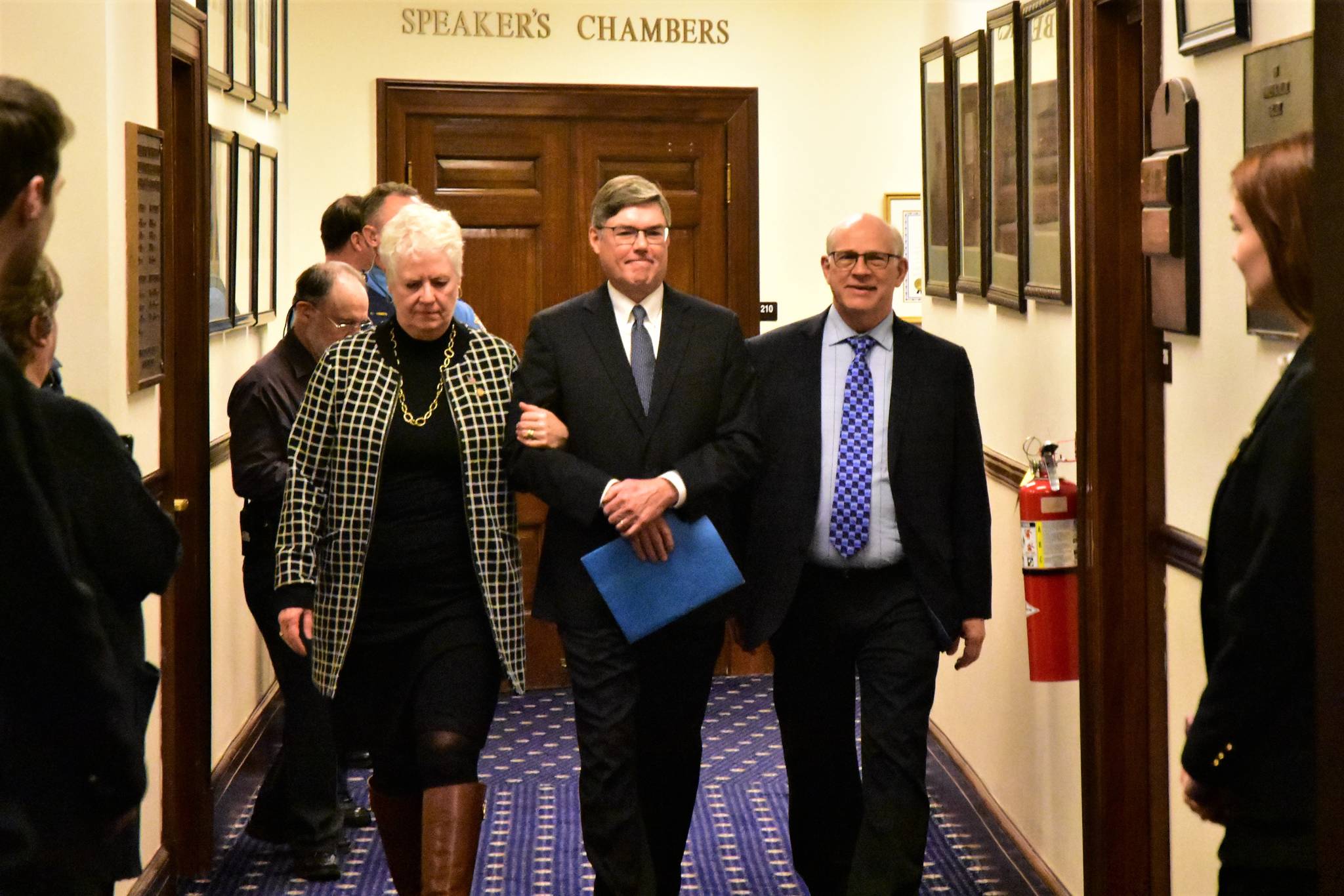
Peter Segall | Juneau Empire                                Alaska Supreme Court Chief Justice Joel M. Bolger, center, is escorted into the House Chamber by Rep. Louise Stutes, R-Kodiak, and Sen. John Coghill, R-North Pole, on Wednesday.

Peter Segall | Juneau Empire Alaska Supreme Court Chief Justice Joel M. Bolger, center, is escorted into the House Chamber by Rep. Louise Stutes, R-Kodiak, and Sen. John Coghill, R-North Pole, on Wednesday.

Chief Justice says courts don’t have optional programs, calls for more funding

Chief Justice Bolger told lawmakers judiciary needs more funds to serve Alaskans

The state’s judiciary is strong but not immune to budget cuts, said Alaska Supreme Court Chief Justice Joel M. Bolger near the beginning of his State of the Judiciary speech to the Legislature Wednesday.

Bolger said the judiciary would need additional funding to do its job.

“Courts do not have optional programs and we have to accommodate every decrement to our budget by adjusting our core services,” Bolger told a joint session of the Legislature gathered in the House Chambers at the Capitol.

The state has a backlog of felony cases, the number of which grew over the past few years, but it does not have enough judges to work through the backlog in a timely manner, Bolger said. The courts received 7,500 felony cases in 2019, 1,000 more than just two years ago, he said.

Bolger said he was requesting an additional judge to help work through the caseload. He said the judiciary supported a bill introduced last year by Sen. David Wilson, R-Wasilla. Senate Bill 55 would allow the Chief Justice to appoint court of appeals judges for no more than two years.

He also asked for additional funding for the state’s therapeutic courts, which he said had been proven to reduce recidivism if people graduated from its programs. But, he said, the courts are resource intensive.

“Our statewide (therapeutic court) coordinator is in dire need of help,” Bolger said, and asked the Legislature for funding to appoint a deputy coordinator.

Lastly, he asked for a 1% cost-of-living increase for non-judicial staff within the court system. The courts had already gone through reductions in staff, pay and hours as part of efforts to cut costs.

“Those cuts have absolutely resulted in a reduction of services to the public,” Bolger said.

Bolger said he was asking only for the things the court system absolutely needed, and any request for an increase in funding was carefully considered. He thanked the Legislature for their support of the judiciary in the past and having funded all the court system’s requests for additional funding.

Speaking with reporters following the address, Bolger said he could not comment on the case concerning the effort to recall Gov. Mike Dunleavy because it was ongoing litigation. He did say the court would pursue the matter in a timely fashion.

Vetoes to the court system and the governor’s refusal to appoint a Palmer Superior Court Judge within 45 days are both cited by the Recall Dunleavy campaign as legal reasons to recall the governor.

In March 2019, Dunleavy said his refusal to appoint a Palmer judge was because he felt the candidates presented to him by the Alaska Judicial Council were not qualified for the position.

“Alaska’s constitutional judicial selection process is supposed to be merit and qualifications based,” Dunleavy wrote in a statement at the time. “The list you provided me does not appear to uphold this important standard.”

Bolger said he believed Alaska’s method of judicial selection was one of the best in the nation, and attributed that to the framers of the Alaska Constitution having the benefit of learning from other states’ experiences.

Asked about the apparent tension between the courts and administration, Bolger said he had faith in the system to work out those differences.

“Courts resolve these types of questions everyday. Courts are faced with circumstances where one party or the other is alleging conflict of interest, personal interest, position that seems to be conflicted,” Bolger said. “We resolve those questions. We have legal rules for resolving those questions as well and we do those thing one at a time.”
Peter Segall | Juneau Empire                                Alaska Supreme Court Chief Justice Joel M. Bolger, center, is escorted into the House Chamber by Rep. Louise Stutes, R-Kodiak, and Sen. John Coghill, R-North Pole, on Wednesday.

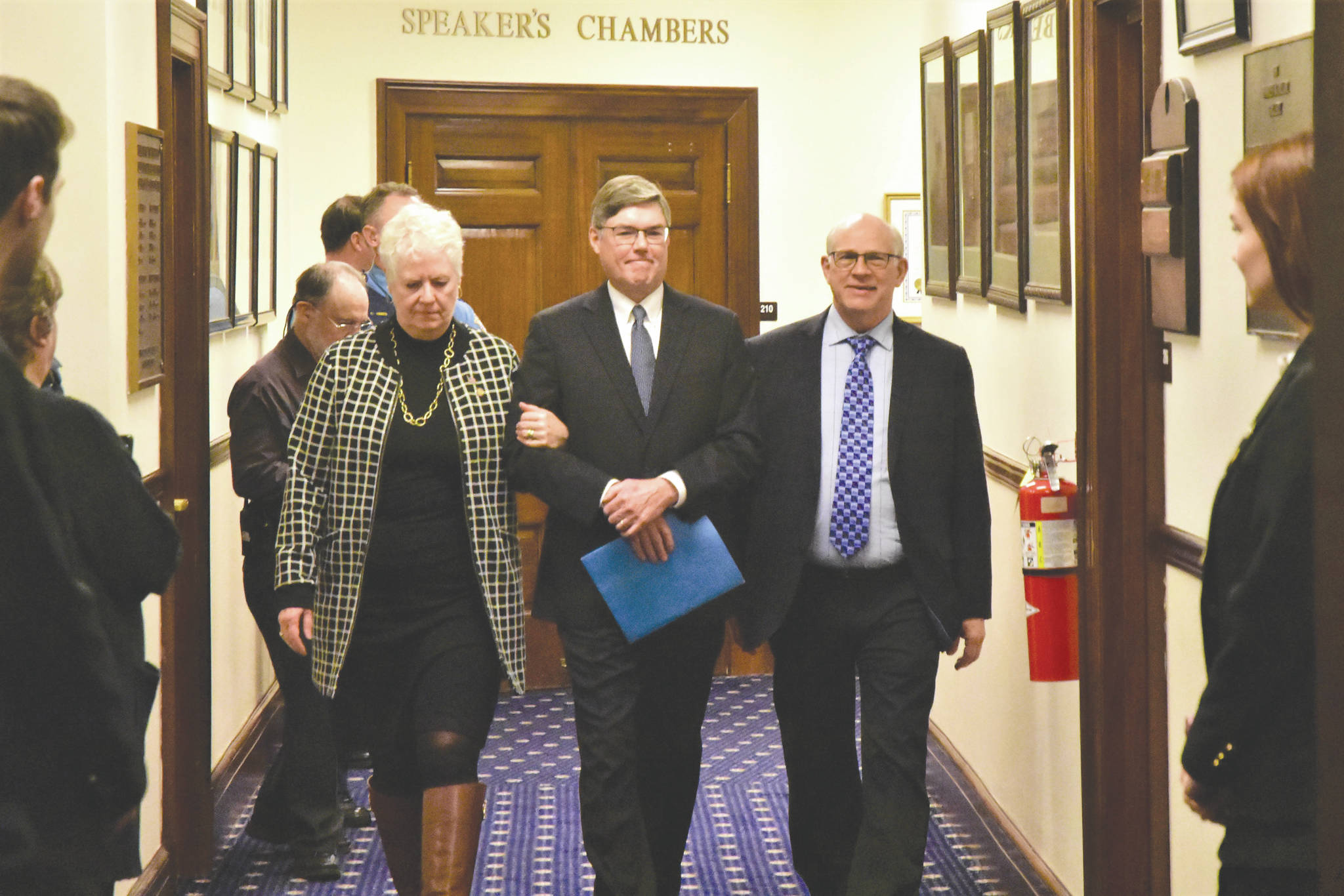
Peter Segall | Juneau Empire Alaska Supreme Court Chief Justice Joel M. Bolger, center, is escorted into the House Chamber by Rep. Louise Stutes, R-Kodiak, and Sen. John Coghill, R-North Pole, on Wednesday.

More in News

Retired Biologist and former manager of the Kenai National Wildlife Refuge will “Looking Back, Looking Forward,” a talk about his solo trip on the Yukon River, on Tuesday evening at the Refuge headquarters in Soldotna. The Homer-based nonprofit organization Friends of Alaska National Wildlife Refuges is hosting a virtual watch party in Homer. Photo courtesy of Friends of Alaska National Wildlife Refuges
Looking back, looking forward

Robin West will give a talk about his 30-year career Tuesday evening at the Kenai refuge headquarters and virtually.

Ryan Tunseth speaks during a meeting of the Kenai Peninsula Borough Assembly in Soldotna, Alaska, on Tuesday, May 6, 2025. (Jake Dye/Peninsula Clarion)
Assembly addresses formal presentations in code amendment

An ordinance passed Feb. 3 clarifies that formal presentations made before the Kenai Peninsula Borough Assembly should relate to borough matters.

Rep. Andi Story (D-Juneau), co-chair of the House Education Committee, speaks in favor of overriding Gov. Mike Dunleavy’s veto of an education funding bill during a joint session of the Alaska Legislature in 2025. (Juneau Empire file photo)
Juneau bill aims to stabilize education funding

House Bill 261 would change how schools rely on student counts.

The Alaska State Capitol building stands on Tuesday, Jan. 20, 2025. (Mari Kanagy/Juneau Empire)
Ruffridge, Elam introduce new legislative bills

The representatives filed bills relating to tax exemptions for EMS personnel and dental care.

Members of the Kachemak Bay Search and Rescue group receive instruction from helicopter pilot Steven Ritter (left) on Jan. 30, 2026, during a training weekend at Kachemak Emergency Services station in Homer, Alaska. Photo courtesy Kasey Aderhold
Search and rescue group members receive certification

The initial cohort of a Homer-based search and rescue group recently completed a hands-on, nationally-certified training session.

A recent photo of Anesha "Duffy" Murnane, missing since Oct. 17, 2019, in Homer, Alaska. (Photo provided, Homer Police Department)
Calderwood pleads guilty to murder of Homer woman

Kirby Calderwood pleaded guilty to the 2019 murder of Anesha “Duffy” Murnane on Feb. 5, four years after his arrest in 2022.

State of Alaska Department of Law logo. Photo courtesy of the State of Alaska Department of Law
Kenai man sentenced for sexual abuse charges

Ollie Garrett, 62, will serve 15 years in prison for sexual abuse of a minor.

teaser
Seward student to present salt brine alternative to Alaska Senate

Hannah Leatherman, winner of the 35th annual Caring for the Kenai competition, will travel to Juneau to present her idea to the Senate transportation committee.

Jan Krehel waves at cars passing by as she holds a "Stand With Minnesota" banner during the "ICE OUT" demonstration on Sunday, Feb. 1, 2026, at WKFL Park in Homer, Alaska. (Delcenia Cosman/Homer News)
Homer stands with Minneapolis

Nearly 300 people took part in an “ICE OUT” demonstration on Sunday.

Most Read