
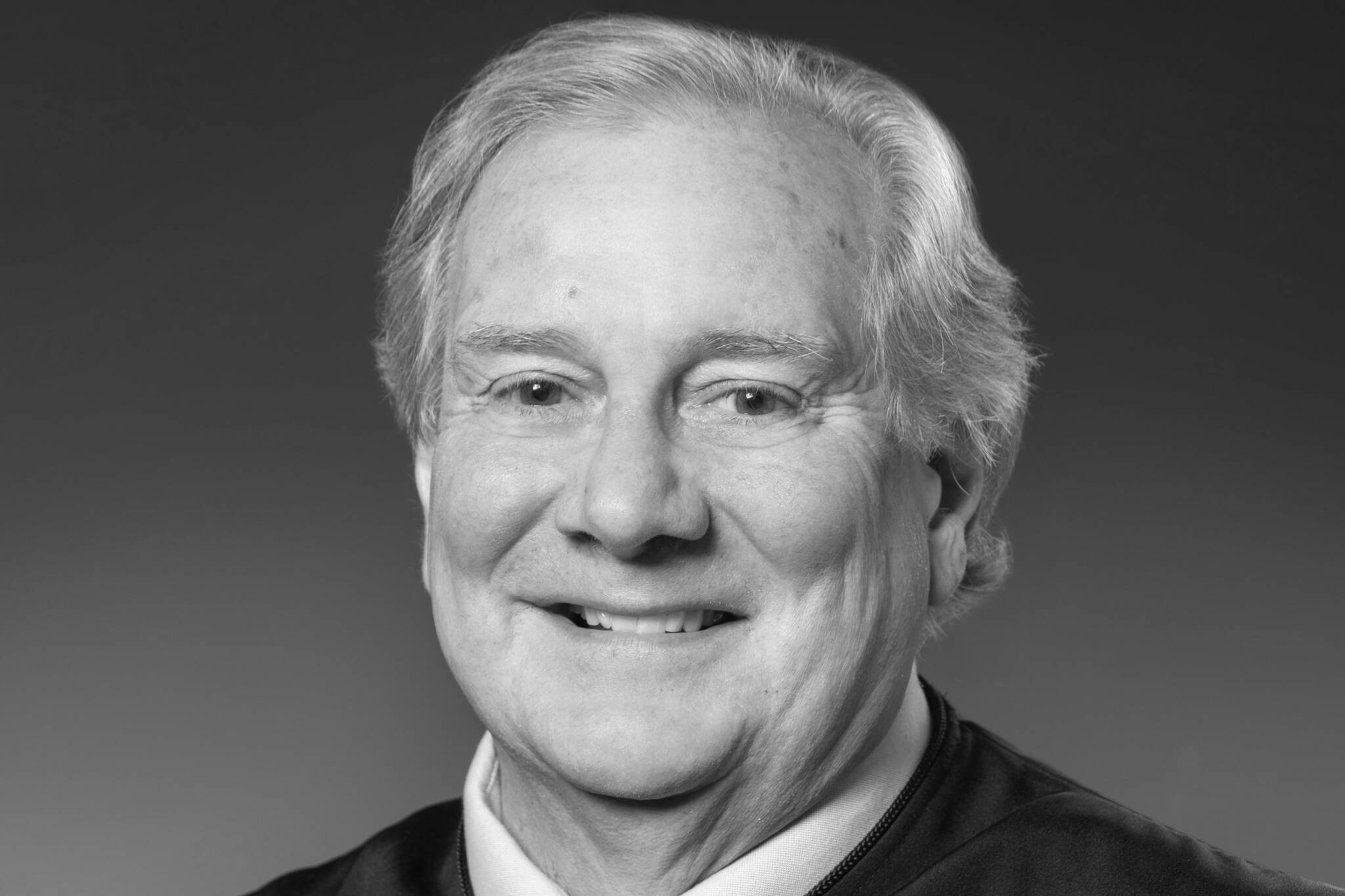
Chief Justice of the Alaska Supreme Court Daniel Winfree spoke with the Empire about Alaska’s court system and its judicial selection process. Winfree is the first Chief Justice to be born in Alaska and spent 25 years in private practice before joining the court. (Courtesy photo/ Alaska Court System)

Chief Justice of the Alaska Supreme Court Daniel Winfree spoke with the Empire about Alaska’s court system and its judicial selection process. Winfree is the first Chief Justice to be born in Alaska and spent 25 years in private practice before joining the court. (Courtesy photo/ Alaska Court System)

Chief Justice: Cases decided on merit, not politics

Chief Justice Winfree says Alaska’s courts are transparent and open

Chief Justice of the Alaska Supreme Court Daniel Winfree is the first Alaska-born person to hold that position, and it comes after a long legal career in the state.

After 25 years in private practice, Winfree was appointed to the Alaska Supreme Court in 2008. He served as president of the Alaska Bar Association and as chair of its ethics committee.

Winfree, who was born in Fairbanks, in the Alaska Territory, told the Empire in an interview Thursday that he followed his older brothers, whom he looked up to, into the legal profession. He initially thought he wanted to go into business with a legal background, he said, but once he enrolled in a joint business and law degree program at U.C. Berkeley, he knew he wanted to focus on law.

Speaking to the Empire by videoconference, Winfree emphasized the dedication judges have to impartiality and that they try their best not to let politics impact their decision-making. Members of the court do their best to look at the facts of the case, Winfree said, and try to rule according to the written law, not politics or the popular will.

“Courts aren’t supposed to reflect the will of the people,” Winfree said. “We don’t decide cases based on political demographics or what the majority wants us to say the U.S. Constitution of the Alaska Constitution says.”

Some Alaska Republicans have criticized the state’s judicial selection process, saying the process is too tightly controlled by the Alaska Judicial Council and the Alaska Bar Association. Some Republican lawmakers have introduced legislation to change the selection process laid out in the state’s constitution. Rep. Chris Kurka, R-Wasilla, introduced a bill in April for a constitutional amendment that would have Supreme Court Justices selected by voters every four years in a general election.

[City extends COVID mitigation measures, restores fines for violations]

Earlier this year, Gov. Mike Dunleavy asked the Judicial Council for a new slate of nominations after his preferred candidate wasn’t selected. Winfree was selected following the retirement of former Chief Justice Joel Bolger, who retired earlier this year. The Alaska Constitution does provide periodic public votes to retain justices and requires they retire at age 70.

The framers of the Alaska State Constitution specifically didn’t want elected judges, according to Winfree, who said at the time there were several scandals involving elected judges in the U.S. Winfree called changing the state’s judicial selection process a bad idea, and said advocates for the change would have to make a strong argument for changing what the founders purposefully enshrined in the state constitution.

“Can you imagine what it would be like if I had to go out and get campaign money,” Winfree said. “How do you sit on cases when people have given you money for your elections?”

Winfree said the court goes to great lengths to be transparent, and that court proceedings are televised and rulings made available to the public. He encouraged people to read the court’s decisions and listen to arguments before deciding a ruling is politically driven.

“I recognize that we’re not going to please everybody at any time, at least half of the people involved are going to be upset,” Winfree said. “We take the facts of each case and decide on its merits.”

Winfree will make his first State of the Judiciary address to the Alaska State Legislature in February.

Contact reporter Peter Segall at psegall@juneauempire.com. Follow him on Twitter at @SegallJnuEmpire.

More in News

Sterling resident Jonny Reidy walks 11 miles from his dry cabin to his part-time job at Fred Meyer on Dec. 15, 2025. Reidy aims to walk 1,000 miles by midsummer, and he’s asking people to pledge donations to food banks for every mile he travels. Photo courtesy of Jonny Reidy
Sterling man is walking 1,000 miles for hunger awareness

Jonathan Reidy asks people to pledge donations to local food banks for every mile he walks.

Soldotna High School students learn how to prepare moose meat through the school’s annual Moose Permit Project, an educational partnership between SoHi and the Alaska Department of Fish and Game. Photo courtesy of Tabitha Blades/Soldotna High School
Soldotna students get hands-on moose harvest experience

SoHi’s annual Moose Permit Project is an educational collaboration between the school and the Alaska Department of Fish and Game.

A snowmachine rider takes advantage of 2 feet of fresh snow on a field down Murwood Avenue in Soldotna, Alaska, on Monday, Dec. 12, 2022. (Jake Dye/Peninsula Clarion)
Kenai refuge announces snowmachine opening

All areas traditionally allowing snowmachine use in the Kenai National Wildlife Refuge are now open.

Kate Rich’s play, “The Most Comfortable Couch in Town,” is performed during “Stranded: A Ten-Minute Play Festival” in August 2025 in Homer, Alaska. Photo provided by Jennifer Norton
Homer playwright receives fellowship award

Kate Rich is revising a new play, which she hopes to take to the Valdez Theatre Conference Play Lab.

A BUMPS bus waits for passengers in the Walmart parking lot in Kenai, Alaska, on Oct. 15, 2018. (File photo)
Ninilchik Traditional Council expands public bus service

The Homer-Kenai BUMPS bus will now run five days a week.

Balloons fall on dozens of children armed with confetti poppers during the Ninth Annual Noon-Year’s Eve Party at the Soldotna Public Library in Soldotna, Alaska, on New Year’s Eve, Tuesday, Dec. 31, 2024. (Jake Dye/Peninsula Clarion)
Out with the old, in with the new

The Peninsula Clarion looks back on 2025 in this “year in review.”

The sign in front of the Homer Electric Association building in Kenai, Alaska as seen on April 1, 2020. (Photo by Brian Mazurek/Peninsula Clarion)
State regulatory commission approves electric utility rate increase

The Homer Electric Association ratified a 4% base rate increase in November.

A map presented by the Alaska Department of Natural Resources during a virtual meeting on Dec. 11, 2025, shows the location of a potential Kenai Peninsula State Forest. Screenshot.
Community meeting in Homer to focus on proposed state forest

The Department of Natural Resources will continue to gather community input on the potential establishment of a Kenai Peninsula State Forest during a meeting on Tuesday at Kachemak Bay Campus.

File.
Soldotna aims to change short-term rental tax and permitting

Public hearings for two ordinances addressing existing short-term rental regulations will occur during the next city council meeting on Jan. 14.

Most Read