
After months of uncertainty amid the Trump administration’s deep cuts to the National Oceanic and Atmospheric Administration, the council that manages commercial fisheries in federal waters off Alaska now has all the federal funding that had been allocated to it for 2025 operations.
But the North Pacific Fishery Management Council now faces a new source of uncertainty: the federal government shutdown.
The funding and shutdown complications have reshaped the council’s October meeting, underway this week.
The meeting is being held entirely online, based on a decision made in June when officials were unsure if they could pay for an in-person event in Anchorage, the usual meeting site.. At the time, the council had received less than half of its grant from the National Oceanic and Atmospheric Administration for 2025 operations.
Later in the summer, the council got assurances that it had its full operational grant, said executive director Dave Witherell.
“The good news is that in July, we received an additional allotment of grant funding, and in August, we received the remainder of the 2025 grant funding,” Witherell said by email.
The news about funding came too late for the council to change its plans and switch to an in-person event.
The meeting agenda, meanwhile, has been hastily revised because of the likely absences later in the week of many federal scientists who normally present to and advise the council.
Ian Stewart, co-chair of the council’s Scientific and Statistical Committee, advised his colleagues of the late agenda switches as the shutdown loomed.
“We have got some fairly major schedule changes today in order to make the best use of our time with the federal employees while they’re with us,” Stewart said on Tuesday, the second day of that committee’s meeting.
North Pacific Fishery Management Council meetings start with meetings of the organization’s Scientific and Statistical Committee and Advisory Panel. The full council starts its proceedings a few days later, using advice from the affiliated committees. This week, the full council is scheduled to start its meeting on Thursday.
The impacts of both the budget uncertainties and the shutdown create a less-than-ideal situation, officials said.
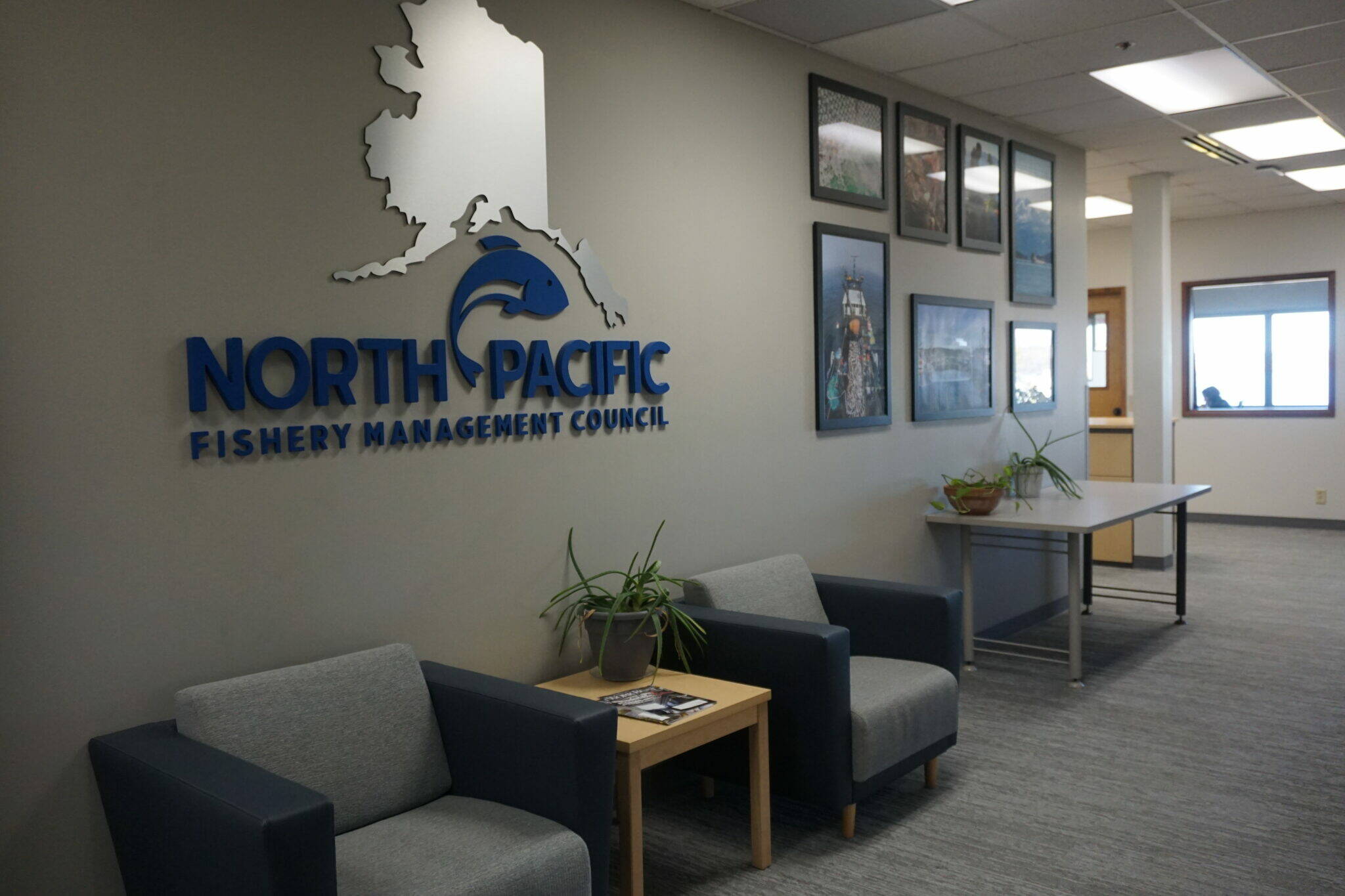
The North Pacific Fishery Management Council’s Anchorage office is seen on Tuesday. The council is holding its October meeting online instead of in person in Anchorage, as is the usual practice. Funding uncertainties prompted the decision to hold the meeting online. (Photo by Yereth Rosen/Alaska Beacon)
Witherell said in-person meetings are “highly preferable” for the council because they allow for conversations and information exchanges between advisers, scientists, council members, council staff and the public, he said.
The public can still tune in to the online meeting and give oral testimony, though the deadline for written comments has passed.
“In-person meetings also build trust and relationships as people get to speak to each other during breaks and before and after the meetings,” he said by email. “One could make the case that more informed decisions lead to better outcomes.”
The shutdown challenges now threaten to force postponement of some of the work the council had expected to do at the current meeting, Witherell said.
Among the items on the agenda at this meeting are decisions about Bering Sea snow crab and red king crab management. Those are high-profile issues because key harvests have only recently resumed after being shut down for consecutive seasons because of stock crashes.
Also on the agenda, and due for a final council vote, are adjustments to rules for what is called the “maximum retainable amount,” a metric used for the incidental catch of untargeted species by commercial fishing vessels. The changes being contemplated could apply to all commercial vessel types operating in the Bering Sea, Aleutian Islands and Gulf of Alaska.
Witherell said the proceedings are being adjusted to account for the possibility that federal scientists might not be able to participate.
If scientists from NOAA’s National Marine Fisheries Service are not available to answer questions, the council’s members will have to decide whether they have enough information to proceed with action, Witherell said.
One agenda item that will be dropped if there is a shutdown is discussion of what is known as Essential Fish Habitat, or EFH, Witherell said. Identification of Essential Fish Habitat informs fishery plans.
A federal government shutdown threatens to limit the availability of fish stock information used to guide harvest management, the executive director of NOAA’s Alaska Fisheries Science Center said Tuesday.
Bob Foy, who heads the center, said there is a contingency plan in place for a federal government shutdown.
If the shutdown lasts for fewer than five days, “then we would plan for all the assessments to be completed as scheduled for the current year,” he told the Scientific and Statistical Committee.
But impacts of a long shutdown could be serious, Foy said.
“If we go greater than 15 business days, that’s going to dramatically impact our ability to produce our stock assessments in time for our internal and your review deadlines. We would not likely meet any of those deadlines,” he said.
Yereth Rosen came to Alaska in 1987 to work for the Anchorage Times. This article originally appeared online at alaskabeacon.com. Alaska Beacon, an affiliate of States Newsroom, is an independent, nonpartisan news organization focused on connecting Alaskans to their state government.
