
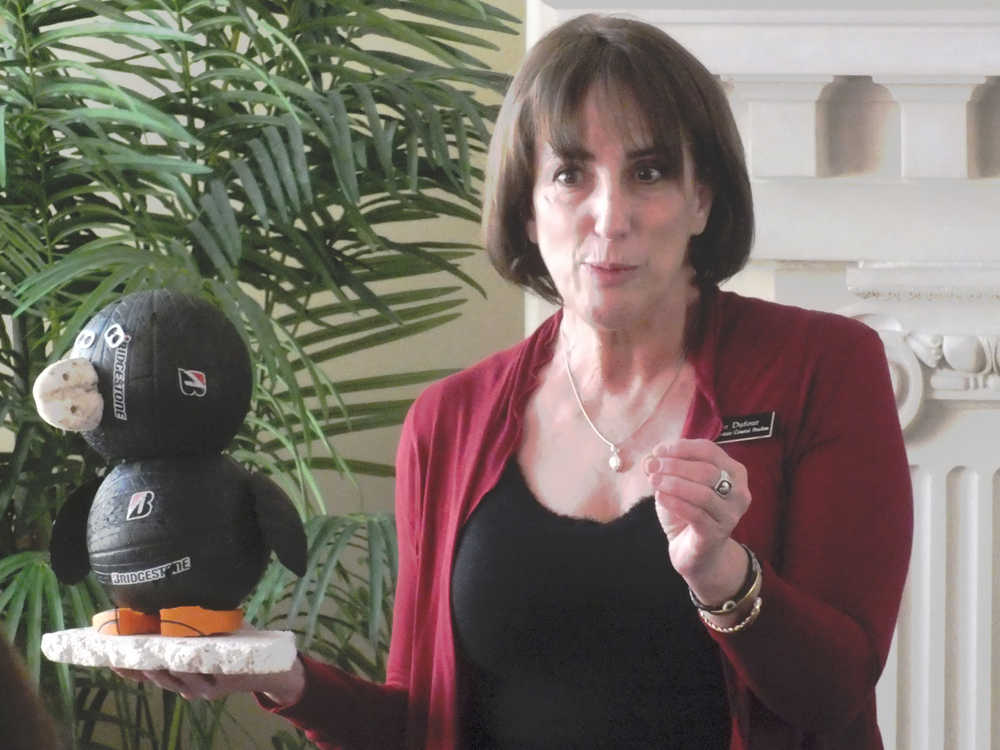
Among other things, Melanie Dufour’s listeners at the Soldotna Chamber of Commerce luncheon Tuesday learned a little about sea stars.
“There aren’t any starfish,” Dufour said. “It’s part of our mission to help people learn that there are no starfish. They don’t have fins, they can’t swim, they are not fish. Those creatures are called sea stars.”
The proper names of Cook Inlet’s wildlife are one important fact the Coastal Studies Center teaches the school groups that take field trips to its Homer headquarters for hands-on lessons in animal biology and coastal ecology. The center operates its tours, camps and other activities on both sides of Kachemak Bay. This summer it will offer four summer camps as well as youth internships and guided tours. During the winter, they offer free weekly snowshoeing and sledding trips with bonfires in the evenings at their 140-acre Wynn Nature Center on Homer’s Skyline Drive.
Dufour, the Coastal Studies Center marketing director, said her group provides “place-based education,” a necessary supplement to classroom science lessons.
“You integrate what you feel and see and touch into what you read from a book,” she said. “You take the environment that you’re in and use the tools that are found there to not only learn visually and verbally, but kinesthetically.”
Founded by volunteers in the late 1970s as the China Poot Society, the group became the Center for Alaskan Coastal Studies in 1982. The group’s guided tours — including a look at the wildlife of the Homer dock and walks on a trail system with five heated yurts for overnight stays on the south side of Kachemak Bay — pay for its school program, Dufour said. It employs four full-time staff members, including Dufour, and several seasonal workers.
Last summer, the center also had seven high school-age interns who, in addition to helping lead and organize camps, each completed a project over the summer. Dufour said the interns “did a huge variety of things” with the projects, ranging from wildflower drawings to taking landscape video footage with aerial drones.
“Pretty much anything they have an interest in that includes nature,” Dufour said.
Other intern activities include ecological monitoring programs, which Dufour said observe and measure populations of sea stars and shorebirds, and keeping an eye on the inlet’s collection of debris.
“That’s a citizen science project that’s been going on 30 years now — tracking what kind of marine debris comes into Kachemak Bay, and cleaning it up,” Dufour said. Changes the group has tracked in the bay’s debris accumulation has revealed both long-term trends and odd, one-time events.
“There was a lot debris in the bay from Japan after the tsunami there,” Dufour said. “We get light items from container spills that are interesting. We’ve definitely noticed a change from commercial fishing debris to more recreational debris, and now more to just people not being conscious of what they’re throwing away. … But still lots of cigarette butts.”
Aside from the value of gathering extra information and removing debris from the coastal ecosystem, Dufour said that such place-based educational programs teach youth personal lessons as well as scientific ones.
“They learn there’s a place to go that’s not on a phone or something electronic,” Dufour said. “(They learn) ‘I can go outside and feel strong and be healthy.’”
She said it isn’t only youth who need place-based experiences.
“Kids after school don’t necessarily go outside,” Dufour said. “All of us, when we finish our duties for the day, many of us tend to look at technology, something on a screen, more than we used to look outside for something to do. And it’s important to keep that in our lives.”
Reach Ben Boettger at ben.boettger@peninsulaclarion.com.
