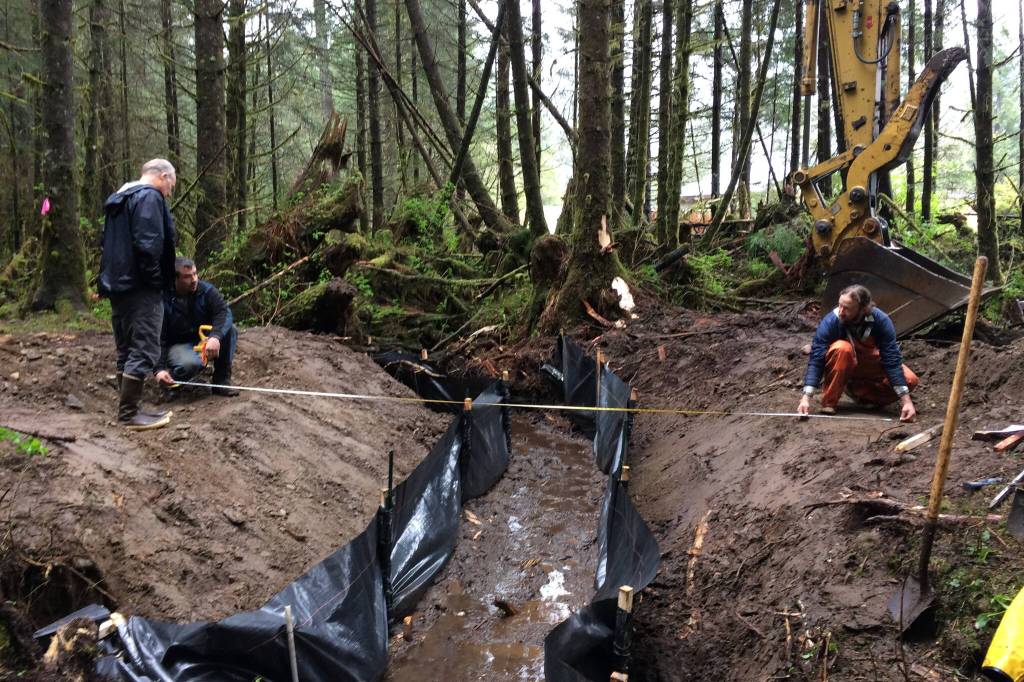
Workers replace a failed log culvert with a small foot bridge over Switzer Creek in a project funded by the U.S. Fish and Wildlife Service, with some materials provided by the Alaskan Brewing Company. The federal government on Thursday announced an additional $1 billion in grants is being made available during the next five years for culvert repairs in areas where fish passage is blocked. (Courtesy Photo / Southeast Alaska Watershed Coalition)

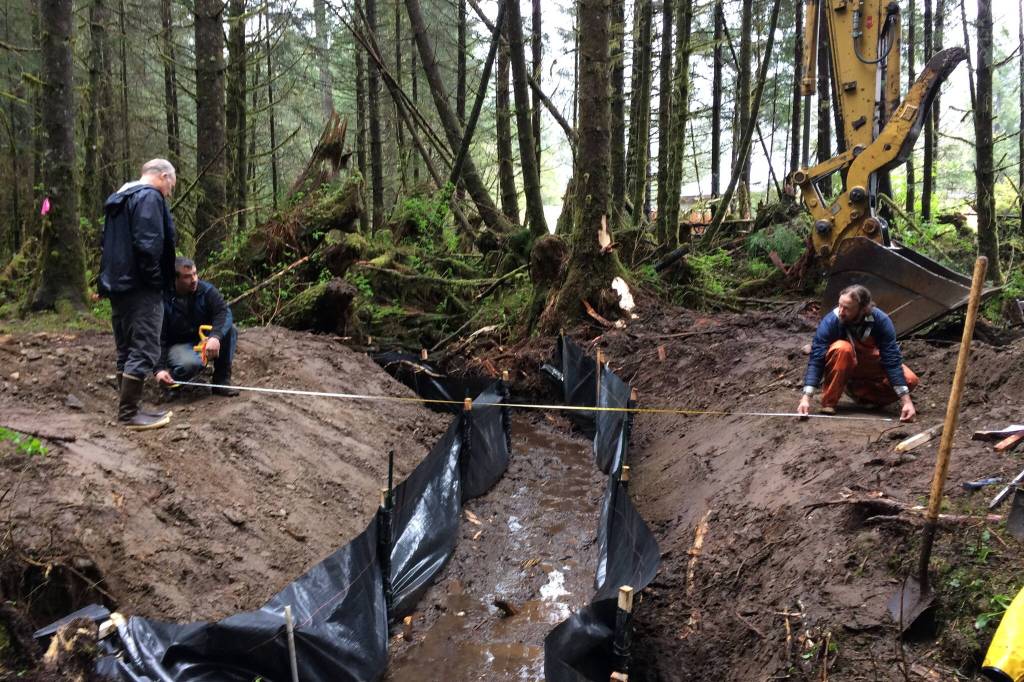
Workers replace a failed log culvert with a small foot bridge over Switzer Creek in a project funded by the U.S. Fish and Wildlife Service, with some materials provided by the Alaskan Brewing Company. The federal government on Thursday announced an additional $1 billion in grants is being made available during the next five years for culvert repairs in areas where fish passage is blocked. (Courtesy Photo / Southeast Alaska Watershed Coalition)

Cash flow: $1B in fed funds for freer fish

Grants to replace culverts impeding streams available to tribal, local and state governments

“Why did the fish cross the road” sounds like the setup for a groan-inducing punchline, but since another $1 billion to help them do it is being provided by the federal government it’s no joke.

The funding will be available for tribal, local and state governments seeking to remove and repair culverts under roads that can prevent fish passage, U.S. Transportation Secretary Pete Buttigieg said Thursday during an event in Washington state. The program stemming from last year’s $1.2 trillion bipartisan infrastructure law is scheduled to allocate $200 million to applicants during each of the next five years.

“With this investment, we’re helping protect local economies that count on healthy fisheries and also make key roads less prone to flooding,” Buttigieg said. “This first-in-its-kind effort will begin to address the longstanding challenges posed by existing culverts for fishing and tribal communities, from the Pacific Northwest to the low-lying communities in the southeast.”

While Buttigieg’s “southeast” wasn’t referring to the Alaska panhandle, there are literally hundreds of “red pipes” in the region the U.S. Forest Service has identified as needing replacement, said Katie Rooks, environmental policy analyst for the Southeast Alaska Conservation Council. While Forest Service officials sought to do six such repairs last year, only two ended up being completed for reasons related to the COVID-19 pandemic.

“I don’t think they can do more than single digits each year because it’s complex,” she said.

Long lists of culvert repair projects exist at the federal, state, tribal and local levels due to the pipes getting clogged or unable to handle higher water flow levels, a situation worsening in many areas due to more extreme conditions caused by climate change, according to the DOT’s online overview of the new grant funding. Many repair projects, in addition to allowing freer fish passage, seek to make the culverts more resilient to increasing flooding.

Among those directly involved with identifying and assisting with the coordination of restoration projects is the Southeast Alaska Watershed Coalition, whose current culvert undertakings include a bridge in Gustavus that was recently repaired, a private driveway in Douglas and another bridge project pending in Klawock that tops the priority list, said Rob Cadmus, the organization’s executive director.

“It’s part of a really important subsistence watershed,” he said. The current culvert is “blocking more than a mile of sockeye salmon spawning habitat.”

The cost of projects can range from roughly $100,000 for a small forestry road in an undeveloped area to a repair under a major freeway crossing a large stream that might cost the entire amount of the new federal program, Cadmus said. As would be expected in a largely rural/remote state, Alaska’s list of projects falls on the lower end of that scale.

Priority will be given to projects that improve passage for fish listed as endangered or threatened species (or have a reasonable chance of being classified as such), that are prey for endangered species, are climate-resilient, and/or open up more than 200 meters of upstream habitat, according to the program’s website.

The application deadline is Feb. 6, 2023.

Contact reporter Mark Sabbatini at mark.sabbatini@juneauempire.com.
More in News

The U.S. Forest Service Porcupine Campground offers gorgeous views of the Kenai Mountains and Turnagain Arm, as seen here on July 20, 2020, near Hope, Alaska. (Photo by Michael Armstrong/Homer News)
Department of Natural Resources seeks public input on proposed Kenai Peninsula State Forest

DNR is gathering community perspectives during several meetings this week.

David Ross is sworn in as Kenai Police Chief on Tuesday, May 31, 2016 at Kenai City Hall. The Alaska Association of Chiefs of Police named Ross the 2025 Police Chief of the Year, recognizing over two decades of service. Photo by Megan Pacer/Peninsula Clarion
Kenai police chief named 2025 Police Chief of the Year

The Alaska Association of Chiefs of Police recognized David Ross for his more than two decades of leadership.

The cast of Nikiski Middle School’s upcoming performance of “Alice in Wonderland” is pictured on Dec. 2, 2025. The upperclassmen-directed play opens on Friday, with additional showtimes Saturday and next weekend. Photo courtesy of Carla Jenness
Nikiski Middle School debuts student-led “Alice in Wonderland”

The show opens on Friday, with additional showtimes this weekend and next.

On Tuesday, the Kenaitze Indian Tribe unveiled Kahtnu Area Transit, a public transportation service open to the entire Peninsula Borough community. Photo courtesy of Kahtnu Area Transit
Kenaitze Indian Tribe unveils Kahtnu Area Transit

The fixed bus route offers 13 stops between Nikiski and Sterling.

The Kenai Chamber of Commerce and Visitor Center hosts the annual Christmas Comes to Kenai on Nov. 28<ins>, 2025</ins>. The beloved event began over 40 years ago, and this year over 1,000 attendees enjoyed hot chocolate, fireworks, pictures with Santa and shopping. Photo courtesy of the Kenai Chamber of Commerce
 Photo courtesy of the Kenai Chamber of Commerce
The Kenai Chamber of Commerce and Visitor Center hosted the annual Christmas Comes to Kenai on Nov. 28. The beloved event began over 40 years ago, and this year over 1,000 attendees enjoyed hot chocolate, fireworks, pictures with Santa and shopping.
Kicking off a month of holiday festivities

Last weekend’s holiday events, including the annual Christmas Comes to Kenai and the Soldotna Turkey Trot, drew folks from all over the Kenai Peninsula.

Starting Dec. 2, Aleutian Airways will offer roundtrip flights between Anchorage and Unalakleet every Tuesday, Friday and Sunday.
Aleutian Airways to offer roundtrip flights between Anchorage and Unalakleet

Starting Dec. 2, Aleutian Airways will offer three roundtrip flights per week.

The Trump administration’s “Big Beautiful Bill” act requires the Bureau of Ocean Energy management to hold at least six offshore oil and gas lease sales in Alaska between 2026-2028 and 2030-2032. The first of these sales — known as “Big Beautiful Cook Inlet 1,” or BBC1— is scheduled for March 2026. Photo courtesy of the Bureau of Ocean Energy Management
Cook Inletkeeper launches petition against federal government

The organization is calling for transparency in Cook Inlet offshore oil and gas sales.

Winter dining has always carried more weight than the menu might suggest. In the off-season, eating out isn’t just about comfort food or convenience; it’s a way of supporting local businesses as they hold steady through the slower months. Photo credit: Canva.
The ripple effect: How local spending builds stronger communities on the Kenai Peninsula

From cozy cafés to fine-dining bistros, purchases made close to home sustain local jobs and services

Courtesy Harvest
On the Kenai Peninsula, a dormant liquefied natural gas export plant could be repurposed to receive cargoes of imported LNG under a plan being studied by Harvest, an affiliate of oil and gas company Hilcorp. The fuel would be transferred from ships to the tanks on the left, still in liquid form, before being converted back into gas and sent into a pipeline.
Utilities say Alaska needs an LNG import terminal. Consumers could end up paying for two.

Planning for two separate projects is currently moving ahead.

Most Read