
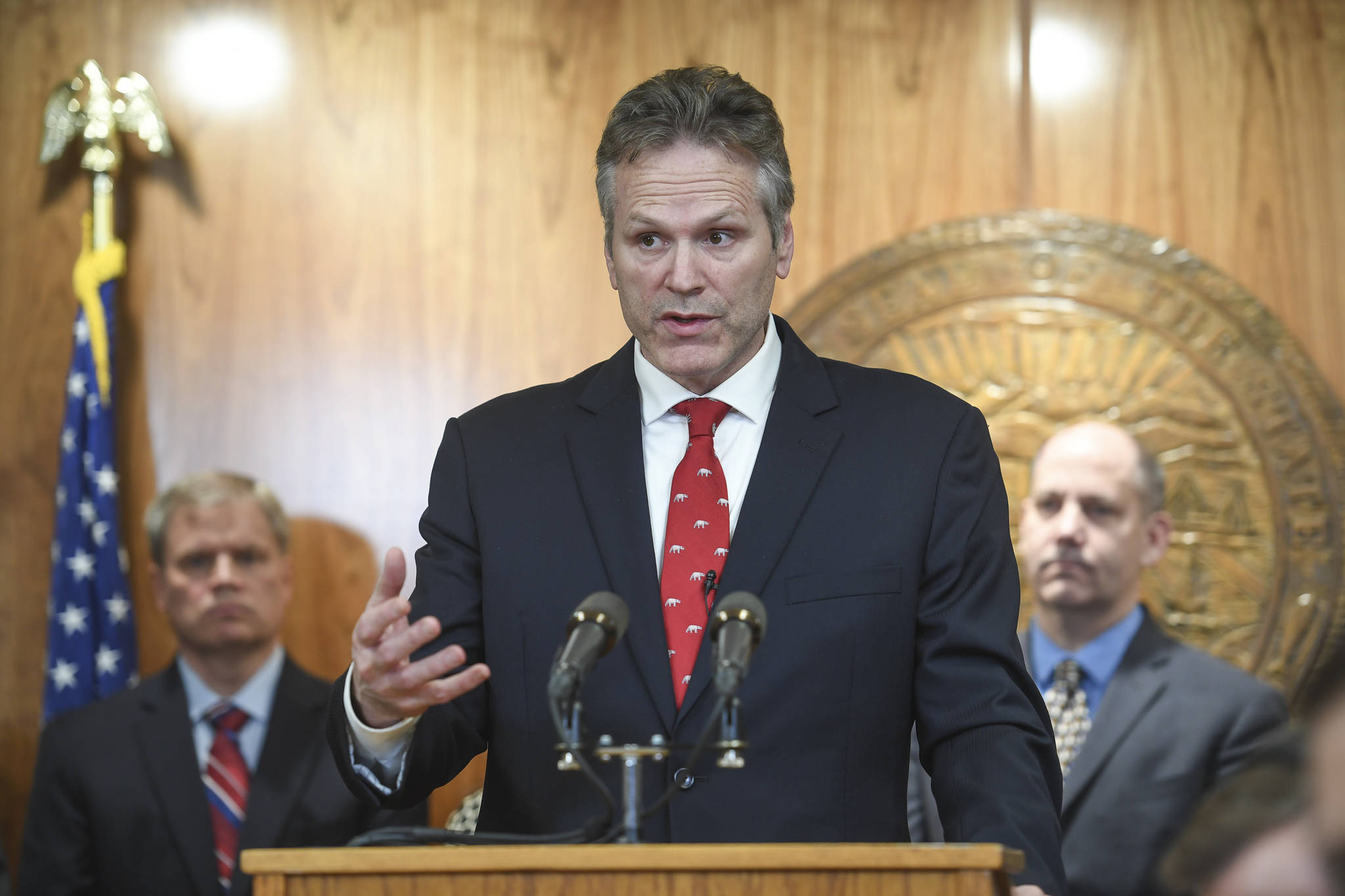
Gov. Mike Dunleavy released a budget Wednesday that avoided last year’s massive cuts, but tasked the Legislature with finding ways of reducing spending in the long-term.
The budget includes mostly flat funding for fiscal year 2021, and would pay each Alaskan a $3,170 dividend from the Alaska Permanent Fund. It includes $4.532 billion unrestricted general funds (UGF), $969 million designated general funds (DGF), $760.3 million other state funds, and $3.9 billion federal funding.
The budget increases for resources to the Department of Public Safety, the Department of Corrections, the Department of Law and the Alaska Court System, according to the budget summary provided by the office of the governor.
The budget pulls about $1.5 billion from the state’s Constitutional Budget Reserve, which is a 30-year-old savings account that held an account balance of $2.16 billion at the end of November, according to the Department of Revenue.
“The budget’s going to rely on the (Constitutional Budget Reserve) this year,” Dunleavy said in his live press conference Wednesday afternoon. “About a $1.5 billion draw from the CBR, which leaves a balance of $540 million.”
Dunleavy said in the press conference that he wants the Legislature to pass laws changing how much programs are funded, including by looking at programs with funding determined by formulas. He also wants an amendment for a constitutional spending limit, the Juneau Empire reported Wednesday.
Rep. Ben Carpenter, R-Nikiski, said in an email Thursday that the proposed budget “effectively continues the unfinished conversation about state spending priorities.” He said the governor’s budget properly places the responsibility for a long-term solution where it belongs, “in the hands of the people’s representatives in the Legislature.”
“My goal for the next session is to see an effective constitutional spending limit enacted and to minimize negative impacts to the private sector economy that will likely result from a push to enact new taxes to balance this budget,” Carpenter said.
Sen. Peter Micciche, R-Kenai/Soldotna, said he was surprised there weren’t more specific goals laid out in the budget but does see it as “the perfect playing field” for legislators to work through what he described as a “self-inflicted recession.”
“At this point it’s going to be tough to find cuts that are supported by the public, so it’s going to be very important that we find a way to regulate spending, and I believe it should be done through constitutional means,” Micciche said. “If we can make sure that our spending lines up with inflation and doesn’t exceed it, it’s going to be a tight few years but I believe we can come out of it in the black, in perpetuity.”
Micciche said that he will be holding community meetings in his district prior to the start of the next legislative session in January in order to hear the priorities of his constituents. Micciche will also be releasing a survey for the public similar to the one he did last year, but this time with more specifics on the areas that people believe should be funded more or less.
“Rather than dropping large cuts, any cuts made need to be creative and responsive to the people’s wishes,” Micciche said. “The public needs to feel like we’re making these cuts with them, not to them.”
Rep. Gary Knopp, R-Kenai/Soldotna, said the governor’s proposed budget “pleasantly surprised” him due to the lack of cuts. He said he’s glad the governor and his administration acknowledged that the proposed budget was just a starting point for negotiations. He said that he hopes lawmakers can come together and achieve good results.
“I’m pretty sure we’re not interested in spending more savings,” Knopp said. “We’re going to try and manage the revenues that we have. But again, that is just the start of the conversation. It’s at least a reasonable start, so I’m happy to see that. At least we’re not going to go in and start doing battle. We’re going to go in and have a civilized conversation with administration this year. I’m encouraged by that.”
The Legislature will have a chance at the budget once the next legislative session begins Jan. 21.
