
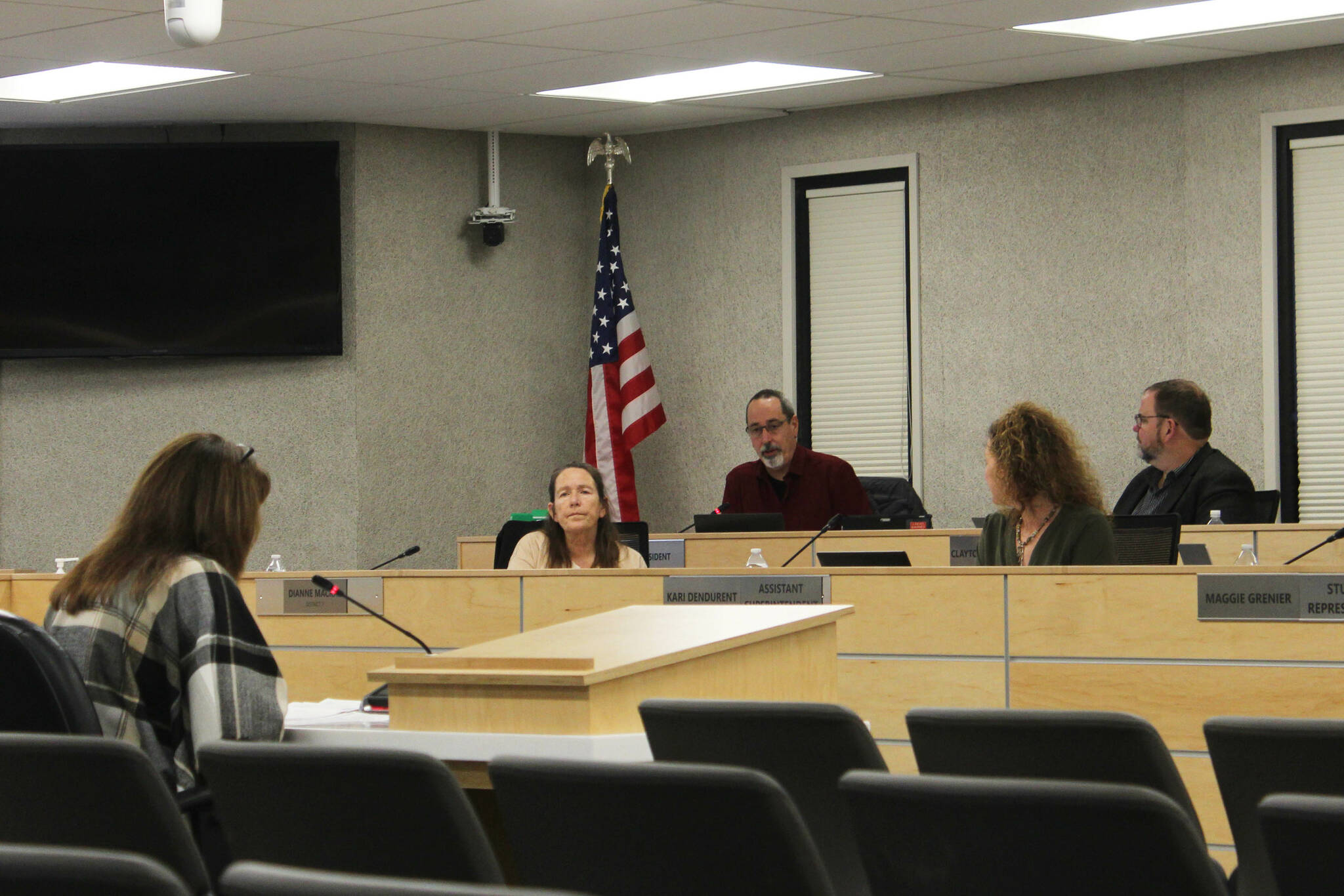
Warnings about the implications and scale of the budget deficit the Kenai Peninsula Borough School District is facing for the upcoming fiscal year again dominated meetings of the board of education, which met Monday in Soldotna.
KPBSD in September warned that it would be starting its budget cycle with a $13 million difference between revenues and expenditures. The announcement came after hearty lobbying of the state Legislature by KPBSD and other school districts for an increase to state funding for K-12 education through the base student allocation, or the amount of money the state gives school districts per student.
State lawmakers failed to adopt an increase to the per-student amount, which has remained almost flat since fiscal year 2017. Instead, they approved $175 million in one-time funds, half of which Gov. Mike Dunleavy vetoed last June.
KPBSD Finance Director Elizabeth Hayes told board members Monday that, of $87.5 million remaining in one-time funds last year, about $5.2 million went to KPBSD and was used to offset last year’s budget deficit, which was also about $13 million. Board members also approved unpopular budget cuts, used the school district’s remaining $6.2 million in federal COVID-19 relief funds and drew from savings to help balance the budget.
For fiscal year 2025, which starts on July 1, 2024, and ends on June 30, 2025, the school district is again facing a $13 million deficit. This year, though, KPBSD doesn’t have any COVID-19 relief funds to fill in gaps and is expecting the amount of money it gets from the state to go down.
The version of the fiscal year 2025 budget presented to board members Monday, Hayes said, is a status-quo budget, meaning a budget that funds everything the school district currently provides.
It assumes that the school district will receive full funding from the Kenai Peninsula Borough for the upcoming fiscal year and does not plan for increases to the amount of money the state spends per student, also called the base student allocation. Because Alaska’s legislative session doesn’t end until May, Hayes said the district doesn’t always know how much money it has to work with as it crafts its budget.
“I cannot budget one-time money in the hopes that this Legislature gives us money again this year,” she said. “We had a reduction in our state revenue — based on our projected enrollment and the loss of one-time money — to the tune of $9.6 million. That’s lower than we’ve ever gotten from the state.”
Part of the reason the amount of state funding for KPBSD is expected to go down is because the number of students enrolled in KPBSD has gone down. For the current fiscal year, the district’s average daily membership was expected to be 8,450 students, while the actual number was 8,302. That resulted in a loss of about $900,000 for the current year.
Another reason state funding is expected to go down is that the state’s assessed value of the Kenai Peninsula Borough’s taxable real and personal property has gone up, which reduces the amount of money the state gives the borough for schools. For the upcoming fiscal year, the assessment is expected to decrease the amount of money the Kenai Peninsula Borough can give the district by about $1.4 million.
Hayes said Alaska school districts are this year to report how much money they have in savings to the State of Alaska. Districts must report the amount twice per year, including once in the middle of the year. Hayes said the midyear report doesn’t accurately reflect how much money KPBSD actually has in savings because it doesn’t account for money that has already been encumbered.
“(In) the first report, it appeared that we had $16 million in unassigned fund balance and I can tell you that is not an accurate number, but that was based on our expenditures at that time,” Hayes said. “Be very cautious if a legislator approaches you with that fund balance number.”
Multiple district staff and board members reiterated calls for an increase to the base student allocation during committee meetings, work sessions and at the board’s regular meeting Monday night.
School Board President Zen Kelly said he’s been accused of working to divide community members as the board mulls budget cuts. The status quo budget, though, contains a $13 million deficit and doesn’t consider increases in costs, such as for utilities, nor any changes to the district’s staff contracts.
“We’re basically in a much worse position than we were last year, and last year’s conversation was really hard,” Kelly said. “I keep getting accused of dividing our community. … I don’t want to divide our community. I don’t want to pit pools and our theaters against our classrooms. That’s not my intent. But our job as a board of nine is to come up with a balanced budget. We’ve got to do it one way or another.”
Board member Jason Tauriainen had similar thoughts, saying that the discrepancies between when the school district sends out contracts and when it learns from the State of Alaska how much money it will receive for the following fiscal year forces the board to make hard decisions.
“Everybody in Nikiski knows I support athletics with a passion and I support the arts passionately,” he said. “I did not want to cut those programs, but in order to get the contracts out we chose hoping that we were going to get that money.”
KPBSD Superintendent Clayton Holland during Monday’s regular school board meeting again urged that the KPBSD community rally around the issue of school funding as state lawmakers again consider changes during the legislative session that starts Jan. 16.
“We’re facing a $13 million budget shortfall for next year, which is about 10% of our general fund budget,” Holland said. “Moving forward, our unified advocacy is going to be crucial.”
More information about the school district’s budget process, including recordings of the district’s Budget 101 series, can be found on the district’s finance website at kpbsd.org/finance.
Reach reporter Ashlyn O’Hara at ashlyn.ohara@peninsulaclarion.com.
