
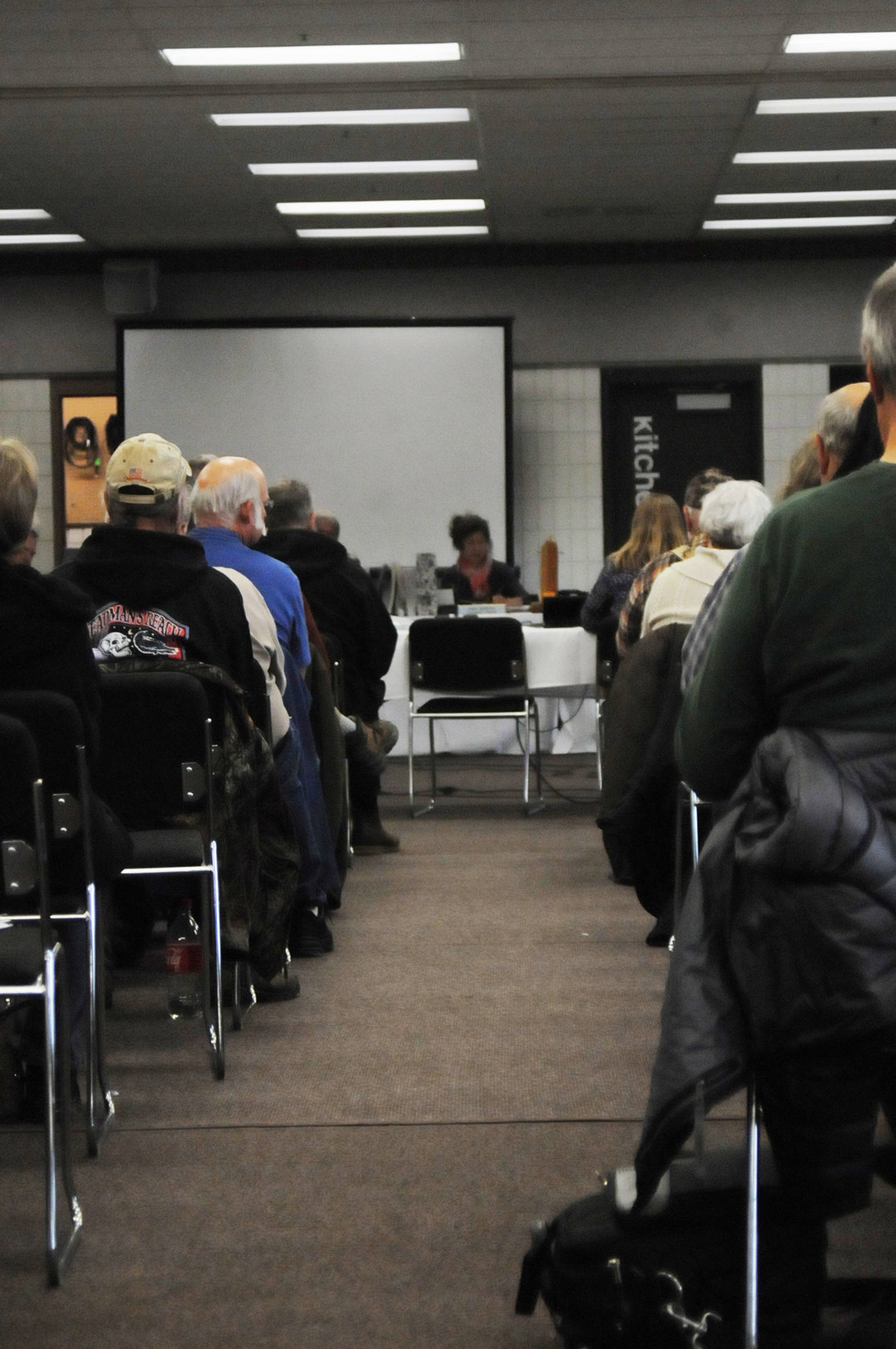
The Board of Fisheries has again snubbed the Kenai Peninsula for its Upper Cook Inlet regulatory meeting in 2020.
The members of the fisheries regulatory board voted during a work session Thursday to hold the next Upper Cook Inlet cycle meeting in Anchorage, as it has done for the past two decades. The decision divided the seven-member board, with four supporting a meeting in Anchorage and three supporting a Soldotna meeting.
Board member Robert Ruffner, who lives on the central Kenai Peninsula, made the case for a Soldotna meeting in part because that’s where most of the stakeholders who attend the Upper Cook Inlet meetings live.
“On all counts, most of the proposals, most of the people, most of the comments were coming from the central Kenai Peninsula,” he said. “There has been a lot of pressure to say, ‘Hey, we would like to see a meeting down here,’ including the local governments have put in letters multiple times … it has been quite a while since we had a regulatory meeting down there.”
Board member Fritz Johnson agreed, saying holding a meeting on the central peninsula would allow members of the community to weigh in on fisheries issues as well as direct stakeholders.
“I think … it’s important to get a hearing from the local business and community and even the people who don’t participate in resource extraction,” he said.
However, other members favored Anchorage as a meeting location. Board member Reed Morisky said he saw Anchorage as a neutral location between the stakeholder areas in Upper Cook Inlet.
“I sympathize with Member Ruffner’s comments, but in my opinion, Anchorage is a neutral location,” Morisky said. “It’s an appropriate place to have a meeting.”
Board member Israel Payton said he favored Anchorage because the conflict between users over the meeting location doesn’t help the discussion.
“I do agree with (Ruffner about) decreasing tension and I think this kind of squabble of where to have the meeting doesn’t ease the tension — it just kind of enflames it,” he said.
Board member Al Cain said he would prefer to see the Upper Cook Inlet meeting location rotate among the central Kenai Peninsula, Anchorage and the Mat-Su Valley.
“(Have the board) go to Kenai-Soldotna for one cycle, Anchorage for another one and Wasilla Palmer for another one,” he said. “That gets the board in your town once a decade.”
Morisky pointed out that future board members could decide to change where the meetings are held, and moving forward with the intention to rotate meeting locations could be nixed by boards down the line. Ultimately, the board voted to hold the meeting in Anchorage 4-3, with Ruffner, Cain and Johnson supporting a meeting in Soldotna.
The meeting location for the Upper Cook Inlet regulatory meeting has been a political football for the last 20 years. The last meeting on the central Kenai Peninsula was held in 1999, when some board members claimed they felt threatened by some attendees’ behavior. The main source of contention is between user groups — as the most populous area in Alaska, Upper Cook Inlet hosts vast numbers of subsistence and sport fishermen as well as multimillion dollar commercial fisheries. Debate at the meetings, which last about two weeks, can be heated.
Multiple groups asked the board to return to the central peninsula in public comments. The cities of Kenai and Soldotna and the Kenai Peninsula Borough submitted a joint letter asking to host the meeting in the community, as did other individual groups.
In the letter from the cities and borough, Kenai Mayor Brian Gabriel, Soldotna Mayor Pete Sprague and Kenai Peninsula Borough Mayor Mike Navarre offered free venue space, free coffee and free transportation, as well as information technology support and a police officer for security. Because the board’s schedule is fluid and changes without warning, people wanting to attend can risk high costs of travel and lodging as well as having to find time off work to attend the meeting and participate in committees.
“… By not holding the UCI meeting on the Kenai Peninsula on a periodic basis, the BOF process itself is rendered less comprehensive and effective,” the letter states. “By minimizing or eliminating input and testimony from residents of the Kenai Peninsula, the BOF is denied the knowledge of individuals who are closest to, and most directly affected by, the fisheries and decisions made by the BOF.”
Another stakeholder group, the Kenai Area Fisherman’s Coalition, asked the board to cycle meetings among the peninsula, Anchorage and the Mat-Su Valley. Most of the attendees are from the peninsula, so it makes sense to host it there, wrote organization chairman Ed Schmitt.
“Last year it cost our organization about $3,200 for three of us to attend the meeting in its entirety,” he wrote. “Roughly 95 percent of the attending audience on any given day after public testimony was from the Kenai area so you can imagine the total financial burden on Kenai area individuals and organizations.”
Only one other meeting location in the 2019–2020 cycle required a vote — Kodiak. The board voted 4-3 to hold the meeting in Kodiak, after a debate on whether to hold the meeting in Anchorage in light of the discussion over how to address the genetic information revealed in a recent study that Kodiak purse seine fishermen harvest large numbers of Cook Inlet-bound sockeye salmon.
The Lower Cook Inlet meeting will be held in Seward and the 2019 worksession will be held in Anchorage.
Reach Elizabeth Earl at elizabeth.earl@peninsulaclarion.com.
