
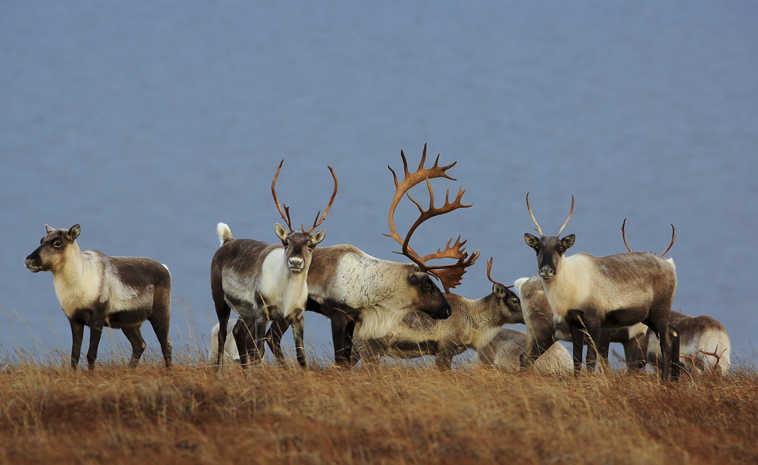
JUNEAU — The size of a large caribou herd in Alaska’s Arctic region has dropped by more 50 percent over the last three years, and researchers who have tentatively ruled out hunting and predation as significant factors for the decline are trying to determine why.
The state’s Central Arctic herd, which roams an area of north-central Alaska about the size of Ohio, hit a peak of about 70,000 caribou in 2010.
It fell to 50,000 in 2013. That year, spring arrived late, meaning caribou had to trudge through snow later than usual at a time when their bodies are already stressed and not getting the grasses they need for nutrition.
Surveys by the Alaska Department of Fish and Game suggest the herd dwindled to about 22,000 caribou this year. There has been a higher than normal rate of death among adult female caribou tracked with radio collars but the reason for that is unclear, said state wildlife biologist Beth Lenart.
The department does not believe hunting is a factor in the decline, saying caribou killed by hunters account for a small portion of overall deaths. The department doesn’t think predation by wolves and bears plays a large role in regulating Arctic caribou herds, and biologists so far have not detected diseases affecting the herd, Lenart said.
Pregnancy rates for female caribou are down slightly since 2013, but not alarmingly so, she said. Fewer adult males are tracked by tracking collars, making it more difficult to spot trends in their numbers. Researchers conclude that caribou have likely died when the sensors on their collars indicate the animals have not moved for at least 12 hours.
Lenart plans to review more closely weather data to see if there might have been changes that biologists hadn’t picked up on, like impacts to vegetation that could affect caribou nutrition. “But other than that, it’s pretty challenging” pinpointing a cause, she said. The caribou’s diet includes mushrooms, lichen, willow leaves, small shrubs and grass-like plants called sedges.
Some of the Central Arctic herd caribou may have joined other herds, though the extent to which that may have happened is unclear, Lenart said. The herd’s territory covers 44,400 square miles from the Arctic coast to the Prudhoe Bay oil fields to the southern side of the Brooks Range of mountains.
It’s not unusual for there to be rises and falls in the numbers of caribou in herds, but Lenart described the change for the Central Arctic herd as “definitely a steep decline.”
While there’s no evidence that climate change is affecting the herd yet, the Arctic is seeing the effects of a warming climate, with polar bears serving as a poster child of sorts for the change.
The International Union for Conservation of Nature estimates the worldwide polar bear population at about 26,000 animals, but there are no comparable historical numbers.
Polar Bears International, an advocacy group, says the bears are traditionally difficult to count because it’s expensive to survey the remote locations where they live. The U.S. government has protected polar bears and some seals, citing long-term threats posed to them by declining sea ice.
The U.S. Geological Survey is trying to understand how future environmental change might affect caribou habitat, food and reproduction.
Longer periods of abundant food could help animals put on more weight for the winter but if summers are very buggy, with insects harassing caribou so much that they can’t eat or must travel long distances to get away, that could have an impact, said Layne Adams, a research wildlife biologist with the U.S. Geological Survey.
Work last summer evaluating caribou range quality compared to the 1970s found no clear changes, Adams said.
Some Alaska hunters are critical of current hunting rules that allow non-residents to kill up to five caribou during the hunting season and allow the killing of females that might have calves depending on them.
“Obviously hunting contributes to decline. Whether it’s a significant factor, we don’t know,” said Mark Richards, executive director of the Resident Hunters of Alaska group. “But you can’t deny that hunting has an effect. Otherwise, they wouldn’t restrict hunting.”
The fish and game department said it plans to recommend an overall reduction in the number of caribou that can be killed from the Central Artic herd because it now has fewer than the 28,000 to 32,000 animals considered its optimal management size.
Adams said the Central Arctic and other herds in the region that have experienced recent declines all reached historic highs prior to their drops.
Two other northern Alaska herds, the Western Arctic and Teshekpuk, have seen declines in recent years, though the Teshekpuk appears to have stabilized, said Lincoln Parrett, a research coordinator with the state Department of Fish and Game.
