
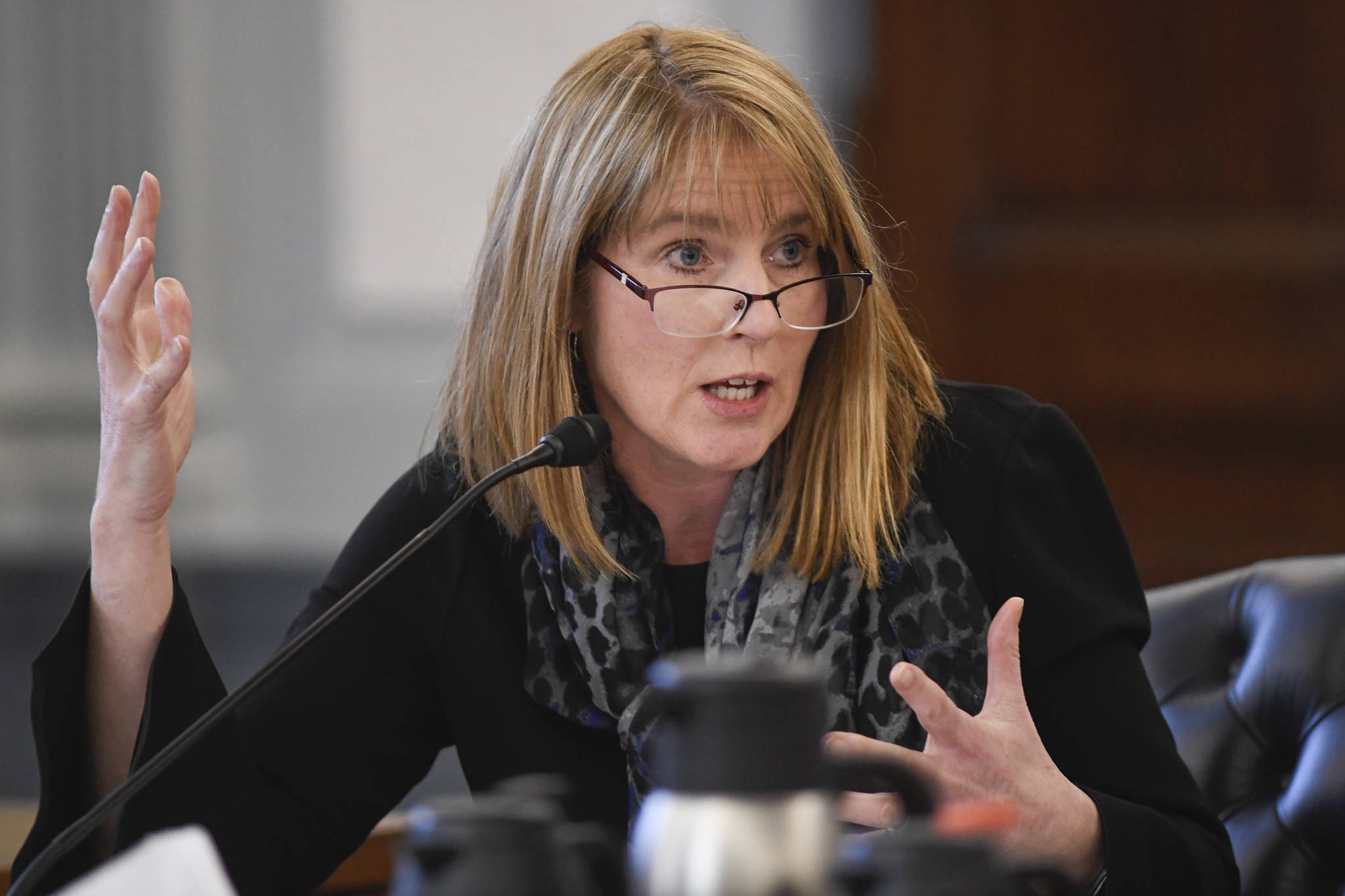
Sen. Natasha Von Imhof, R-Anchorage, pictured here on Feb. 18, asks why adult preventative care was targeted for elimination, saying she has heard from providers that this service often will bring people into a clinic where they can be asked if they have other medical needs. (Michael Penn | Juneau Empire File)                                Sen. Natasha Von Imhof, R-Anchorage, pictured here on Feb. 18, 2019, asks why adult preventative care was targeted for elimination, saying she has heard from providers that this service often will bring people into a clinic where they can be asked if they have other medical needs. (Michael Penn | Juneau Empire File)

Sen. Natasha Von Imhof, R-Anchorage, pictured here on Feb. 18, asks why adult preventative care was targeted for elimination, saying she has heard from providers that this service often will bring people into a clinic where they can be asked if they have other medical needs. (Michael Penn | Juneau Empire File) Sen. Natasha Von Imhof, R-Anchorage, pictured here on Feb. 18, 2019, asks why adult preventative care was targeted for elimination, saying she has heard from providers that this service often will bring people into a clinic where they can be asked if they have other medical needs. (Michael Penn | Juneau Empire File)

Bills look at PFD’s future, spending cap for Legislature

Finance Committee unveils legislation on limiting state spending

The Senate Finance Committee introduced two bills Friday that would cap government spending and establish a 50-50 split between dividends and state expenses from the earnings reserve of the Permanent Fund.

Senate Bill 103 splits revenue from the state’s annual draw of the Permanent Fund’s earnings reserve equally between dividends and state expenses. This bill follows in the footsteps of Senate Bill 26, which passed into law last year.

SB 26 limited the amount the Legislature can pull from the Permanent Fund’s earnings reserve to prevent the government from taking too much from the fund. That bill did not clear up how much of that draw (which is 5.25 percent of the fund’s market value) could go to expenses and how much goes to dividends.

SB 103 seeks to clarify how much of that 5.25 percent can go to state services and how much can go to dividends, so that future dividends are more consistent.

“The Senate is committed to protecting the Permanent Fund and dividends for future generations of Alaskans,” said Sen. Bert Stedman, R-Sitka, co-chair of the Senate Finance Committee, in a press release. “SB 103 creates a revenue limit for government and ensures the dividend program survives by protecting it from being consumed by the operating budget. It draws a line in the sand beyond which the state cannot cross over and take from the dividend.”

[Alaskans weigh cost of protecting PFDs]

Under a 50-50 split, eligible Alaskans would receive approximately $2,340 in their PFD, according to a presentation to the Senate Finance Committee last week.

One of the main themes heard around the Capitol this session is that these budgets and proposals are serving as starting points rather than the final word on the issue. Sen. Natasha von Imhof, R-Anchorage, co-chair of the Senate Finance Committee, characterized SB 103 in the same way.

“SB 103 is a conversation starter,” Von Imhof said in a release from the Senate Finance Committee.

Senate Bill 104, which was also introduced Friday, would cap government spending at $5 billion for the 2021 fiscal year.

“A spending cap gives the Legislature the discipline it needs to keep state spending at a reasonable level from one year to the next,” Von Imhof said in the release.

SB 103 and SB 104 were referred to the Senate Finance Committee where a hearing is scheduled for both bills on Wednesday, April 10.


• Contact reporter Alex McCarthy at amccarthy@juneauempire.com. Follow him on Twitter at @akmccarthy.


More in News

File.
Soldotna aims to change short-term rental tax and permitting

Public hearings for two ordinances addressing existing short-term rental regulations will occur during the next city council meeting on Jan. 14.

Low clouds hang over Cook Inlet north of Anchor Point on Oct. 23, 2025. (Photo by Yereth Rosen/Alaska Beacon)
Inletkeeper condemns federal management of Cook Inlet oil lease sale

The agency alleges an environmental study by the Bureau of Ocean Energy Management was conducted with a “serious” lack of transparency.

The Kenai Chamber of Commerce announced the winners of the 13th annual gingerbread house competition on Dec. 20, 2025. This creation by Sierra won the 2-5 year old age category. Photo courtesy of the Kenai Chamber of Commerce
Wrapping up the holiday season

The Kenai Chamber of Commerce’s Angel Tree program and gingerbread house competition spread Christmas cheer to hundreds locally.

The Challenger Learning Center is seen here in Kenai<ins>, Alaska,</ins> on Sept. 10, 2020. (Photo by Brian Mazurek/Peninsula Clarion)
Kenai City Council considers possible uses for Challenger Center

One option would assess the facility’s potential as the new public safety building.

A snowmachine rider takes advantage of 2 feet of fresh snow on a field down Murwood Avenue in Soldotna, Alaska, on Monday, Dec. 12, 2022. (Jake Dye/Peninsula Clarion)
Ice fishing opens on some Kenai National Wildlife Refuge lakes

Snowmachines are permitted for ice fishing access on Hidden, Kelly, Petersen, Engineer and Watson lakes.

The waters of Cook Inlet lap against Nikishka Beach in Nikiski, Alaska, where several local fish sites are located, on Friday, March 24, 2023. (Jake Dye/Peninsula Clarion)
Kenai asks for fishery economic disaster declaration

The Kenai City Council requested that Gov. Dunleavy declare a disaster and support a recovery plan for the Upper Cook Inlet East Side Set Net fishery.

The Kenai Peninsula Borough School District logo. (Photo courtesy of Kenai Peninsula Borough School District)
District superintendent dispels rumors about student construction

Superintendent Clayton Holland said student involvement in Seward High School construction is “based on rumor, not fact.”

Anchorage-based singer and songwriter Keeley Boyle is pictured in Anchorage<ins>, Alaska,</ins> on Sept. 26, 2023. Boyle, who was raised on the Kenai Peninsula, will use a $10,000 grant she received from the Rasmuson Foundation to create an album of songs about her grandparents’ home in Nikiski. Photo courtesy of Jovell Rennie
Musician hailing from Kenai receives Rasmuson grant

Keeley Boyle will record an album of songs about her grandparents’ Nikiski home.

Commercial fishing and recreational vessels are docked in the Homer harbor on Oct. 23, 2025. The commercial fishing industry endured a series of challenges over the year, some of them imposed by the new Trump administration. (Photo by Yereth Rosen/Alaska Beacon)
Alaska fisheries in 2025: turmoil, economic and environmental challenges and some bright spots

NOAA cuts, economic headwinds and invasive species pose problems, but there was some recovery in crab stocks and salmon harvests.

Most Read