
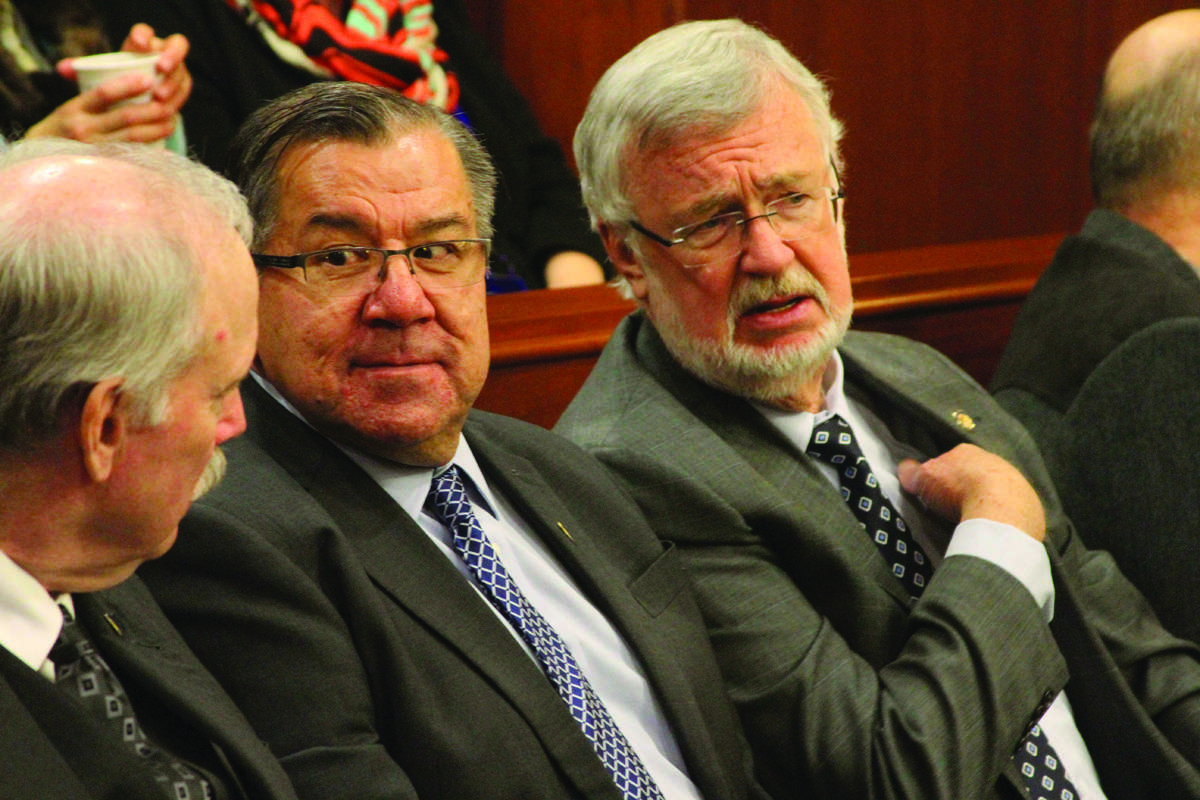
Heading into his 19th year as a state senator, Sen. Gary Stevens, R-Kodiak, has some advice for Homer’s newest legislator, Rep.-elect Sarah Vance. She’s the third Homer representative he will work with after Rep. Drew Scalzi and Rep. Paul Seaton, who Vance defeated to win election to District 31.
“It’s probably good to be quiet for awhile, just to figure out the lay of the land and how things work,” Stevens said. “… Make sure what’s going on and then take advice from your senator, too.”
Stevens, 77, met with Homer News staff last Thursday on a trip to Homer. He had planned to visit earlier, but had to cancel because his flight couldn’t make it into Homer. Stevens also met with the Homer Chamber of Commerce and Visitor Center, the North Pacific Fisheries Association, local school principals, and the Homer City Council, and stopped by an open house at the Legislative Information Office.
When he heads to Juneau on Jan. 15, Stevens will be working with new Gov. Mike Dunleavy, a slightly different Senate, and a House still unorganized as a seat that Republican Bart LeBon of Fairbanks won by one vote faces a challenge in the Alaska Supreme Court. Rep. Gary Knopp, R-Soldotna, also has said he won’t join a potential 21-member Republican majority and seeks to form a bipartisan coalition.
Fellow Republican Dunleavy should be allowed to try to do what he promised and what 51 percent of the voters who elected him expect, Stevens said: fund the Permanent Fund Dividend to the traditional formula, cut government spending and don’t create new revenues through taxes like an income or sales tax.
“I think you have to let Dunleavy be Dunleavy,” Stevens said. “He won resoundingly. We have to support him in so many ways.”
The PFD and how to fund it will be a big issue, Stevens said. The state has about $16 billion in the Permanent Fund reserve that can be used to fund a $3,000 PFD, though that’s at the cost of inflation proofing that hasn’t been paid for a few years and hasn’t allowed the fund to grow as much as it could. The state also once had $16 billion in the Constitutional Budget Reserve, a rainy-day account built up during years of high oil prices.
“We’ve spent it down to about $2 billion now,” Stevens said. “Now we’ve got in a really tough spot where we hardly have any savings left.”
What will be harder is to fund a $6,000 retroactive PFD to pay back citizens lower PFDs from when former Gov. Walker vetoed part of a PFD and the Legislature used a portion of it to help fund government.
“That will be a killer,” Stevens said of a $6,000 PFD. “I understand why he (Dunleavy) wants it, I understand why the public wants it, but I don’t think folks realize what a dangerous position that’s putting us in in terms of paying for government.”
Dunleavy’s promise to cut government also needs to be considered.
“We have to let him try,” Stevens said. “…I had a friend tell me the budget will be a jaw-dropping budget.”
The Legislature most likely will resist cuts, he said.
“I can’t defend everything in that budget, but everything in the budget is something someone feels is important,” Stevens said.
Dunleavy has the upper hand and an important tool: the line-item veto.
“Say he cuts public radio,” Stevens said. “ … We put it back in. He gets the line-item veto. The only only way we can override him is with a three-quarters vote. We have 20 members. I don’t think we can even get 15 votes.”
One potential cut Stevens said he thinks Dunleavy will try is the Department of Health and Social Services budget, one of the biggest parts of the budget.
“We spend a lot of money on social services,” Stevens said. “I don’t know that it’s misspent, but I think we will see some cuts there.”
One worry Stevens said he has is cuts to the Alaska Marine Highway System. Coastal communities like Homer, Kodiak, Seward, Dutch Harbor, and the Southeast cities understand its importance.
“It’s really crucial. It is a highway,” he said. “… I know it’s going to be a difficult issue because folks in Anchorage, the Valley and Fairbanks are not particularly concerned about the Marine Highway System.”
The Legislature this session won’t be likely to increase oil taxes or consider new revenue taxes like an income tax or a sales tax, Stevens said. The public voted for Dunleavy so there wouldn’t be an income tax. Some day new revenues will be necessary, Stevens said.
“I’m a realist. If you look at our savings and it’s gone, the only way to get revenue is an income or sales tax,” he said. “… If we keep spending down our savings, in four or five years we’re going to have to face the piper.”
Stevens said he enjoyed knowing and working with the previous two Homer representatives, Scalzi and Seaton.
“Drew was just the best friend. You meet somebody, you think you knew him all your life,” he said. “I think the world of Paul. … He did a great job. I depended on him of course to tell me what the needs of Homer were.”
With Vance, Stevens said he also hopes to have a good relationship.
“I know it has to be,” he said. “There are some senators who don’t get along with their reps. It’s a terrible mistake. If you want to protect your community, you have to make sure that you get along, that you work together. … I’m looking forward to working with her.”
As the Legislature grinds through the next session, Stevens said he expects it to end by the 120-day limit on when per diem gets paid. Under a new law, legislators can’t collect per diem that pays food and lodging past 120 days. That will make it tough for Legislators, especially considering Juneau’s high cost of living.
“It is expensive,” Stevens said. “…If you have to live in Juneau without per diem, it’s not doable.”
Beyond the end of the session, Steven said he wasn’t yet ready to answer the big question about his job: Is he going to run for re-election?
“I’m keeping it … sort of thinking about it,” he said. “It’s been a great experience. It really is an honor. I’ve learned so much. I really love it.”
Reach Michael Armstrong at marmstrong@homernews.com.
