
Gov. Mike Dunleavy’s budget proposes making a lot of cuts. There’s been outcry. There have been protests.
But has there been enough analysis? The budget director with over 20 years of experience working in Alaska thinks not, and that there needs to be more caution in accepting these cuts.
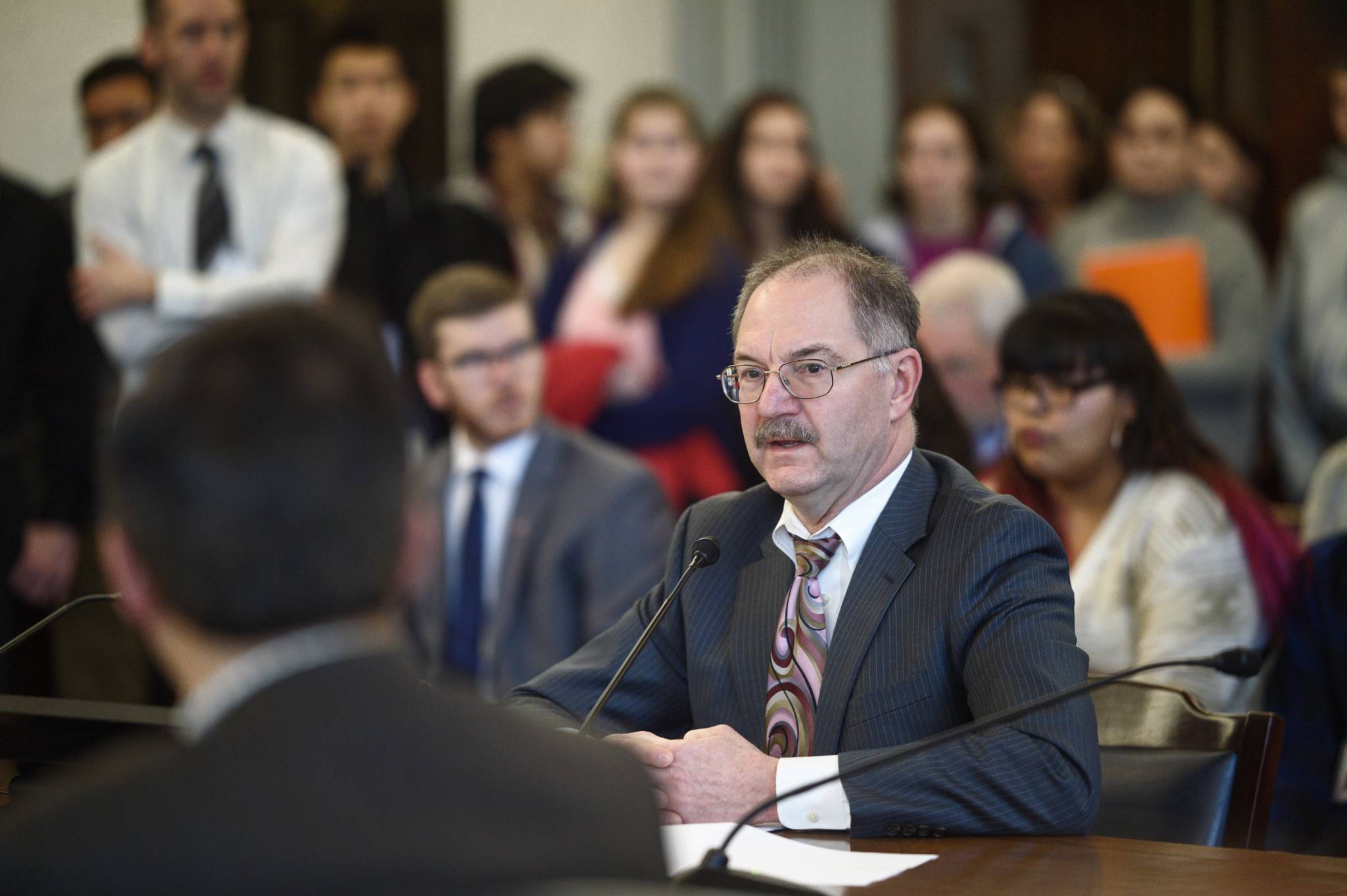
David Teal, the budget director of the non-partisan Legislative Finance Division, presented an overview of the governor’s proposed FY20 budget and said there is no way that the Office of Budget and Management or the Legislature could possibly analyze the effects of the budget given that the session is almost halfway over already.
[Economy to take a hit, no matter the budget outcome]
“It seems many of you share my disappointment in the lack of analysis done to support the government’s proposals,” Teal said. “I think (the) budget shouldn’t simply be a math problem … you cannot make good policy or budget decisions without full information. All cuts are not equal,” he said, adding that the OMB has justified many of the cuts by stating the most important thing is to address the deficit, and that it is not their job to do analysis of the effects on independent bodies such as municipalities or school districts.
He said the Legislature would have a difficult time even if all the analysis that is needed to make this decision was available right now.
“Maybe creating chaos is just a clever way to force a conversation that needs to happen to move forward,” said Teal. “Maybe people are going to see these budget reductions that are required to pay a $3,000 dividend, and they’re going to come in and plead to reduce the dividend to avoid the consequences of the budget cuts.”
When questioned about this statement in a later interview with the Empire, the governor said chaos was not his intention.
“Chaos — that wasn’t the intent … but certainly the budget is a conversation to have with the people of Alaska and the Legislature as to what we value, what we want to fund, what we can fund and how we fund it,” Dunleavy said.
In order to be more transparent, Teal said he thinks that all revenues and expenditures should be included in the budget discussion, including the fiscal notes of the governor’s proposed crime bills and the separate amendments the governor proposed to pay out a super-sized dividend over three years.
“I look at the budget as it’s not simply the operating capital bill — the budget is the full fiscal plan,” Teal said. “It includes all revenue measures. It includes any of the bills that might affect either appropriations themselves or the fiscal notes.”
Dunleavy said Tuesday afternoon others are going to propose to bridge the deficit using the PFD or taxes, but he said he thinks this causes more problems.
“Alaska with 730,000 people, high unemployment rate, lack of investment in the state of Alaska, I think if we go down the road of taxing or taking money out of the pockets of Alaskans, we’ll see more of an exodus out of the state,” Dunleavy said. “If we start taking more money out of the pockets of Alaskans, it’s going to force more people to decide if they want to stay or go, and I believe that more and more people will leave.”
Sen. Donald Olson, D-Golovin, said in the morning meeting the budget the governor proposed was unrealistic. Teal said the cuts themselves aren’t unrealistic, but approving them without analysis is.
“The unrealistic part to me is any expectation that you have enough time to really consider these, especially considering the fact that the information is not available to you now,” Teal said.
Alaska is really looking at losing about 5,000 jobs, not the roughly 700 number that OMB originally gave the day of the budget release, Teal said.
“I consider government to be state, local and school districts, because schools are funding by the government,” Teal said. “You’re looking at significant job loss. And I don’t know when the economists are coming, but it will be interesting.”
The committee also discussed the proposed cuts to the Alaska Marine Highway System.
“The ferry system has stopped taking reservations after Sep. 30,” said Sen. Bill Wielechowski, D-Anchorage. “Can the governor just do that on his own? We’re the appropriating body,” he said, noting they haven’t passed any legislation to stop funding the ferries.
Teal said whether or not Gov. Mike Dunleavy can, he did.
He said much of the balancing of the budget comes by shifting the burden to municipalities.
“If revenue is volatile, how will the budget be more predictable than oil prices themselves?” Teal said. “Are we going to cut the budget every time revenue from oil falls? I don’t see how saying expenditures equal revenue makes the budget any more predictable. It seems to me the governor took two of the three normal budget balancing tools (adding revenue and pulling money from reserves) off the table.”
• Contact reporter Mollie Barnes at mbarnes@juneauempire.com or 523-2228.
