
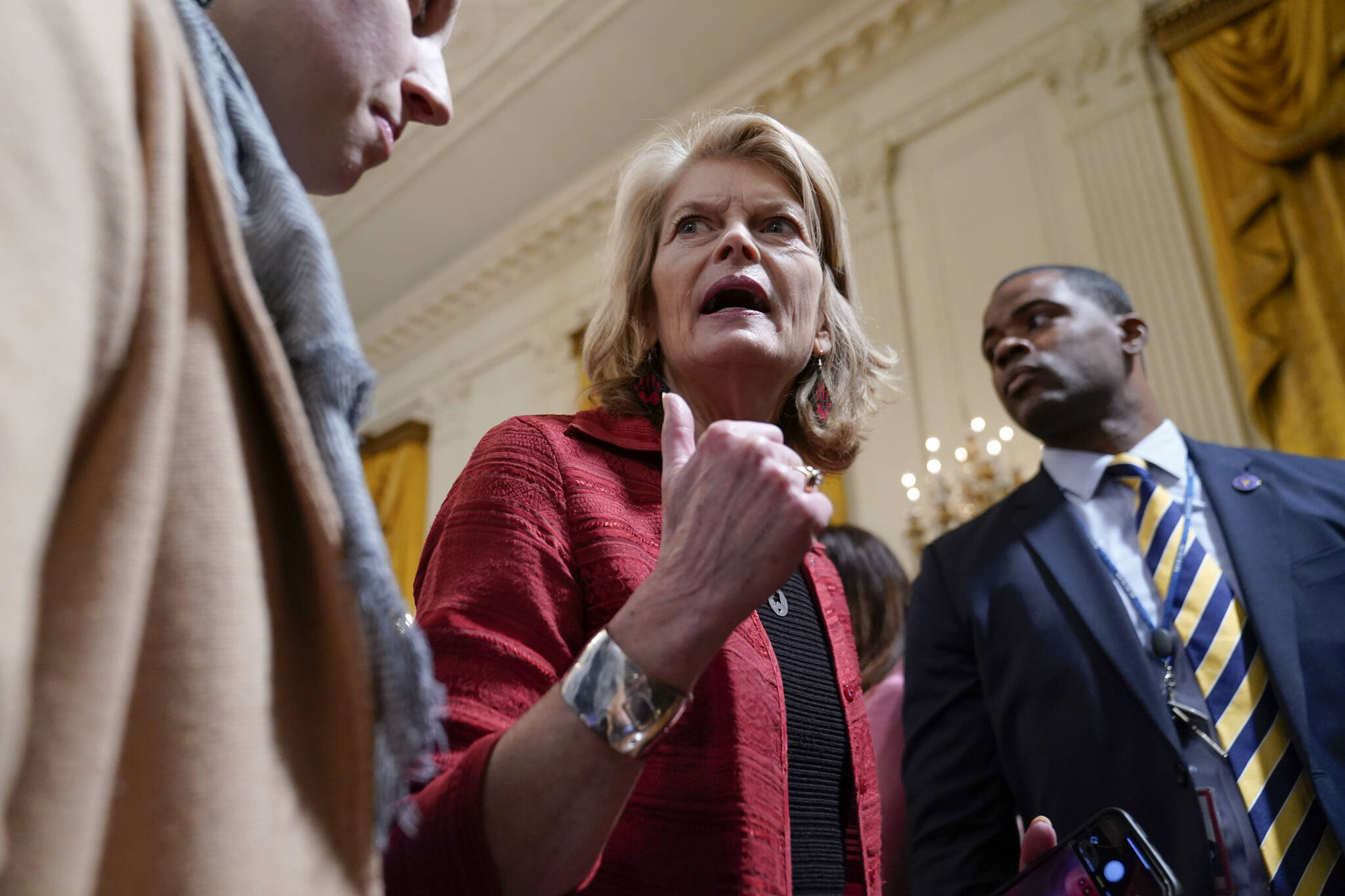
Sen. Lisa Murkowski, R-Alaska, talks with a reporter after attending at an event to celebrate the reauthorization of the Violence Against Women Act in the East Room of the White House, Wednesday, March 16, 2022, in Washington. Murkowski spoke the the Alaska House of Representatives Special Committee on Tribal Affairs Thursday about what the bill means for Alaska. (AP Photo/Patrick Semansky)

Sen. Lisa Murkowski, R-Alaska, talks with a reporter after attending at an event to celebrate the reauthorization of the Violence Against Women Act in the East Room of the White House, Wednesday, March 16, 2022, in Washington. Murkowski spoke the the Alaska House of Representatives Special Committee on Tribal Affairs Thursday about what the bill means for Alaska. (AP Photo/Patrick Semansky)

Alaskans laud Violence Against Women Act reauthorization

Reauthorization will create pilot program for Alaskan tribal courts

Alaskans are lauding the reauthorization of the Violence Against Women Act included in the $1.5 trillion omnibus spending bill recently signed into law by President Joe Biden.

The bill was celebrated during a ceremony at the White House Wednesday where tribal leaders from across the country were guests, including Central Council of the Tlingit and Haida Indian Tribes of Alaska President Richard Chalyee Éesh Peterson. Peterson and his delegation posted pictures of themselves to social media, including a photo of Peterson shaking hands with Biden.

The reauthorization was the work of a bipartisan group of lawmakers including U.S. Sen. Lisa Murkowski, R-Alaska. VAWA was initially enacted in 1994, and it has been reauthorized several times over the ensuing decades.

Speaking to the Alaska House of Representatives Special Committee on Tribal Affairs on Thursday morning, Murkowski called the reauthorization “an extraordinary step forward,” and said it was the result of several years of work. The bill includes a provision for a pilot program for Alaska tribes to exercise jurisdiction over non-tribal citizens for certain crimes.

“We know the status quo is not working,” Murkowski said. “The president yesterday said this legislation is not changing the law, we’re changing the culture. We know that we have to secure enduring policy changes, that’s going to require greater resources.”

Murkowski said the pilot program would allow a limited number of tribes to exercise jurisdiction over non-tribal citizens for crimes related to domestic violence and obstruction of justice. According to the senator, participating tribal courts will have to apply to the U.S. Department of Justice and be able to ensure civil protections enshrined in the U.S. Constitution and the Indian Civil Rights Act.

Thursday’s committee meeting also featured testimony from local experts about how the state can improve protections in Alaska Native villages. Presiding Judge with Tlingit and Haida Debra O’Gara told members Alaska ranks as one of the most dangerous places in the world for women, and Indigenous women are overrepresented in statistics.

Gara said she had previously testified to the committee about the “interconnection between domestic violence, sexual assault and the and the disproportionality of high numbers of missing and murdered Indigenous women, girls, men and our LGBT relatives.”

The reauthorization continues and in some cases increases funding for extant programs, and Murkowski said it will provide additional federal resources to help tribes and the State of Alaska to coordinate on public safety.

“Yes it’s challenging,” Murkowski said. “Jurisdictional issue makes it complex and sometimes confusing, but that should never deny safety or justice.”

Both Murkowski and U.S. Rep. Don Young, R-Alaska, voted for the omnibus spending bill in which the reauthorization was included, but Sen. Dan Sullivan, R-Alaska, did not. In a statement, Sullivan said there was much in the bill he supported including the VAWA reauthorization.

“However, this is a more than $1.5 trillion dollar bill, negotiated and agreed to only by House and Senate leadership, and their staff. It is 2,700 pages long, with thousands more pages in supporting documentation, and senators were provided a little over one day to review and analyze it,” Sullivan said in a statement. “Therefore, I could not support such a bill on which my staff and I were unable to do our appropriate and necessary due diligence. We need to fix our broken budget process that does not serve our military, government or the American people well.”

Contact reporter Peter Segall at psegall@juneauempire.com. Follow him on Twitter at @SegallJnuEmpire.

More in News

File.
Soldotna aims to change short-term rental tax and permitting

Public hearings for two ordinances addressing existing short-term rental regulations will occur during the next city council meeting on Jan. 14.

Low clouds hang over Cook Inlet north of Anchor Point on Oct. 23, 2025. (Photo by Yereth Rosen/Alaska Beacon)
Inletkeeper condemns federal management of Cook Inlet oil lease sale

The agency alleges an environmental study by the Bureau of Ocean Energy Management was conducted with a “serious” lack of transparency.

The Kenai Chamber of Commerce announced the winners of the 13th annual gingerbread house competition on Dec. 20, 2025. This creation by Sierra won the 2-5 year old age category. Photo courtesy of the Kenai Chamber of Commerce
Wrapping up the holiday season

The Kenai Chamber of Commerce’s Angel Tree program and gingerbread house competition spread Christmas cheer to hundreds locally.

The Challenger Learning Center is seen here in Kenai<ins>, Alaska,</ins> on Sept. 10, 2020. (Photo by Brian Mazurek/Peninsula Clarion)
Kenai City Council considers possible uses for Challenger Center

One option would assess the facility’s potential as the new public safety building.

A snowmachine rider takes advantage of 2 feet of fresh snow on a field down Murwood Avenue in Soldotna, Alaska, on Monday, Dec. 12, 2022. (Jake Dye/Peninsula Clarion)
Ice fishing opens on some Kenai National Wildlife Refuge lakes

Snowmachines are permitted for ice fishing access on Hidden, Kelly, Petersen, Engineer and Watson lakes.

The waters of Cook Inlet lap against Nikishka Beach in Nikiski, Alaska, where several local fish sites are located, on Friday, March 24, 2023. (Jake Dye/Peninsula Clarion)
Kenai asks for fishery economic disaster declaration

The Kenai City Council requested that Gov. Dunleavy declare a disaster and support a recovery plan for the Upper Cook Inlet East Side Set Net fishery.

The Kenai Peninsula Borough School District logo. (Photo courtesy of Kenai Peninsula Borough School District)
District superintendent dispels rumors about student construction

Superintendent Clayton Holland said student involvement in Seward High School construction is “based on rumor, not fact.”

Anchorage-based singer and songwriter Keeley Boyle is pictured in Anchorage<ins>, Alaska,</ins> on Sept. 26, 2023. Boyle, who was raised on the Kenai Peninsula, will use a $10,000 grant she received from the Rasmuson Foundation to create an album of songs about her grandparents’ home in Nikiski. Photo courtesy of Jovell Rennie
Musician hailing from Kenai receives Rasmuson grant

Keeley Boyle will record an album of songs about her grandparents’ Nikiski home.

Commercial fishing and recreational vessels are docked in the Homer harbor on Oct. 23, 2025. The commercial fishing industry endured a series of challenges over the year, some of them imposed by the new Trump administration. (Photo by Yereth Rosen/Alaska Beacon)
Alaska fisheries in 2025: turmoil, economic and environmental challenges and some bright spots

NOAA cuts, economic headwinds and invasive species pose problems, but there was some recovery in crab stocks and salmon harvests.

Most Read