
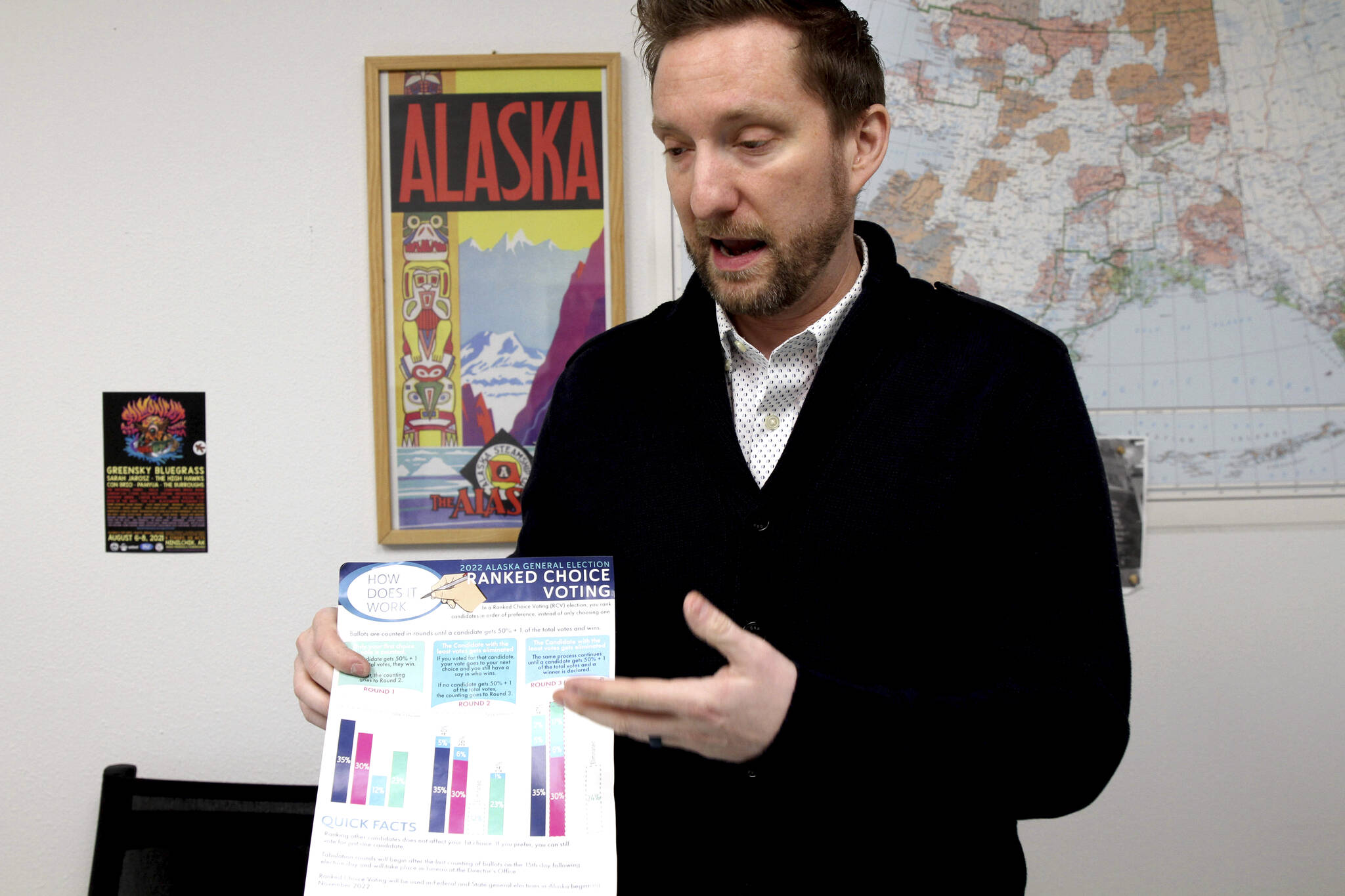
Former Alaska lawmaker Jason Grenn holds an Alaska Division of Elections brochure explaining ranked choice voting at his office in Anchorage, Alaska, on Friday, Jan. 14, 2022. The Alaska Supreme Court has upheld as valid a voter-approved election system that would end party primaries in the state and institute ranked choice voting in general elections. A brief order released Wednesday, Jan. 19, 2022, affirmed a lower court ruling from last year. (AP Photo/Mark Thiessen, File)

Former Alaska lawmaker Jason Grenn holds an Alaska Division of Elections brochure explaining ranked choice voting at his office in Anchorage, Alaska, on Friday, Jan. 14, 2022. The Alaska Supreme Court has upheld as valid a voter-approved election system that would end party primaries in the state and institute ranked choice voting in general elections. A brief order released Wednesday, Jan. 19, 2022, affirmed a lower court ruling from last year. (AP Photo/Mark Thiessen, File)

Alaska high court upholds ranked choice voting system

The voter-approved election system would end party primaries in the state

By Becky Bohrer

Associated Press

JUNEAU — The Alaska Supreme Court on Wednesday upheld as valid a voter-approved election system that would end party primaries in the state and institute ranked choice voting in general elections.

A brief order affirmed a lower court ruling from last year. A fuller opinion explaining the Supreme Court’s decision was expected later.

The ruling comes one day after the justices heard arguments in the case. The new system, narrowly approved by voters in 2020, is unique among states and set to be used for this year’s elections. It is viewed by supporters as a way to encourage civility and cooperation among elected officials.

Under the open primary, the top four vote-getters in a race, regardless of party affiliation, would advance to the general election, where ranked voting would be used.

Attorney Kenneth Jacobus; Scott Kohlhaas, who unsuccessfully ran for the state House in 2020 as a Libertarian; Bob Bird, chair of the Alaskan Independence Party; and Bird’s party sued in late 2020 over the initiative, challenging its constitutionality.

Jacobus, who argued the case before the Supreme Court, said Wednesday he was disappointed with the outcome.

“But Alaskans are going to have what they voted for. They voted for it, so they got it, whether people understood it or not,” he said. “And we’re going to have to live with it.”

Jason Grenn, a Republican-turned-independent former state lawmaker and a sponsor of the initiative, said backers can now focus more attention on voter education and outreach ahead of the elections. He said the decision removes any lingering questions about whether the new system will be used this year.

A message seeking comment was sent to a spokesperson for the state Department of Law, which defended the measure’s constitutionality. Laura Fox, an attorney for the state, and Scott Kendall, an attorney for the group behind the initiative, made arguments in support of the system on Tuesday.

Opponents of the measure argued it would dilute the power of political parties and raised constitutional questions, including around the use of ranked voting for governor.

Kendall, who helped write the initiative, told justices Tuesday that political parties “have no right to be gatekeepers to the ballot.”

He said the state and country are “at a turning point,” politically and economically, and that Alaska voters created a “new electoral system that they maybe believe is an attempt to turn the tide toward reason and compromise. They have the right to do that. They have the right to make that experiment.”

Grenn recently told The Associated Press that Alaska was a test case “in a major way” for similar efforts being considered in other states, including Nevada.

He said the system would reward candidates who are willing to work with others, no matter their party affiliation, and that voters will be “empowered in a different way.”

Alaska lawmakers have a history of crossing party lines to form majorities in the state House or Senate. Republicans hold a majority of seats in both chambers but two Republicans in the House have joined with Democrats and independents to form a slim majority there.

This year’s elections feature races for U.S. Senate, Alaska’s lone seat in the U.S. House of Representatives and governor.

Under the new system, candidates for governor and lieutenant governor will run as a team from the outset. Previously, winners of their respective party primaries for each office were paired for the general election.

Under a redistricting plan that is the subject of litigation, all but one of the Legislature’s 60 seats also would be up for election this year.

The top office holders in Alaska — the members of the state’s congressional delegation and governor — are all Republicans. The largest group of registered voters in the state is listed as “undeclared,” according to the Alaska Division of Elections.

More in News

The Challenger Learning Center is seen here in Kenai<ins>, Alaska,</ins> on Sept. 10, 2020. (Photo by Brian Mazurek/Peninsula Clarion)
Kenai City Council considers possible uses for Challenger Center

One option would assess the facility’s potential as the new public safety building.

A snowmachine rider takes advantage of 2 feet of fresh snow on a field down Murwood Avenue in Soldotna, Alaska, on Monday, Dec. 12, 2022. (Jake Dye/Peninsula Clarion)
Ice fishing opens on some Kenai National Wildlife Refuge lakes

Snowmachines are permitted for ice fishing access on Hidden, Kelly, Petersen, Engineer and Watson lakes.

The waters of Cook Inlet lap against Nikishka Beach in Nikiski, Alaska, where several local fish sites are located, on Friday, March 24, 2023. (Jake Dye/Peninsula Clarion)
Kenai asks for fishery economic disaster declaration

The Kenai City Council requested that Gov. Dunleavy declare a disaster and support a recovery plan for the Upper Cook Inlet East Side Set Net fishery.

The Kenai Peninsula Borough School District logo. (Photo courtesy of Kenai Peninsula Borough School District)
District superintendent dispels rumors about student construction

Superintendent Clayton Holland said student involvement in Seward High School construction is “based on rumor, not fact.”

Anchorage-based singer and songwriter Keeley Boyle is pictured in Anchorage<ins>, Alaska,</ins> on Sept. 26, 2023. Boyle, who was raised on the Kenai Peninsula, will use a $10,000 grant she received from the Rasmuson Foundation to create an album of songs about her grandparents’ home in Nikiski. Photo courtesy of Jovell Rennie
Musician hailing from Kenai receives Rasmuson grant

Keeley Boyle will record an album of songs about her grandparents’ Nikiski home.

Commercial fishing and recreational vessels are docked in the Homer harbor on Oct. 23, 2025. The commercial fishing industry endured a series of challenges over the year, some of them imposed by the new Trump administration. (Photo by Yereth Rosen/Alaska Beacon)
Alaska fisheries in 2025: turmoil, economic and environmental challenges and some bright spots

NOAA cuts, economic headwinds and invasive species pose problems, but there was some recovery in crab stocks and salmon harvests.

Cook Inlet near Clam Gulch is seen on Oct. 23, 2025. (Photo by Yereth Rosen/Alaska Beacon)
Disputed oil lease sale in Alaska’s Cook Inlet upheld in new Trump administration decision

After completing a court-ordered environmental study, the Bureau of Ocean Energy Management said no changes are needed for the 2022 sale that drew just one bid.

The Kenai Peninsula Borough School District logo.
School district projects $7.5 million budget deficit for fiscal year 2027

Decreased enrollment and increased property values mean less local and state funding.

The sign in front of the Homer Electric Association building in Kenai, Alaska as seen on April 1, 2020. (Photo by Brian Mazurek/Peninsula Clarion)
Homer Electric Association announces rate increase

The proposed increase, if approved by the Regulatory Commission of Alaska, will go into effect Jan. 1.

Most Read