
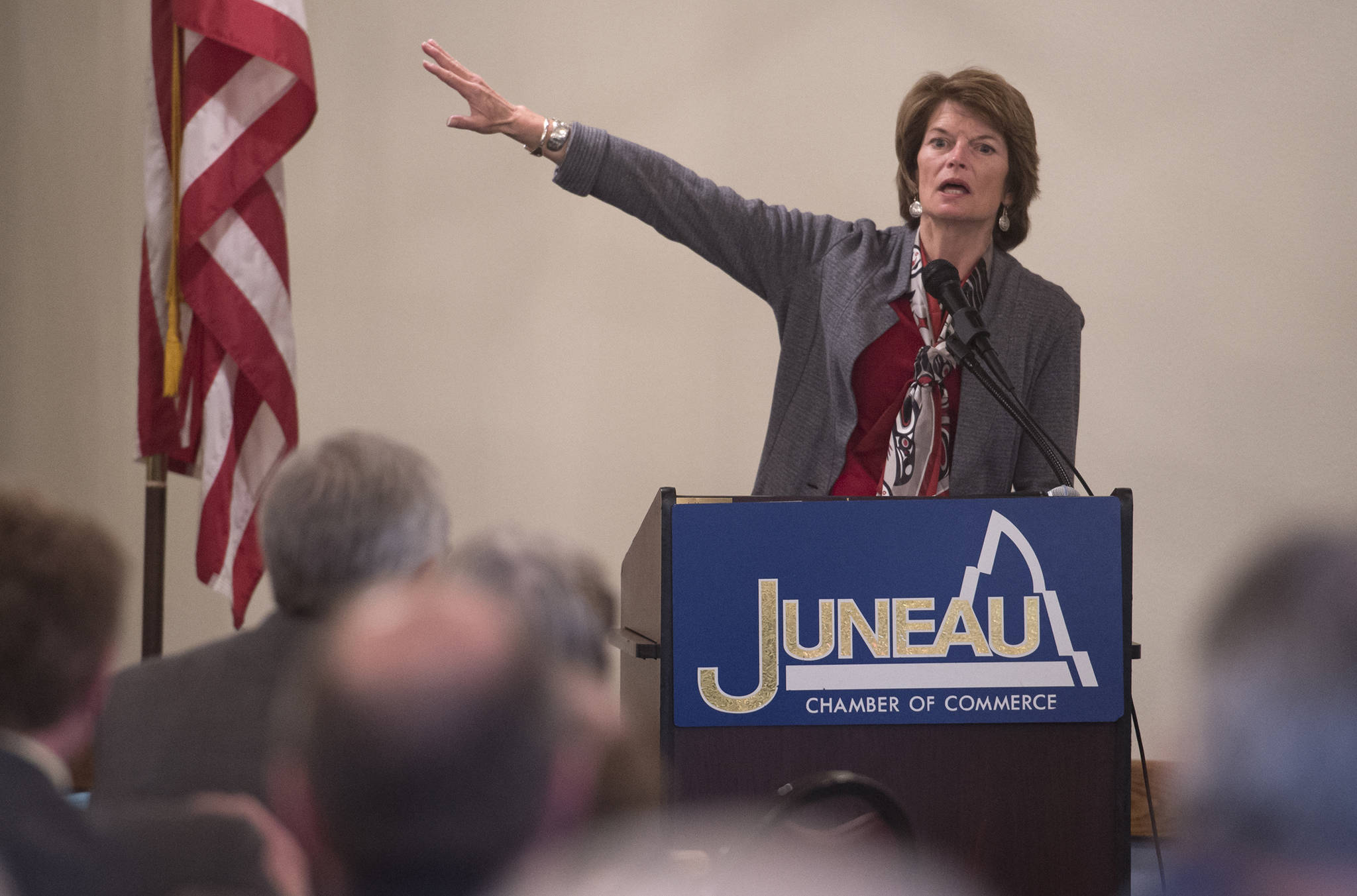
Alaska Sen. Lisa Murkowski speaks at the Juneau Chamber of Commerce’s weekly luncheon at the Moose Lodge on Thursday, June 1, 2017.

Alaska Sen. Lisa Murkowski speaks at the Juneau Chamber of Commerce’s weekly luncheon at the Moose Lodge on Thursday, June 1, 2017.

Alaska cities, boroughs see more cash from Department of the Interior

Sen. Lisa Murkowski’s funding efforts pay off for communities

The Department of the Interior will send more than $32.3 million to local governments across Alaska as part of this year’s Payment in Lieu of Taxes Program.

The department announced this year’s disbursements on Tuesday, and Sen. Lisa Murkowski, R-Alaska, trumpeted the figure in a series of notices Wednesday.

“We worked hard in the appropriations process to ensure it received full funding, and now, as the Department of the Interior disburses these payments, we are enabling our communities to provide for first responders, roads, and other critical services,” she said in a prepared statement.

PILT payments have come from the federal government to communities across the country each year. The program was created in 1976 by Congress to compensate communities for federal land within their borders. Since municpalities and states can’t tax federal property, they lose out on potential revenue. PILT compensates for that loss.

Murkowski is in a powerful position as chairwoman of the appropriations committee for the Department of the Interior and last year included $553 million for PILT payments in the federal budget, up significantly from the year before.

The City and Borough of Juneau will receive $2.8 million, more than the city had been expecting and a significant increase from prior years. In fiscal year 2018, for example, the city received $2.2 million. The city’s FY19 budget anticipated $2.15 million in PILT payments.

At $2.8 million, PILT payments are higher than they have ever been. In FY10, for example, the payments were $1.4 million. In FY14, there were no PILT payments after Congress failed to appropriate any money.

Other communities across Alaska are seeing similar increases. Skagway, for example, will receive $196,000, according to figures provided by treasurer Heather Rodig. That’s up from $172,000 last year and $162,000 the year before.

The Matanuska-Susitna Borough will receive more than $3.6 million, as will the Kenai Peninsula Borough. Both are the top recipients of PILT. Last year, each received about $3.1 million.


• Contact reporter James Brooks at jbrooks@juneauempire.com or 523-2258.


More in News

A snowmachine rider takes advantage of 2 feet of fresh snow on a field down Murwood Avenue in Soldotna, Alaska, on Monday, Dec. 12, 2022. (Jake Dye/Peninsula Clarion)
Ice fishing opens on some Kenai National Wildlife Refuge lakes

Snowmachines are permitted for ice fishing access on Hidden, Kelly, Petersen, Engineer and Watson lakes.

The waters of Cook Inlet lap against Nikishka Beach in Nikiski, Alaska, where several local fish sites are located, on Friday, March 24, 2023. (Jake Dye/Peninsula Clarion)
Kenai asks for fishery economic disaster declaration

The Kenai City Council requested that Gov. Dunleavy declare a disaster and support a recovery plan for the Upper Cook Inlet East Side Set Net fishery.

The Kenai Peninsula Borough School District logo. (Photo courtesy of Kenai Peninsula Borough School District)
District superintendent dispels rumors about student construction

Superintendent Clayton Holland said student involvement in Seward High School construction is “based on rumor, not fact.”

Anchorage-based singer and songwriter Keeley Boyle is pictured in Anchorage<ins>, Alaska,</ins> on Sept. 26, 2023. Boyle, who was raised on the Kenai Peninsula, will use a $10,000 grant she received from the Rasmuson Foundation to create an album of songs about her grandparents’ home in Nikiski. Photo courtesy of Jovell Rennie
Musician hailing from Kenai receives Rasmuson grant

Keeley Boyle will record an album of songs about her grandparents’ Nikiski home.

Commercial fishing and recreational vessels are docked in the Homer harbor on Oct. 23, 2025. The commercial fishing industry endured a series of challenges over the year, some of them imposed by the new Trump administration. (Photo by Yereth Rosen/Alaska Beacon)
Alaska fisheries in 2025: turmoil, economic and environmental challenges and some bright spots

NOAA cuts, economic headwinds and invasive species pose problems, but there was some recovery in crab stocks and salmon harvests.

Cook Inlet near Clam Gulch is seen on Oct. 23, 2025. (Photo by Yereth Rosen/Alaska Beacon)
Disputed oil lease sale in Alaska’s Cook Inlet upheld in new Trump administration decision

After completing a court-ordered environmental study, the Bureau of Ocean Energy Management said no changes are needed for the 2022 sale that drew just one bid.

The Kenai Peninsula Borough School District logo.
School district projects $7.5 million budget deficit for fiscal year 2027

Decreased enrollment and increased property values mean less local and state funding.

The sign in front of the Homer Electric Association building in Kenai, Alaska as seen on April 1, 2020. (Photo by Brian Mazurek/Peninsula Clarion)
Homer Electric Association announces rate increase

The proposed increase, if approved by the Regulatory Commission of Alaska, will go into effect Jan. 1.

A photo of Anesha “Duffy” Murnane, missing since Oct. 17, 2019, in Homer, Alaska. (Photo provided, Homer Police Department)
Calderwood pretrial hearing rescheduled

The omnibus hearing for Kirby Calderwood was continued to Jan. 21. Trial week is currently scheduled for Feb. 17, barring finalization of a plea agreement.

Most Read