
Peter Segall / Juneau Empire
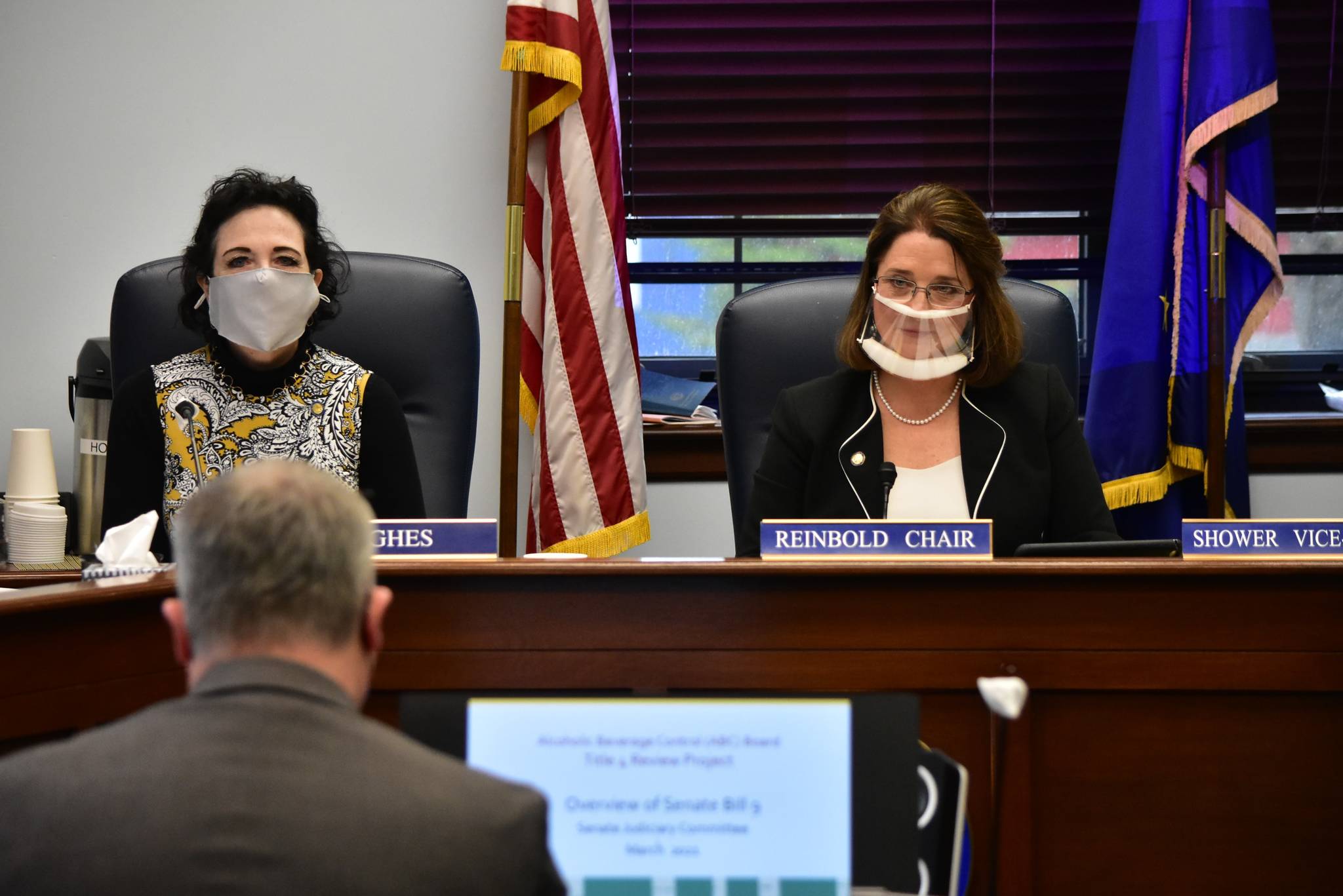
Sens. Shelley Hughes, R-Palmer, left, and Lora Reinbold, R-Eagle River, question acting Attorney General Treg Taylor about the administration’s approach to legal matters at a Senate Judiciary Committee hearing on Wednesday.

Peter Segall / Juneau Empire Sens. Shelley Hughes, R-Palmer, left, and Lora Reinbold, R-Eagle River, question acting Attorney General Treg Taylor about the administration’s approach to legal matters at a Senate Judiciary Committee hearing on Wednesday.

AG defends pandemic emergency orders during hearing

Disaster declaration carried force of law, Taylor says

Senators questioned Attorney General Treg Taylor on Wednesday, voicing concerns about executive branch overreach and other legal interpretations. The hearing was part of Taylor’s confirmation process after being appointed by Gov. Mike Dunleavy. His two immediate predecessors resigned following reports of past indiscretions.

Members of the Senate Judiciary Committee questioned Taylor on legal matters, asking how he would approach certain situations. One main concern for the committee’s chair Sen. Lora Reinbold were the restrictions put in place during the pandemic.

Reinbold asked Taylor several times if he believed health mandates put in place under the state’s emergency declaration carried the force of law, and if so, if he believed it was permissible for those mandates to curtail certain Constitutional liberties even without due process of law.

[Attorney general discusses plans, Clarkson in hearing]

Taylor affirmed that he did. The U.S. and state constitutions as well as the Alaska Disaster Act gave the governor the power to issue certain kinds of orders under extraordinary circumstances. Through the disaster declaration, the Legislature granted some of its rule-making authority to the governor under the conditions laid out under established Alaska law, Taylor said. Disaster declarations are meant to bypass the typical legislative process, he said, which is meant to be slow.

“I think the Alaska Disaster Act is an acknowledgment that sometimes in certain conditions that (legislative process) needs to be bypassed,” Taylor said. “Like any of those liberties, there are times when those can be infringed upon.”

Taylor gave what he said was the classic example of not being able to yell “Fire!” in a crowded theater.

Sens. Jesse Kiehl, D-Juneau, and Mike Shower, R-Wasilla, both pointed out the Legislature had the ability to call itself back into session and chose not to. Some lawmakers had wanted to call themselves into special sessions to address the emergency order but did not have the 40 votes necessary to do it.

In November, lawmakers sent a letter to Dunleavy asking him to call lawmakers into session, but the governor ultimately decided against it.

Republican lawmakers asked what Taylor would do as attorney general to push back against what they said was executive overreach from the Biden Administration concerning resource development. Taylor said the Department of Law was already working on several suits related to the issue.

Taylor gave the example of the Biden administration’s decision to review the decision to repeal the 2001 Roadless Rule as one area where DOL would push to assert state control. The Roadless Rule was repealed by the Trump administration despite protests from local conservationists, fishermen and tribal governments.

Kiehl questioned Taylor on DOL’s interpretation of what funds were susceptible to a financial mechanism known as “the sweep,” which moves the remainder of certain funds into the Constitutional Budget Reserve. In the past, the Dunleavy administration has tried to determine what funds are able to be swept, Kiehl said, in particular the Power Cost Equalization fund, which subsidizes electrical service in rural areas.

A review of the PCE issue is currently taking place, Taylor said, adding that he was willing to work with the Legislature on the matter.

Contact reporter Peter Segall at psegall@juneauempire.com. Follow him on Twitter at @SegallJnuEmpire.

More in News

A snowmachine rider takes advantage of 2 feet of fresh snow on a field down Murwood Avenue in Soldotna, Alaska, on Monday, Dec. 12, 2022. (Jake Dye/Peninsula Clarion)
Ice fishing opens on some Kenai National Wildlife Refuge lakes

Snowmachines are permitted for ice fishing access on Hidden, Kelly, Petersen, Engineer and Watson lakes.

The waters of Cook Inlet lap against Nikishka Beach in Nikiski, Alaska, where several local fish sites are located, on Friday, March 24, 2023. (Jake Dye/Peninsula Clarion)
Kenai asks for fishery economic disaster declaration

The Kenai City Council requested that Gov. Dunleavy declare a disaster and support a recovery plan for the Upper Cook Inlet East Side Set Net fishery.

The Kenai Peninsula Borough School District logo. (Photo courtesy of Kenai Peninsula Borough School District)
District superintendent dispels rumors about student construction

Superintendent Clayton Holland said student involvement in Seward High School construction is “based on rumor, not fact.”

Anchorage-based singer and songwriter Keeley Boyle is pictured in Anchorage<ins>, Alaska,</ins> on Sept. 26, 2023. Boyle, who was raised on the Kenai Peninsula, will use a $10,000 grant she received from the Rasmuson Foundation to create an album of songs about her grandparents’ home in Nikiski. Photo courtesy of Jovell Rennie
Musician hailing from Kenai receives Rasmuson grant

Keeley Boyle will record an album of songs about her grandparents’ Nikiski home.

Commercial fishing and recreational vessels are docked in the Homer harbor on Oct. 23, 2025. The commercial fishing industry endured a series of challenges over the year, some of them imposed by the new Trump administration. (Photo by Yereth Rosen/Alaska Beacon)
Alaska fisheries in 2025: turmoil, economic and environmental challenges and some bright spots

NOAA cuts, economic headwinds and invasive species pose problems, but there was some recovery in crab stocks and salmon harvests.

Cook Inlet near Clam Gulch is seen on Oct. 23, 2025. (Photo by Yereth Rosen/Alaska Beacon)
Disputed oil lease sale in Alaska’s Cook Inlet upheld in new Trump administration decision

After completing a court-ordered environmental study, the Bureau of Ocean Energy Management said no changes are needed for the 2022 sale that drew just one bid.

The Kenai Peninsula Borough School District logo.
School district projects $7.5 million budget deficit for fiscal year 2027

Decreased enrollment and increased property values mean less local and state funding.

The sign in front of the Homer Electric Association building in Kenai, Alaska as seen on April 1, 2020. (Photo by Brian Mazurek/Peninsula Clarion)
Homer Electric Association announces rate increase

The proposed increase, if approved by the Regulatory Commission of Alaska, will go into effect Jan. 1.

A photo of Anesha “Duffy” Murnane, missing since Oct. 17, 2019, in Homer, Alaska. (Photo provided, Homer Police Department)
Calderwood pretrial hearing rescheduled

The omnibus hearing for Kirby Calderwood was continued to Jan. 21. Trial week is currently scheduled for Feb. 17, barring finalization of a plea agreement.

Most Read