
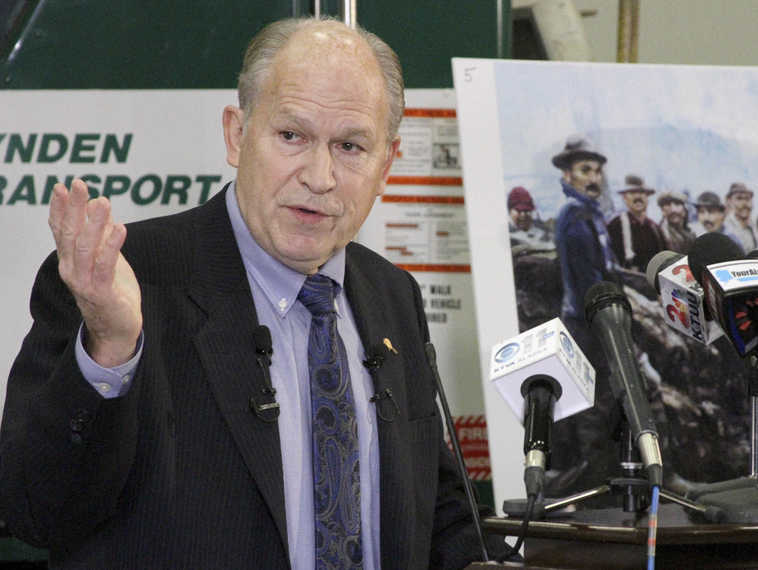
In this Dec. 9, 2015 photo, Alaska Gov. Bill Walker speaks at a news conference about his plan for the state budget in Anchorage, Alaska. Walker has proposed sweeping changes to help reduce the state's billion budget deficit, including instituting a state income tax for the first time in 35 years. (AP Photo/Mark Thiessen)

In this Dec. 9, 2015 photo, Alaska Gov. Bill Walker speaks at a news conference about his plan for the state budget in Anchorage, Alaska. Walker has proposed sweeping changes to help reduce the state's billion budget deficit, including instituting a state income tax for the first time in 35 years. (AP Photo/Mark Thiessen)

A look at Gov. Walker’s income tax, other budget proposals

  • By Becky Bohrer
  • Monday, December 14, 2015 9:56pm
  • News

JUNEAU — If Gov. Bill Walker gets his way, Alaskans will be chipping in to help reduce the state’s estimated $3.5 billion budget deficit.

Walker has proposed sweeping changes, including instituting an income tax for the first time in 35 years.

He’s suggested using the fund that provides annual checks to Alaskans to generate cash to help finance state government. His proposal would change how dividends are calculated, putting the checks at about $1,000 in the near future. The dividend over its lifetime has averaged about $1,150.

Here’s a closer look at Walker’s tax proposals:

What kind of income tax is being proposed?

The personal income tax would be 6 percent of your federal tax liability, the amount in taxes you pay the federal government. If your federal tax liability is $5,000, you would pay $300 in state taxes.

The approach is unique among states with income taxes, said Jared Walczak, an analyst with the Tax Foundation, an independent tax policy research organization.

Alaska’s tax would generate about $200 million a year.

Who would pay?

Walker has said the income tax wouldn’t apply to those at lower-income levels.

Generally, a single person under 65 would have to make at least $10,150 to file a federal return. For a married couple filing jointly, both under 65, that would be $20,300, according to Internal Revenue Service filing instructions for 2014.

The administration says the tax would capture out-of-state workers and profits of partnerships and “S corporations.” According to the IRS, S corporations allow income to flow through them without being taxed until it’s claimed by the shareholders.

If you itemize your federal income tax, the state tax would be deductible, state tax division director Ken Alper said.

How would this be implemented?

Earlier this year, following a proposal from Rep. Paul Seaton, R-Homer, the Department of Revenue estimated it would cost $14 million to add an income tax component to its tax revenue management system.

The department also figured it ultimately would need to hire 60 employees with annual operating costs at that staffing level starting around $7.2 million. Alper doesn’t expect that employee estimate to change dramatically under Walker’s proposal.

The state also anticipates needing to hire someone to help with an implementation plan, costing about $250,000, since the department doesn’t have much expertise administering personal income taxes, Alper said. Lawmakers did away with the state’s individual income tax in 1980.

“One of the inevitable controversies of the income tax is, it costs money to implement,” he said.

What about other taxes?

Walker is proposing increases in industry taxes, including mining, fishing, oil and tourism; increases in fuel for planes, boats and vehicles; and increases in alcohol and cigarette taxes. He’s also proposing changes to the oil tax credit program.

The alcohol tax equates to an increase of 10 cents per drink, and cigarettes to $1 a pack. The increase would be paid by wholesale distributors but likely will be passed on, Alper said.

What are the plan’s chances?

Legislators gave Walker credit for laying out a plan but were quick to pick at many of the ideas.

The entire package is likely to be a tough sell, with Republicans wanting to see deeper budget cuts and Democrats saying the tax and reduced dividend would hurt working-class Alaskans. Next year is also an election year.

House Finance Committee co-chair Steve Thompson, R-Fairbanks, said he doesn’t want to ask Alaskans to pay an income tax unless it’s absolutely necessary.

“We’re not sure we’re there yet; there’s room for more cuts,” he said in a release.

More in News

A snowmachine rider takes advantage of 2 feet of fresh snow on a field down Murwood Avenue in Soldotna, Alaska, on Monday, Dec. 12, 2022. (Jake Dye/Peninsula Clarion)
Ice fishing opens on some Kenai National Wildlife Refuge lakes

Snowmachines are permitted for ice fishing access on Hidden, Kelly, Petersen, Engineer and Watson lakes.

The waters of Cook Inlet lap against Nikishka Beach in Nikiski, Alaska, where several local fish sites are located, on Friday, March 24, 2023. (Jake Dye/Peninsula Clarion)
Kenai asks for fishery economic disaster declaration

The Kenai City Council requested that Gov. Dunleavy declare a disaster and support a recovery plan for the Upper Cook Inlet East Side Set Net fishery.

The Kenai Peninsula Borough School District logo. (Photo courtesy of Kenai Peninsula Borough School District)
District superintendent dispels rumors about student construction

Superintendent Clayton Holland said student involvement in Seward High School construction is “based on rumor, not fact.”

Anchorage-based singer and songwriter Keeley Boyle is pictured in Anchorage<ins>, Alaska,</ins> on Sept. 26, 2023. Boyle, who was raised on the Kenai Peninsula, will use a $10,000 grant she received from the Rasmuson Foundation to create an album of songs about her grandparents’ home in Nikiski. Photo courtesy of Jovell Rennie
Musician hailing from Kenai receives Rasmuson grant

Keeley Boyle will record an album of songs about her grandparents’ Nikiski home.

Commercial fishing and recreational vessels are docked in the Homer harbor on Oct. 23, 2025. The commercial fishing industry endured a series of challenges over the year, some of them imposed by the new Trump administration. (Photo by Yereth Rosen/Alaska Beacon)
Alaska fisheries in 2025: turmoil, economic and environmental challenges and some bright spots

NOAA cuts, economic headwinds and invasive species pose problems, but there was some recovery in crab stocks and salmon harvests.

Cook Inlet near Clam Gulch is seen on Oct. 23, 2025. (Photo by Yereth Rosen/Alaska Beacon)
Disputed oil lease sale in Alaska’s Cook Inlet upheld in new Trump administration decision

After completing a court-ordered environmental study, the Bureau of Ocean Energy Management said no changes are needed for the 2022 sale that drew just one bid.

The Kenai Peninsula Borough School District logo.
School district projects $7.5 million budget deficit for fiscal year 2027

Decreased enrollment and increased property values mean less local and state funding.

The sign in front of the Homer Electric Association building in Kenai, Alaska as seen on April 1, 2020. (Photo by Brian Mazurek/Peninsula Clarion)
Homer Electric Association announces rate increase

The proposed increase, if approved by the Regulatory Commission of Alaska, will go into effect Jan. 1.

A photo of Anesha “Duffy” Murnane, missing since Oct. 17, 2019, in Homer, Alaska. (Photo provided, Homer Police Department)
Calderwood pretrial hearing rescheduled

The omnibus hearing for Kirby Calderwood was continued to Jan. 21. Trial week is currently scheduled for Feb. 17, barring finalization of a plea agreement.

Most Read