Upper Cook Inlet harvest comes in low
Published 4:55 am Friday, September 30, 2016
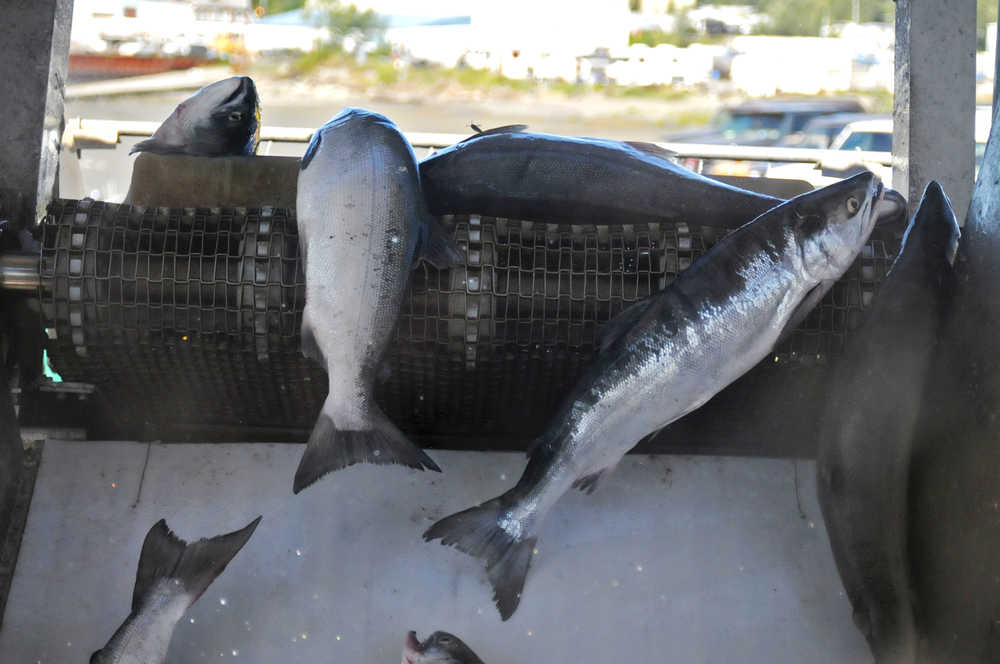
None of the fishermen in Cook Inlet had a traditional big catch day this year, for the second year in a row.
The overall harvest for commercial fishermen in Upper Cook Inlet, which includes Cook Inlet north of the Anchor Point Light, clocked in at approximately 3 million salmon, about 500,000 fish short of the recent 10-year average annual harvest. Commercial fishermen brought in approximately $22.3 million in exvessel value, $21 million of which came from sockeye salmon, according to the 2016 Upper Cook Inlet Commercial Salmon Fishery Season Summary.
Fishermen were expecting a run significantly larger than the one that actually returned. The Alaska Department of Fish and Game’s commercial fishing managers forecast an approximately 7.1 million salmon return across Upper Cook Inlet, but only 5.2 million returned, about 27 percent less than predicted. Commercial fishermen harvested a little more than half of the forecasted commercial harvest of 4.1 million salmon because fishing managers still had to meet their goals.
All salmon runs across the inlet came in lower than what was forecast, but the Kasilof River’s sockeye run saw the worst of it, according to the season summary. An estimated 559,000 sockeye salmon returned to the Kasilof, the smallest return since 1995, according to the summary.
Salmon don’t seem to be moving up into the rivers in large plumes, either. The largest peak day in the Kenai River in 2016 saw 53,000 salmon pass the sonar, the lowest peak daily passage since the sonar program began the late 1970s, according to the summary.
“The very low daily passage resulted in reduced catch rates by all user groups (sport, commercial and personal use) who harvest Kenai River sockeye salmon,” the summary states.
This is the second year of fairly low passage rates. In 2015, the peak daily passage of 75,000 sockeye salmon was the fourth lowest ever recorded. The low passage trend may be linked to the trend of salmon being more spread out across Cook Inlet, said Pat Shields, area management biologist for the Division of Commercial Fisheries in Soldotna.
“Usually during the course of the year, you’ll have one, two or three really big days,” Shields said. “But we just haven’t seen those for the past two years.”
Drift gillnet fishermen have had two years with lower-than-average peak daily harvests on non-corridor days. This year, daily harvest peaked at 355 sockeye salmon per boat, the third lowest since 1985. Last year, the peak daily harvest of 278 sockeye salmon per boat was the lowest since 1985, according to the summary. Shore-based set gillnet fishermen in the Upper Subdistrict of Upper Cook Inlet also saw a low peak daily harvest, coming in at 99,000 sockeye salmon at the peak. That is the second lowest since 1981, excluding 2012, when set gillnets in the Upper Subdistrict were heavily restricted, according to the summary.
Harvests of the other four species of Pacific salmon were down as well. The coho harvest of approximately 137,000 in all commercial fisheries was about 19 percent less than the recent 10-year average. Approximately 127,000 chum salmon were harvested, about 12 percent less than the recent 10-year average; across Upper Cook Inlet, commercial fishermen harvested 9,613 king salmon, about 6 percent below the average.
Pink salmon harvests were fairly average for an even-year harvest, which is significantly larger than odd-year harvests in Upper Cook Inlet, but tales of extremely large pink salmon came in all season. The fish tickets submitted by Upper Subdistrict setnetters have shown an average of 5-pound pink salmon so far, the largest on record. The recent 10-year average weight for pink salmon in the Upper Subdistrict setnet fishery is 3.6 pounds, and the largest average weight from 1966–2015 was 4.5 pounds.
Pink salmon have returned in poor numbers elsewhere in the state, such as Kodiak, Prince William Sound and Southeast Alaska. In Kodiak, where the recent 10-year average is approximately 20.4 million, according to the 2015 season summary for Kodiak Island, commercial fishermen harvested a little more than 3.2 million pink salmon. In Prince William Sound, the largest pink salmon fishery in the state, commercial fishermen have harvested approximately 8.75 million pink salmon in 2016.
Fish and Game managers forecast approximately 3.8 million pink salmon to return, while the Prince William Sound Aquaculture Corporation projected approximately 19.6 million to return, with a high of 26.2 million and a low of 12.9 million. Only approximately 2.9 million of the hatchery pink salmon returned, according to the aquaculture association’s season summary.
Similar to Cook Inlet, the sizes have been larger as well, according to harvest records from Fish and Game in Prince William Sound.
The average pink salmon harvested there was a 4.3 pounds in 2016, compared to the recent 10-year average of 3.4 pounds, said fishery biologist Stormy Brown with the Division of Commercial Fisheries in Cordova.
“This is the second largest pink salmon (weight) that we have seen in the sound since 1997 (2012 pinks were slightly larger),” he said in an email.
Reach Elizabeth Earl at elizabeth.earl@cmg-northwest2.go-vip.net/peninsulaclarion.