
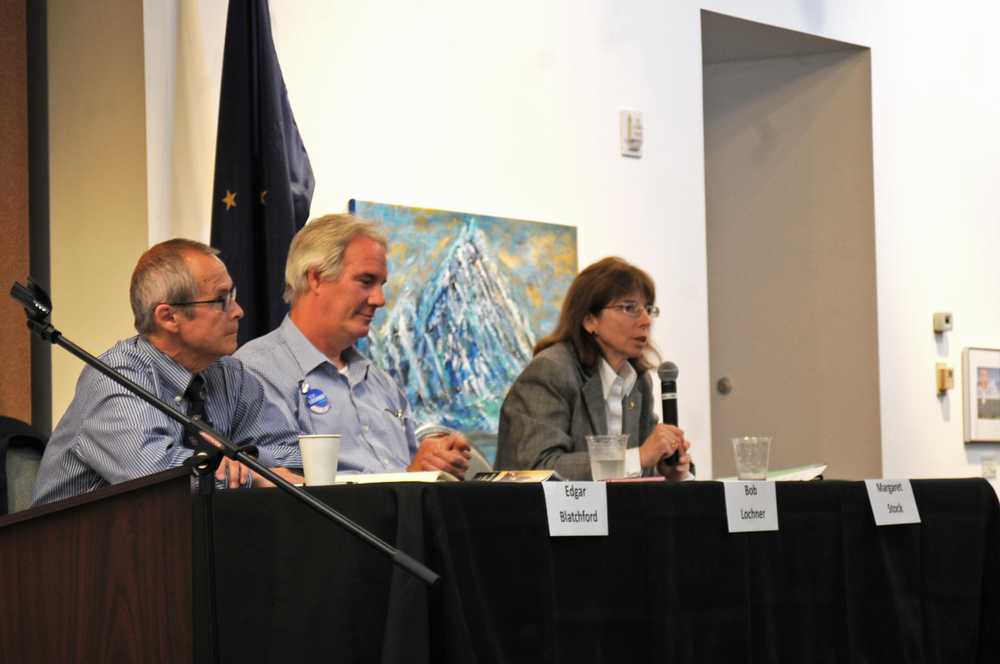
With the primary election less than a month away, three U.S. Senate candidates made their cases in Kenai Wednesday.
There are currently 13 active or pending candidates for the seat, currently held by Sen. Lisa Murkowski (R-Alaska). Of those, seven will be on the primary ticket in August, with four in the Republican race, two in the Democrat and one on Libertarian. Six others are running independently and, if they obtain enough signatures to qualify for the election, will make it onto the ballot in the general election in November.
The three candidates that visited Kenai represent three different parties — Edgar Blatchford is running as a Democrat, Bob Lochner is running for the Republican Party nomination and Margaret Stock is running as an independent.
During a joint Kenai and Soldotna Chambers of Commerce luncheon held Wednesday at the Kenai Cultural and Visitor’s Center, the candidates answered a range of questions from how they would handle federal regulation to how Cook Inlet beluga whales should be managed. The event was the first of the election season and will be followed with similar forums for candidates in other races.
Blatchford, a University of Alaska Anchorage journalism and communications professor and a former mayor of Seward, kicked off the forum with the assertion that one of his biggest concerns was money flowing into politics, stemming from the U.S. Supreme Court’s Citizens United v. Federal Election Commission case in 2010, which dealt with the regulation of political spending by organizations.
“There’s too much money in big politics right now,” Blatchford said. “…There are transnational corporations that migrate from country to country looking for the best tax break.”
Lochner, a North Slope worker from Wasilla and veteran, said he is running a grassroots campaign and, if elected, would work on policies in line with smaller government and shifting more power from the federal government to the states.
“We need to get back to having the average Alaskan be represented, which we’re just not,” Lochner said. “There’s policy being put in place by our current senator that’s going to hurt the fishing industry, that is going to hurt job opportunities for the young people getting out of college with debt. It needs to change around.”
Stock, a former U.S. Army Military Police Corps lieutenant colonel and attorney in Anchorage, said she plans to run on a nonpartisan ticket because the party system “is broken in Washington.”
“You have two parties that are at each other’s throats and not getting anything done in the Senate,” Stock said. “That’s the reason why I decided to run … I’m distressed and concerned about the dysfunction in Washington. And the fact that the congress won’t get anything done means the executive branch is getting too powerful.”
All three candidates expressed frustration at the state of operations in Washington, D.C., saying that the Citizens United ruling has added too much money to the political system. On other issues, though, they differed, such as the issue of immigration.
When asked how to address illegal immigration, Blatchford said he supported a path to citizenship rather than deportation or tightening the borders. Lochner said he thought “we should focus on America’s economy first” and tighten borders to immigration until the unemployment rate has fallen.
Stock, who won a fellowship from the MacArthur Foundation in 2013 for her work on immigration, said she favors a path to citizenship for illegal immigrants. A more efficient immigration system will improve national security, she said.
“They’re married to citizens, they have citizen children, most of them don’t have criminal records and the vast majority of the American public says if they speak English, don’t have a criminal record, they should be allowed to come forth out of the shadows, pay a fine and get some kind of status where they can work legally in the United States,” Stock said.
On resources development, Lochner advocated for the federal government to hand over more of its land holdings to private and state ownership to allow for more access to resources. Regarding climate change, he said he is “not a firm believer that we are a cause in the cycle of the weather,” but if alternative energy technology becomes more affordable, more people will use it.
Both Blatchford and Stock advocated for more use of alternative energy to offset carbon emissions and the effects of climate change. The government has the responsibility to acknowledge that change is happening and respond to it, Blatchford said.
“The idea is that we are in constant change and have to realize that change is happening faster,” Blatchford said. “We have to be on our feet, ready to move at a moment’s notice as we look at what’s happening around the world. Science is increasingly developed and increasingly aware of what’s happening around the world, and we don’t have many chances left to change the course … of global warming.”
Blatchford said diversifying the economy of smaller communities in Alaska will help bolster the economy. When he was mayor of Seward, the major drivers there were timber processing, seafood processing and tourism. Stock agreed that diversifying the economy will be important and said Alaska has a lot of potential for alternative energy industry and new technology companies.
Lochner said he would like to see the timber industry restored to Alaska and some of the regulations on the coal industry relaxed to make it easier to do business. He also said he would encourage more military installations to come to the state.
“We need to revive the timber industry, and we’re on our way to killing the coal industry,” Lochner said. “We have a large opportunity for defense systems to be put in that would defend the United States as a whole.”
Reach Elizabeth Earl at elizabeth.earl@peninsulaclarion.com.
