
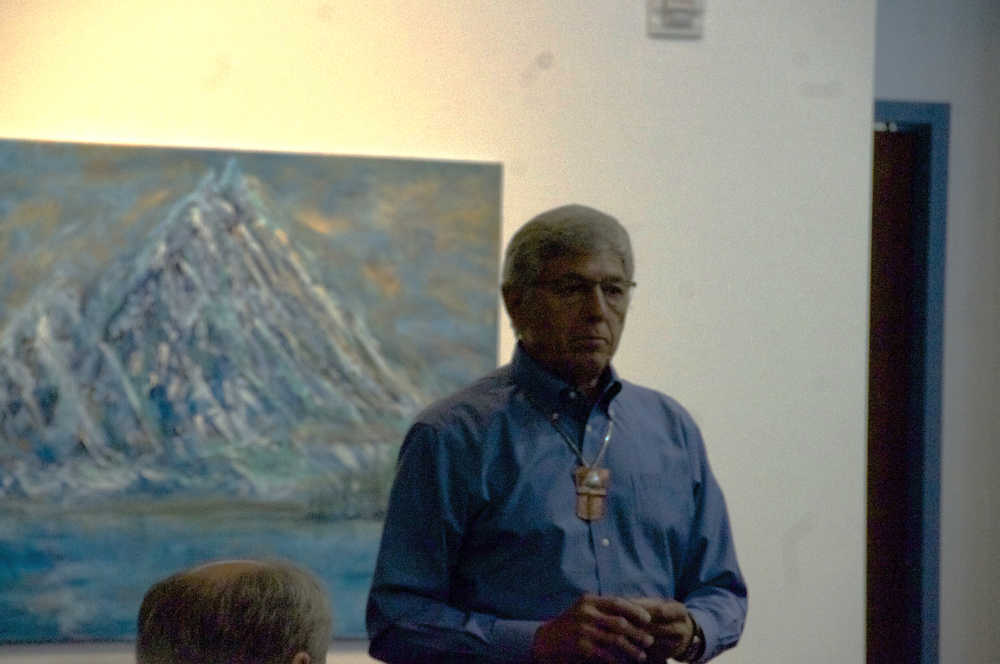
Alaska’s lieutenant governor says Alaskans are starting to understand the need to raise revenue and the need to solve the state’s long-term fiscal issues.
Lt. Governor Byron Mallott visited the Kenai Peninsula this week, stopping in Seward on the Fourth of July to watch the Mt. Marathon race and observing the state of the fisheries on the Kenai Peninsula so far this season. He delivered a brief speech to the joint Kenai and Soldotna chambers of commerce Wednesday at the Kenai Visitors and Cultural Center in Kenai, saying he hoped Alaskans understand the need to use the earnings of the Permanent Fund to help pay for government to avoid drawing down too extensively on savings.
“If we do not resolve the fiscal issue, very soon, we will be in greater need of additional revenue that we cannot really forecast at this point,” Mallott said at the luncheon. “We will need to establish new revenue sources, that if we are able to resolve and close the fiscal gap at the earliest time possible, will not have to be at the levels that they otherwise will need to be.”
Mallott’s visit came a week after Gov. Bill Walker issued a set of vetoes on the state’s fiscal year 2017 budget, eliminating a number of proposed projects, programs and operations and capping the Permanent Fund dividend payouts to $1,000 per person. Walker has also called another special session, set to begin on July 11, for the Legislature to work more on the state’s budget deficit, focusing on sources of new revenue.
However, Mallott said he is personally not optimistic about the upcoming special session. The upcoming election will be telling and will show what kind of Legislature will be arriving in Juneau in the January 2017 session, he said.
“(Individual legislators) are focused on getting through their primaries … and they are focused on the general election,” he said in an interview. “Beyond that … they are looking at how the Legislature will be structured in the next session. When those become the critical priorities, it’s hard to move people, and it’s ever been thus.”
Legislators have shown opposition to the governor’s plan to use the earnings of the Permanent Fund throughout the session. While the Senate passed a measure that would have capped dividend payouts at $1,000 this year and used some of the earnings to pay for government, the measure died in the House Finance Committee. The governor used his veto authority to implement the change anyway, which the Legislature can potentially overturn with a three-fourths majority vote.
The Legislature passed a budget for the year but not a fiscal plan, which the governor has said is necessary for the future of Alaska. Mallott agreed.
“If the Legislature had passed a fiscal plan … the state of our budget right now would be very different than it is now,” Mallott said. “The governor just had to deal with the reality at the moment that we see the budget.”
He said the Legislature gave the governor little choice on the vetoes — the budget is not sustainable and two years of paying for government out of savings will drain them, he said. The state government has already reduced its operations significantly and is still trying to find efficiencies, but government spending is already severely reduced from what it has been, he said.
Alaskans finally have a sense of what needs to be done — some have approached him and said they understand and approve of the state using some of the Permanent Fund earnings to pay for operations, he said.
“We hear it so readily and so pervasively across the state, talking with folks, community leaders, people on the street, people coming up in meetings, and I heard it (in Kenai),” Mallott said. “…I think that Alaskans get it. I’m confident of that.”
The governor wants the Legislature to consider how to carefully implement new revenue sources because if not, it could severely harm the economy, Mallott said. However, it has to be done, “because we are rapidly running out of meaningful options,” he said.
One of those revisions is to reconsider how dependent Alaska is on petroleum — growing the economy will be key for ensuring the state government provides the services Alaskans require in the future.
Although the governor vetoed other megaprojects, including the Knik Arm crossing and the Susitna-Watana Dam, he still plans to continue work for the Alaska LNG Project, which is in the process of conducting field work on the Kenai Peninsula this summer. A number of obstacles for the project have arisen in the past few months, including disagreements among the state’s producer partners on the project leadership and a state attorney general opinion saying the proposed surrender of the state’s taxation power is unconstitutional.
Mallott said the governor is “clear-headed” that the marketplace will be what determines the future of the LNG project, but he wants the project to be ready to move forward if the market will allow it.
“There is organizational and structural change taking place, but not to the point where with this administration that the project itself would in any way be jeopardized,” he said.
Reach Elizabeth Earl at elizabeth.earl@peninsulaclarion.com.
