
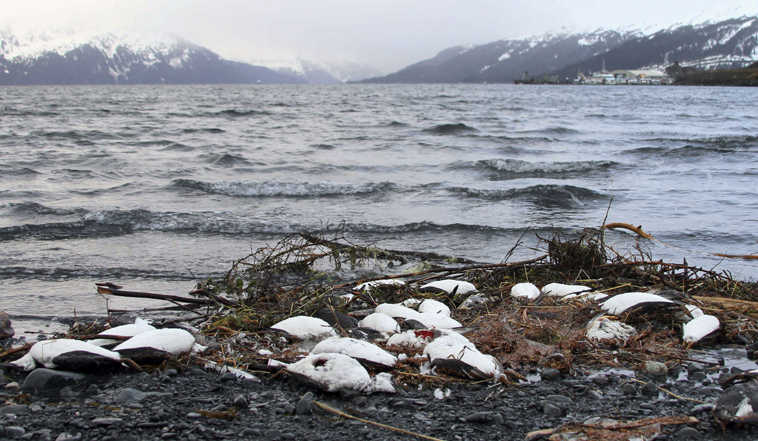
FILE - In this Thursday, Jan. 7, 2016 file photo, dead common murres lie washed up on a rocky beach in Whittier, Alaska. A federal scientist seeking reasons for a massive die-off of one of the most abundant seabirds in Alaska, the common murre, suggests a close look at their relationship to some of the ocean's smallest creatures, zooplankton, that may be affected by warming water. (AP Photo/Mark Thiessen, File)

FILE - In this Thursday, Jan. 7, 2016 file photo, dead common murres lie washed up on a rocky beach in Whittier, Alaska. A federal scientist seeking reasons for a massive die-off of one of the most abundant seabirds in Alaska, the common murre, suggests a close look at their relationship to some of the ocean's smallest creatures, zooplankton, that may be affected by warming water. (AP Photo/Mark Thiessen, File)

Data gaps hinder explanation for Alaska seabird die-off

  • By Dan Joling
  • Thursday, February 4, 2016 9:17pm
  • News

ANCHORAGE — A preliminary investigation into the massive die-off of common murres, one of the Northern Hemisphere’s most abundant seabirds, off Alaska’s coast is revealing gaps in basic information on North Pacific waters and the wildlife that inhabit them.

Federal scientists say the mortality may reach the hundreds of thousands. Emaciated common murre carcasses began washing ashore on Alaska beaches in March. No one knows why common murres appear to be starving. Speculation is hampered by unknowns in common murres’ winter diets, the habits of their prey, and conditions in waters far from shore, their preferred habitat, where it’s notoriously expensive to perform research.

“We know a lot more about what they eat in the summer that what they eat in the winter,” said Heather Renner, a U.S. Fish and Wildlife Service biologist at a presentation last week.

Alaska researchers do not routinely survey forage fish eaten by murres, such as capelin, a kind of smelt, and sand lance, another finger-length silvery fish. Scientists say unusually warm water in the North Pacific may have had an effect on forage fish and the zooplankton eaten by small fish. Murres themselves will eat larger zooplankton such as krill, a small crustacean that floats in the water column.

“The birds have told us something is amiss in the food web,” Renner said. “We desperately need targeted studies on lower trophic levels at the same spatial scale as the bird data. Without these, we can’t disentangle the complex reasons why the birds are starving.”

Three federal agencies, joined by university and private wildlife experts, are analyzing data for a report on the die-off, said John Piatt, a U.S. Geological Survey research wildlife biologist and seabird expert.

Common murres are large by seabird standards and can weigh more than two pounds. They routinely live 20-25 years but have a metabolism rate so high that they can use up fat reserves and drop to a critical threshold for starvation, 65 percent of normal body rate, in three days of not eating, Piatt said.

The Alaska population is estimated at 2.8 million that breed at 230 colonies.

Die-offs have been documented before but not to this degree.

During the first 10 days of January, researchers counted 17,293 dead murres on beaches and 854 more in vessel surveys. Only about 15 percent of carcasses reach shore and only a fall fraction of beaches were surveyed, leading researchers to estimate the deaths will be in the hundreds of thousands.

“What’s unprecedented about this die-off is, first the spatial extent of this die-off, which covers most of southern Alaska,” Renner said. “Second, it represents an extended period of time.”

Carcasses began washing ashore in March and other signs of trouble appeared in the summer. Some colonies thrived in 2015 but at a major colony on remote East Amatuli Island, one of the Barren Islands, murres were not fledging chicks. If stressed, and in the interest of self-preservation, common murre females can chose not to lay an egg.

“In more than three decades of monitoring birds in the Barrens, we’ve never had complete reproductive failure before,” Renner said. “And it wasn’t just there.”

By early winter, starving and disoriented birds were found not only in near-shore waters but as far inland as Fairbanks, 360 miles from salt water. After a fierce winter North Pacific storm the last week of December, 8,000 dead common murres washed ashore at the Prince William Sound community of Whittier.

In the January review of recovered carcasses, Piatt said, birds hatched in 2015 were apparently absent. Body size measurements suggested that many were sub-adults, or less than 5 years old.

Researchers say the die-off may be tied to unusually warm water in the North Pacific. Capelin and sand lance may have fled to cooler water, out of reach of murres.

Biotoxins, created by living organisms, have not been found in murre necropsies, but biologists have not ruled them out. Warmer water can lead to harmful algal blooms that create biotoxins. If detected, they usually show up in animals’ stomach contents and the emaciated murres’ stomachs have been mostly empty, Renner.

If murres already were struggling, the hurricane-force storms of late December could also have prevented them from foraging, according to researchers.

More in News

David Ross is sworn in as Kenai Police Chief on Tuesday, May 31, 2016 at Kenai City Hall. The Alaska Association of Chiefs of Police named Ross the 2025 Police Chief of the Year, recognizing over two decades of service. Photo by Megan Pacer/Peninsula Clarion
Kenai police chief named 2025 Police Chief of the Year

The Alaska Association of Chiefs of Police recognized David Ross for his more than two decades of leadership.

The cast of Nikiski Middle School’s upcoming performance of “Alice in Wonderland” is pictured on Dec. 2, 2025. The upperclassmen-directed play opens on Friday, with additional showtimes Saturday and next weekend. Photo courtesy of Carla Jenness
Nikiski Middle School debuts student-led “Alice in Wonderland”

The show opens on Friday, with additional showtimes this weekend and next.

On Tuesday, the Kenaitze Indian Tribe unveiled Kahtnu Area Transit, a public transportation service open to the entire Peninsula Borough community. Photo courtesy of Kahtnu Area Transit
Kenaitze Indian Tribe unveils Kahtnu Area Transit

The fixed bus route offers 13 stops between Nikiski and Sterling.

The Kenai Chamber of Commerce and Visitor Center hosts the annual Christmas Comes to Kenai on Nov. 28<ins>, 2025</ins>. The beloved event began over 40 years ago, and this year over 1,000 attendees enjoyed hot chocolate, fireworks, pictures with Santa and shopping. Photo courtesy of the Kenai Chamber of Commerce
 Photo courtesy of the Kenai Chamber of Commerce
The Kenai Chamber of Commerce and Visitor Center hosted the annual Christmas Comes to Kenai on Nov. 28. The beloved event began over 40 years ago, and this year over 1,000 attendees enjoyed hot chocolate, fireworks, pictures with Santa and shopping.
Kicking off a month of holiday festivities

Last weekend’s holiday events, including the annual Christmas Comes to Kenai and the Soldotna Turkey Trot, drew folks from all over the Kenai Peninsula.

Starting Dec. 2, Aleutian Airways will offer roundtrip flights between Anchorage and Unalakleet every Tuesday, Friday and Sunday.
Aleutian Airways to offer roundtrip flights between Anchorage and Unalakleet

Starting Dec. 2, Aleutian Airways will offer three roundtrip flights per week.

The Trump administration’s “Big Beautiful Bill” act requires the Bureau of Ocean Energy management to hold at least six offshore oil and gas lease sales in Alaska between 2026-2028 and 2030-2032. The first of these sales — known as “Big Beautiful Cook Inlet 1,” or BBC1— is scheduled for March 2026. Photo courtesy of the Bureau of Ocean Energy Management
Cook Inletkeeper launches petition against federal government

The organization is calling for transparency in Cook Inlet offshore oil and gas sales.

Winter dining has always carried more weight than the menu might suggest. In the off-season, eating out isn’t just about comfort food or convenience; it’s a way of supporting local businesses as they hold steady through the slower months. Photo credit: Canva.
The ripple effect: How local spending builds stronger communities on the Kenai Peninsula

From cozy cafés to fine-dining bistros, purchases made close to home sustain local jobs and services

Courtesy Harvest
On the Kenai Peninsula, a dormant liquefied natural gas export plant could be repurposed to receive cargoes of imported LNG under a plan being studied by Harvest, an affiliate of oil and gas company Hilcorp. The fuel would be transferred from ships to the tanks on the left, still in liquid form, before being converted back into gas and sent into a pipeline.
Utilities say Alaska needs an LNG import terminal. Consumers could end up paying for two.

Planning for two separate projects is currently moving ahead.

A map shows the locations of the 21 Alaska federal offshore oil and gas lease sales proposed by the Trump administration. (Map provided by the U.S. Bureau of Ocean Energy Management)
Trump administration proposes offshore leasing in almost all Alaska waters

A new five-year offshore oil and gas leasing plan proposes 21 sales in Alaska, from the Gulf of Alaska to the High Arctic, and 13 more off the U.S. West Coast and in the Gulf of Mexico.

Most Read