
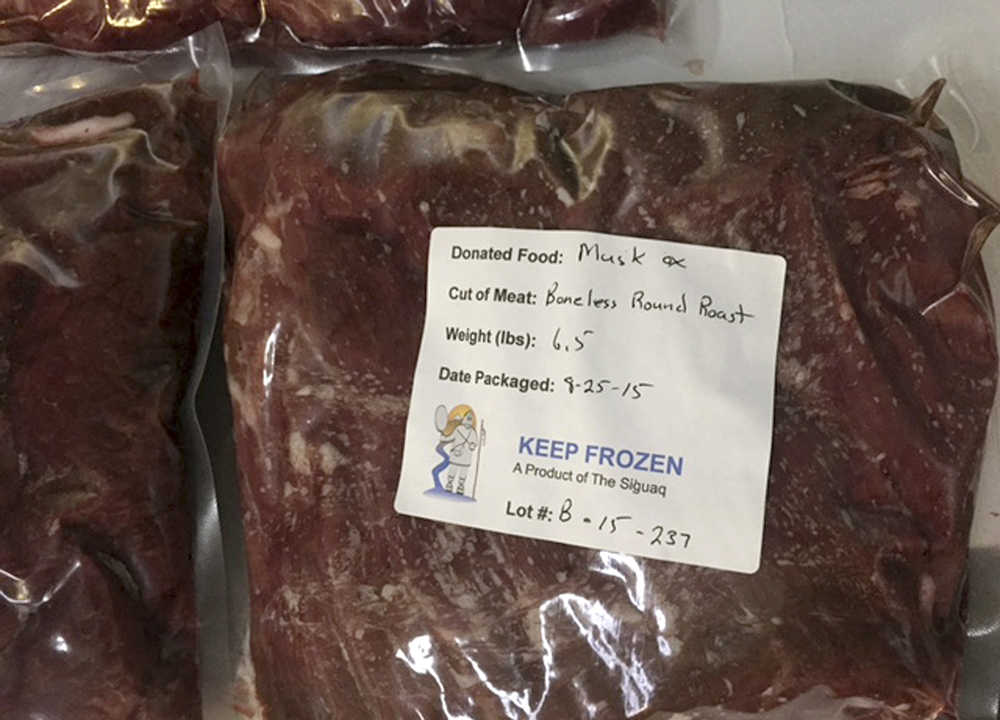
This Sept. 4, 2015 photo released by the U.S. Public Health Service shows a package of donated musk ox meat in Kotzebue, Alaska. Now that the long-term senior care facility in Kotzebue just began incorporating traditional foods into the regular menu, its Alaska Native residents no longer have to just wait for monthly family potlucks to enjoy the taste of the subsistence foods they grew up with. (Chris Dankmeyer/U.S. Public Health Service via AP)

This Sept. 4, 2015 photo released by the U.S. Public Health Service shows a package of donated musk ox meat in Kotzebue, Alaska. Now that the long-term senior care facility in Kotzebue just began incorporating traditional foods into the regular menu, its Alaska Native residents no longer have to just wait for monthly family potlucks to enjoy the taste of the subsistence foods they grew up with. (Chris Dankmeyer/U.S. Public Health Service via AP)

New processing plant prepares traditional Alaska Native food

  • By Rachel D'oro
  • Tuesday, November 24, 2015 10:48pm
  • News

ANCHORAGE — First it was musk ox stew. Then the Alaska nursing home served up musk ox meatloaf to its elderly Inupiat residents and their visiting family members.

The reaction at the long-term residential senior care facility was immediate. “’It was the bomb!’” is how home administrator Val Kreil recalled one young relative describing it. “You don’t hear that every day about meatloaf.”

The facility in Kotzebue, a commercial hub of 3,100 people in northwest Alaska, is incorporating traditional foods donated by hunters into the regular menu — a practice that’s gaining interest nationally under a new federal law.

The measure, passed last year, was largely modeled after an Alaska law and allows donations by approved sources to nursing homes, child nutrition programs and other public and nonprofit facilities, including those run by Indian tribes and tribal groups.

Traditional foods that can be obtained commercially, such as corn and bison, already have been served in some facilities, but the new law will allow access to a wider selection of foods, including game like venison, moose and caribou.

“It opens doors for our tribes and their citizens to continue having access to traditional foods,” said Leslie Wheelock director of the U.S. Department of Agriculture’s office of tribal relations. “It eases the way, I think, tremendously.”

The Birds Springs chapter of the Navajo Nation in Arizona is developing a 20-bed nursing home it hopes to open next year, and the tribe hopes the menu will include elk, deer and other staples like squash and beans from Navajo farmers.

“We owe it to our elders to get them what their lifestyles are accustomed to, and what they respond to physically, mentally, spiritually,” said Thomas Walker, a planner with the chapter.

Under Alaska’s law, other organizations have served traditional foods in their facilities over the years, according to Lorinda Lhotka with the Alaska Department of Environmental Conservation.

Boosting the new endeavor in Kotzebue, however, is a new plant down the road that is processing and storing the meat of animals donated by local hunters, forging a partnership with the 18-bed nursing home that is unique for the time being.

Both facilities are run by the Maniilaq Association, a regional tribal health care nonprofit based in Kotzebue.

The first meat processed was from a state-donated musk ox carcass. The residents got their first taste of it in early September. Until then, they had to wait for monthly family potlucks for a taste of the subsistence food they grew up with.

Most recently, the plant processed caribou meat for the nursing home, called Utugganaat Inaat — Inupiat for “a place for elders.” Some of the meat went into caribou stew with potatoes.

“It was wonderful,” said resident Mary Reed, 80. “I haven’t had it in a while.”

Before opening the plant in July, Maniilaq officials had to work through a maze of regulations with various agencies.

Initially, Maniilaq officials figured they had to get USDA approval. As it turned out, USDA provisions did not directly address such game as moose and caribou, just buffalo, bison and elk, Kreil said.

Ultimately, the USDA deferred the food safety oversight to the state DEC. All the laws were already in place. It was just a matter of juggling them to fit in a workable way, according to Maniilaq sanitarian Chris Dankmeyer.

It’s too early to tally any cost savings involved in accepting donated meets, according to Maniilaq officials.

But it costs up to $100 to purchase a 40-pound case of ground beef, plus $.78 a pound to fly it from Anchorage, so using ground musk ox or other donated meat instead is expected to add up, officials said.

The real payoff for some is the joy elders receive from their favorite traditional foods.

While many Western foods are picked at or left on plates, subsistence meals tend to be gobbled up, according to Cyrus Harris, whose job with Maniilaq includes hunting for the needs of elders.

“It makes a huge difference,” he said.

This Sept. 2, 2015 photo released by the U.S. Department of Agriculture shows diners at a long-term senior care facility in Kotzebue, Alaska. Now that the long-term senior care facility in Kotzebue just began incorporating traditional foods into the regular menu, its Alaska Native residents no longer have to just wait for monthly family potlucks to enjoy the taste of the subsistence foods they grew up with. (Sedelta Oosahwee/U.S. Department of Agriculture via AP)

This Sept. 2, 2015 photo released by the U.S. Department of Agriculture shows diners at a long-term senior care facility in Kotzebue, Alaska. Now that the long-term senior care facility in Kotzebue just began incorporating traditional foods into the regular menu, its Alaska Native residents no longer have to just wait for monthly family potlucks to enjoy the taste of the subsistence foods they grew up with. (Sedelta Oosahwee/U.S. Department of Agriculture via AP)

More in News

A snowmachine rider takes advantage of 2 feet of fresh snow on a field down Murwood Avenue in Soldotna, Alaska, on Monday, Dec. 12, 2022. (Jake Dye/Peninsula Clarion)
Ice fishing opens on some Kenai National Wildlife Refuge lakes

Snowmachines are permitted for ice fishing access on Hidden, Kelly, Petersen, Engineer and Watson lakes.

The waters of Cook Inlet lap against Nikishka Beach in Nikiski, Alaska, where several local fish sites are located, on Friday, March 24, 2023. (Jake Dye/Peninsula Clarion)
Kenai asks for fishery economic disaster declaration

The Kenai City Council requested that Gov. Dunleavy declare a disaster and support a recovery plan for the Upper Cook Inlet East Side Set Net fishery.

The Kenai Peninsula Borough School District logo. (Photo courtesy of Kenai Peninsula Borough School District)
District superintendent dispels rumors about student construction

Superintendent Clayton Holland said student involvement in Seward High School construction is “based on rumor, not fact.”

Anchorage-based singer and songwriter Keeley Boyle is pictured in Anchorage<ins>, Alaska,</ins> on Sept. 26, 2023. Boyle, who was raised on the Kenai Peninsula, will use a $10,000 grant she received from the Rasmuson Foundation to create an album of songs about her grandparents’ home in Nikiski. Photo courtesy of Jovell Rennie
Musician hailing from Kenai receives Rasmuson grant

Keeley Boyle will record an album of songs about her grandparents’ Nikiski home.

Commercial fishing and recreational vessels are docked in the Homer harbor on Oct. 23, 2025. The commercial fishing industry endured a series of challenges over the year, some of them imposed by the new Trump administration. (Photo by Yereth Rosen/Alaska Beacon)
Alaska fisheries in 2025: turmoil, economic and environmental challenges and some bright spots

NOAA cuts, economic headwinds and invasive species pose problems, but there was some recovery in crab stocks and salmon harvests.

Cook Inlet near Clam Gulch is seen on Oct. 23, 2025. (Photo by Yereth Rosen/Alaska Beacon)
Disputed oil lease sale in Alaska’s Cook Inlet upheld in new Trump administration decision

After completing a court-ordered environmental study, the Bureau of Ocean Energy Management said no changes are needed for the 2022 sale that drew just one bid.

The Kenai Peninsula Borough School District logo.
School district projects $7.5 million budget deficit for fiscal year 2027

Decreased enrollment and increased property values mean less local and state funding.

The sign in front of the Homer Electric Association building in Kenai, Alaska as seen on April 1, 2020. (Photo by Brian Mazurek/Peninsula Clarion)
Homer Electric Association announces rate increase

The proposed increase, if approved by the Regulatory Commission of Alaska, will go into effect Jan. 1.

A photo of Anesha “Duffy” Murnane, missing since Oct. 17, 2019, in Homer, Alaska. (Photo provided, Homer Police Department)
Calderwood pretrial hearing rescheduled

The omnibus hearing for Kirby Calderwood was continued to Jan. 21. Trial week is currently scheduled for Feb. 17, barring finalization of a plea agreement.

Most Read