
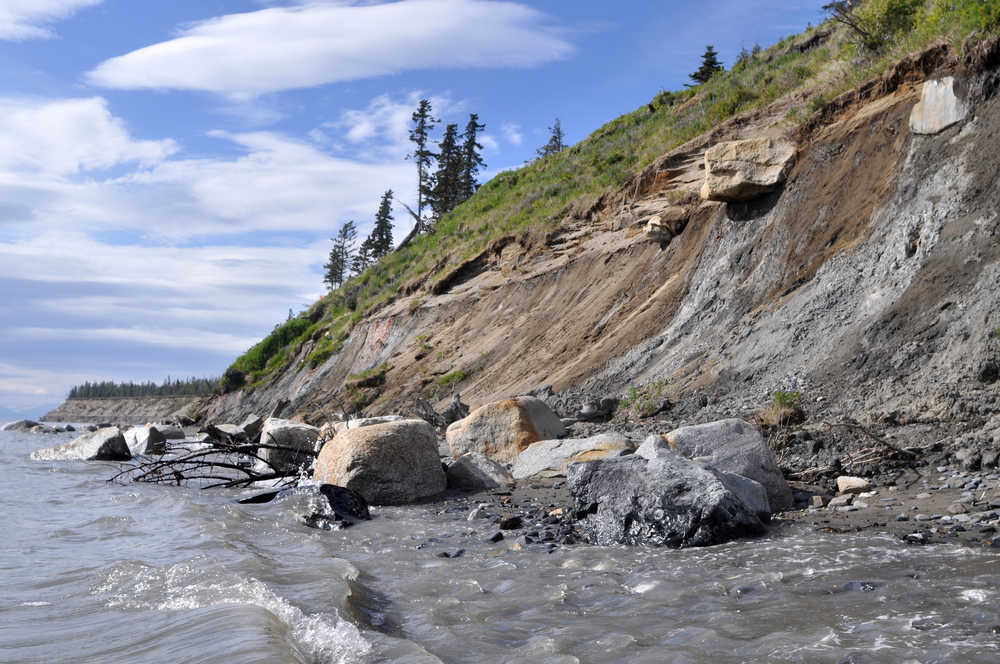
The cost of an upcoming Army Corps of Engineers study necessary to proceed with Kenai’s bluff stabilization project has increased from a May 2015 estimate of $650,000 to a present $1.17 million. The Army Corps and the city of Kenai are splitting the study cost in half. Kenai had previously paid its $252,000 share of the initial cost, and on Wednesday the Kenai City Council unanimously agreed to pay the $333,000 increase with money from a $4 million state grant dedicated to the bluff erosion project.
The Army Corps final feasibility study is one of the last pre-construction steps in a project to shield around 5,000 feet of bluff face near Old Town Kenai from the erosion that presently consumes around 3 feet of bluff-top per year. Although the study was delayed for lack of federal funding from 2011 to 2015, Dave Martinson, the Army Corps of Engineers manager of the Kenai Bluff Stabilization Project, said it is now underway.
Martinson said the study’s estimated cost has risen “because of several factors” including the increased costs of the study’s component elements — particularly real estate and economic analysis — and a wider-than-normal scope.
Martinson said typical Army Corps studies evaluate potential projects on the sole criteria of national economic benefit using a cost-benefit analysis. The study would create a ratio of project cost to economic benefit, considered on a national scale. If the ratio equals more than one — that is, the benefits are greater than the cost — the project can be approved.
Martinson said the Kenai Bluff Stabilization project would not be approved under such an analysis. As an alternative, the upcoming study will be done under a newer administrative structure that allows other considerations to influence the decision.
“What we can do is look at three other accounts,” Martinson said. “One of them is ‘other social’ or cultural. Another one is environmental, and the last one would be regional — regional economic development, as opposed to national. So the nation might not see a benefit, but the region could… We have to do additional analysis to look at those factors.”
This type of evaluation will also allow the Corps to include benefits to private property in its cost-benefit analysis, while the traditional evaluation would only consider public property.
The solution to the bluff erosion problem proposed in previous Army Corps studies is to regrade and vegetate the bluff-top while shielding its base with large stones. In addition to analyzing this solution, the final feasibility study will examine costs and benefits of alternative projects.
Martinson said one alternative to be examined will be leaving the bluff untouched while relocating the buildings and infrastructure on top of it. Another will be moving the entire mouth of the Kenai River to the southwest.
These alternatives were discussed along with other elements of the study at a project charette — a two-day planning session held with Army Corps and Kenai officials at the Kenai City Hall on May 4 and 5, 2015. Martinson said much of the cost increase was due to new requirements brought out at the charrette. One more expensive element is the required real estate study.
“The amount required for the real estate effort definitely increased,” Martinson said, in part because of “the magnitude of the amount of homes we’d have to do that for.”
Army Corps Alaska District Public Affairs Chief Tom Findtner wrote in an email that the final feasibility study will require real estate appraisals of 63 properties, a greater number than first anticipated. Martinson said a requirement unaccounted for in previous estimates — for the appraisals to be reviewed and certified by an a Corps employee in a different district — also added to the cost.
Other elements of the study, listed in the Kenai City Council’s most recent ordinance approving the agreement, include biological assessments of Steller sea lions and beluga whales in the Kenai River, and documentation required by the National Environmental Protection Act.
The Army Corps and Kenai formally entered the cost-share agreement in May 2015, although Kenai first approved signing its part of a similar agreement in September 2011, when the City Council passed a ordinance to pay $253,844 of the study cost — estimated at that time to total $640,989.
Army Corps Alaska District Public Affairs Chief Tom Findtner wrote in an email that the completed final feasibility study is expected to be approved by the Corps in July 2017.
Reach Ben Boettger at ben.boettger@peninsulaclarion.com
