
When members of Alaska’s remote Native villages need to share their concerns about environmental conservation, they can turn a handful of Refuge Information Technicians tasked with bridging the gap between those villages and the U.S. Fish and Wildlife Service.
The Alaska Refuge Information Technician program, launched more than 30 years ago, serves to maintain lines of communication between Alaska Natives and those who oversee conservation efforts and to better inform the projects and research the Fish and Wildlife Service conducts with Alaska Native cultural needs and standards in mind, said Program Coordinator Kevin Painter.
This year’s annual workshop for the program was held at the Kenai National Wildlife Refuge Visitor Center. The 20 current Refuge Information Technicians came together along with U.S. Fish and Wildlife Service personnel to network and discuss ways to improve their outreach and liaison efforts. The program got its start when Fish and Wildlife Service personnel had to address a declining waterfowl population in the 1980s and needed help from Alaska Natives to do it.
“They needed to work with Alaska Natives and rural villagers to number one, find out what’s going on, and then number two, work collectively to help restore waterfowl populations and get the number back up, which meant observing certain regulations, or hunting or gathering at different times,” Painter said. “And that was so successful and the resource… responded so well, and it was such good community involvement and buy-in and people felt empowered out there in those 51 villages that surround Yukon Delta Refuge that they said, ‘Well, let’s try this at other refuges.’”
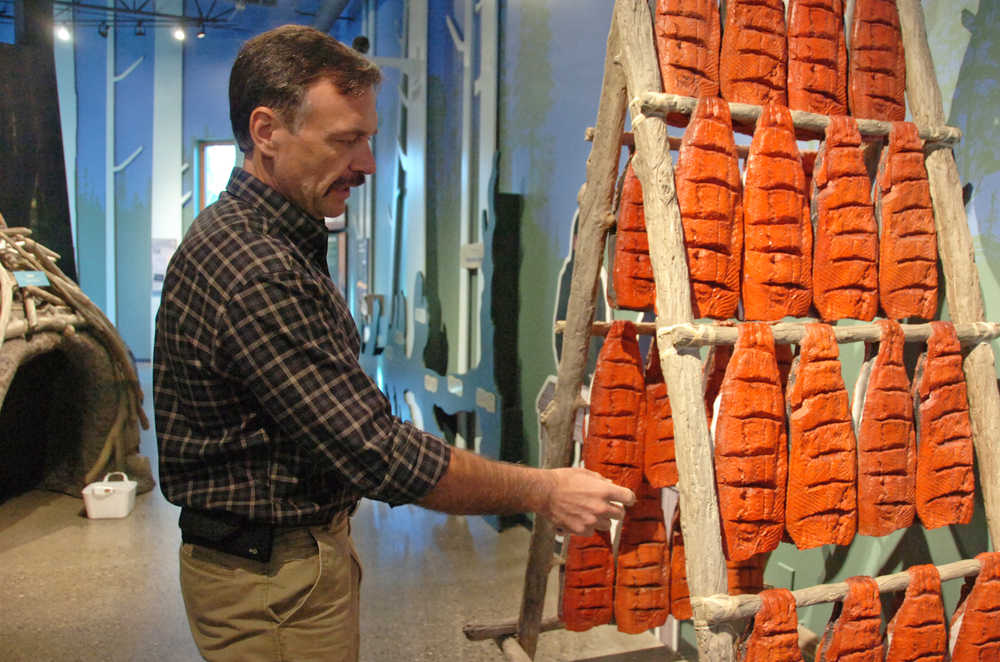
While on the Kenai Peninsula, the program’s technicians took a tour of the Kenaitze K’Beq’ Interpretive Site in Cooper Landing and learned about what is important to Native groups in the area. Painter, who also oversees visitor center development as part of his job description, said this year’s workshop location choice was premeditated.
“The reason we’re in Kenai is because of the facility,” Painter said. “I worked on this visitor center for three years with the idea that once we opened it, I’d love to take this group down here, and the reason being is how we were able to blend Alaska Native culture, in particular Kenaitze and Dena’ina culture, into this facility.”
Prior to the technicians, Alaska Native groups did not have representatives advocating their needs or opinions about environmental conservation to the Fish and Wildlife Service. Orville Lind, the Native liaison for the Office of Subsistence Management for the whole state of Alaska, deals with all 229 federally recognized tribes, 12 regional corporations and 200 village corporations for their subsistence needs. He became a Refuge Information Technician in 1991 and has experienced firsthand how having bridges for tribal groups can help change the way both entities view each other. When he first started approaching tribal groups as a technician, Lind was met with distrust, he said.
“I was told, ‘You’re a traitor, I can’t trust you anymore because you’re in uniform, you work for Fish and Game,’” Lind said. “There were virtually unknown regulations. That’s why the state was … frowned upon. … It was really harsh.”
One job of a Refuge Information Technician is to explain subsistence and hunting laws to tribal groups in their own languages, which has helped immensely to bring people onto the same page, Lind said. Now, Lind said Alaska Natives facing issues with their access to subsistence hunting and fishing have no problem coming to him for help.
“I am their primary contact when it comes to a subsistence issue,” he said, “Basically, if people aren’t getting subsistence needs met, we’re mandated by (the Alaska National Interest Lands Conservation Act) that subsistence users are given priority.”
While the program is federally funded, Painter said it is up to the manager at each Alaska refuge to decide whether to bring on a technician. Refuges don’t get extra federal funding to hire one and would have to work the position into their existing budgets, he said.
The Kenai National Wildlife Refuge does not employ a Refuge Information Technician, which Deputy Refuge Manager Steve Miller said is because of the lack of remote Native villages in the area, the kind the program was meant to serve.
“We have some (villages) on the other side of Kachemak Bay that we don’t get to as much as we’d like to,” Miller said, adding that most Alaska Native groups in the vicinity of the refuge are not remote, and therefore are not in as great of need of a liaison.
The refuge is still able to conduct outreach, he said.
“We have a monthly preschool environmental education program,” Miller said. “We also do a game warden camp. … Constantly we do snowshoe walks in the winter. … We try to have those events here at our environmental education center or at our visitor center.”
During this year’s workshop, the refuge was also able to share some of its own outreach techniques with Refuge Information Technicians. Matt Conner, the chief of visitor services for the refuge, presented on his work using archery classes to connect people to nature.
Painter said the Refuge Information Technicians can share and adapt programs like Conner’s to engage more people, especially young people, in conservation.
Reach Megan Pacer at megan.pacer@peninsulaclarion.com.
