
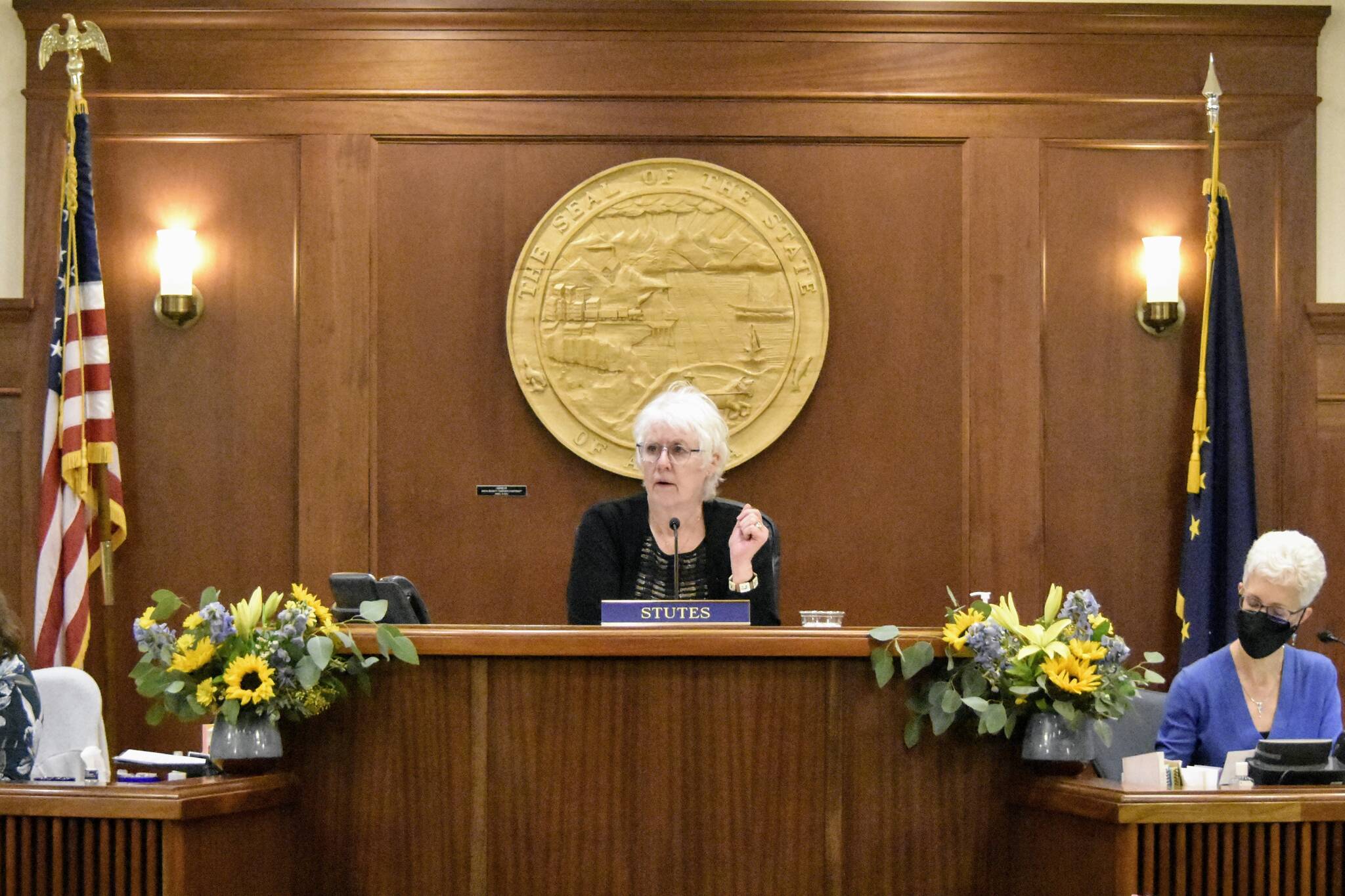
House Speaker Louise Stutes, R-Kodiak, gave a stern warning about decorum to members of the Alaska House of Representatives on the first day of the legislative session on Tuesday, Jan 18, 2022. Last year the Legislature was so divided it took a full regular session and four special sessions before work was completed. (Peter Segall / Juneau Empire)

House Speaker Louise Stutes, R-Kodiak, gave a stern warning about decorum to members of the Alaska House of Representatives on the first day of the legislative session on Tuesday, Jan 18, 2022. Last year the Legislature was so divided it took a full regular session and four special sessions before work was completed. (Peter Segall / Juneau Empire)

1st day of session brings familiar tensions to Legislature

Budget takes priority for leadership

Alaska’s lawmakers were back to business Tuesday, the first day of the legislative session, with many lawmakers commenting it felt as if they’d not been gone.

The session opened with calls for bipartisanship, but tensions were evident in the House of Representatives. Speaker Louise Stutes, R-Kodiak, began the session with a stern warning to lawmakers regarding their conduct on the floor.

“First and foremost, decorum will return to this House,” Stutes told the body. “Special orders will no longer be abused. Impugning members and impugning others will not be allowed.”

Speaking with reporters Tuesday afternoon, Stutes said her caucuses will focus on the budget and trying to avoid some of the issues that troubled last year’s session. But Stutes said her caucus, which includes most Democrats but also Republicans and independents, had been able to meet in the interim and was more cohesive than the previous session.

The House took 30 days to elect leadership last year, meaning legislative work couldn’t fully begin for about a month. That wasn’t an issue this year, Stutes said, and the caucus was more aligned on key issues. But the caucus holds only a slim majority of 21 lawmakers out of 40, enough to pass certain bills but not enough for others that require a two-thirds or three-quarter vote.

That became an issue last year when the House was able to pass a budget but failed to get the two-thirds vote necessary for the effective date clause. Without that clause, a bill goes into effect 90 days after its passage. But the state’s new fiscal year starts on July 1, and without a budget passed by the Legislature, the government faces the possibility of a shutdown.

“The only way we can avoid that is to get the budget passed sooner rather than later,” said House Majority Leader Chris Tuck, D-Anchorage.

[Permanent Fund Corp. board members defend CEO firing]

Political divisions in the Legislature last year took lawmakers through four special sessions, the most in Alaska’s state or territorial history, and despite calls for bipartisanship, there was evident skepticism from members of the House minority.

Speaking on the floor, Rep. Kevin McCabe, R-Anchorage, said he was disappointed the Legislative Council had declined to hear testimony Monday regarding the building’s COVID-19 mitigation policies and was refusing to hear more than one opinion.

“I think that we are going to watch carefully what the other side does,” McCabe said. “It needs to be two-sided.”

Dozens of bills were introduced Tuesday, but it’s unclear how many will pass. This is the last session before an election, meaning any bills that fail to pass both bodies will have to be resubmitted in the next Legislature.

At a news conference Monday, Gov. Mike Dunleavy said he hoped his proposed election bill would be addressed quickly by the Legislature.

Stutes said Tuesday the order in which bills were addressed was up to committee chairs, and she couldn’t say what might happen with the governor’s bill. But Tuck noted there were several elections bills in the Legislature, any of which could incorporate the governor’s policies.

“The governor’s ideas don’t have to be in the governor’s bill,” Tuck said.

On the floor of the Alaska State Senate, things were more subdued.

“What works best in the Senate is our ability to work across the aisle,” said Senate Minority Leader Tom Begich, D-Anchorage, on the floor. “My hope is over the next few months — and I’m praying that it will be a few months — we will actually be able to accomplish the tasks before us.”

Senate President Peter Micciche, R-Soldotna, told the Empire he’s hopeful lawmakers can make significant progress on delivering a long-term fiscal plan for the state.

One of last year’s special sessions saw the creation of a fiscal policy working group that wasn’t able to draft a plan itself but was able to some agreement on what would be necessary for a long-term fiscal plan. Micciche said he believed the Legislature could be able to deliver what he called the “lion’s share” of a fiscal plan.

“When I say lion’s share, I mean the legislation associated with putting us towards a better fiscal future,” Micciche said, which includes a spending limit, a sizable Alaska Permanent Fund dividend and ways to fill any budget gaps that may remain.

Micciche said he believed the upcoming election would put pressure on lawmakers to deliver for Alaskans.

“I think Alaskans are watching,” he said. “They want us to deliver, that’s going to require that we get something done.”

Contact reporter Peter Segall at psegall@juneauempire.com. Follow him on Twitter at @SegallJnuEmpire.

More in News

David Ross is sworn in as Kenai Police Chief on Tuesday, May 31, 2016 at Kenai City Hall. The Alaska Association of Chiefs of Police named Ross the 2025 Police Chief of the Year, recognizing over two decades of service. Photo by Megan Pacer/Peninsula Clarion
Kenai police chief named 2025 Police Chief of the Year

The Alaska Association of Chiefs of Police recognized David Ross for his more than two decades of leadership.

The cast of Nikiski Middle School’s upcoming performance of “Alice in Wonderland” is pictured on Dec. 2, 2025. The upperclassmen-directed play opens on Friday, with additional showtimes Saturday and next weekend. Photo courtesy of Carla Jenness
Nikiski Middle School debuts student-led “Alice in Wonderland”

The show opens on Friday, with additional showtimes this weekend and next.

On Tuesday, the Kenaitze Indian Tribe unveiled Kahtnu Area Transit, a public transportation service open to the entire Peninsula Borough community. Photo courtesy of Kahtnu Area Transit
Kenaitze Indian Tribe unveils Kahtnu Area Transit

The fixed bus route offers 13 stops between Nikiski and Sterling.

The Kenai Chamber of Commerce and Visitor Center hosts the annual Christmas Comes to Kenai on Nov. 28<ins>, 2025</ins>. The beloved event began over 40 years ago, and this year over 1,000 attendees enjoyed hot chocolate, fireworks, pictures with Santa and shopping. Photo courtesy of the Kenai Chamber of Commerce
 Photo courtesy of the Kenai Chamber of Commerce
The Kenai Chamber of Commerce and Visitor Center hosted the annual Christmas Comes to Kenai on Nov. 28. The beloved event began over 40 years ago, and this year over 1,000 attendees enjoyed hot chocolate, fireworks, pictures with Santa and shopping.
Kicking off a month of holiday festivities

Last weekend’s holiday events, including the annual Christmas Comes to Kenai and the Soldotna Turkey Trot, drew folks from all over the Kenai Peninsula.

Starting Dec. 2, Aleutian Airways will offer roundtrip flights between Anchorage and Unalakleet every Tuesday, Friday and Sunday.
Aleutian Airways to offer roundtrip flights between Anchorage and Unalakleet

Starting Dec. 2, Aleutian Airways will offer three roundtrip flights per week.

The Trump administration’s “Big Beautiful Bill” act requires the Bureau of Ocean Energy management to hold at least six offshore oil and gas lease sales in Alaska between 2026-2028 and 2030-2032. The first of these sales — known as “Big Beautiful Cook Inlet 1,” or BBC1— is scheduled for March 2026. Photo courtesy of the Bureau of Ocean Energy Management
Cook Inletkeeper launches petition against federal government

The organization is calling for transparency in Cook Inlet offshore oil and gas sales.

Winter dining has always carried more weight than the menu might suggest. In the off-season, eating out isn’t just about comfort food or convenience; it’s a way of supporting local businesses as they hold steady through the slower months. Photo credit: Canva.
The ripple effect: How local spending builds stronger communities on the Kenai Peninsula

From cozy cafés to fine-dining bistros, purchases made close to home sustain local jobs and services

Courtesy Harvest
On the Kenai Peninsula, a dormant liquefied natural gas export plant could be repurposed to receive cargoes of imported LNG under a plan being studied by Harvest, an affiliate of oil and gas company Hilcorp. The fuel would be transferred from ships to the tanks on the left, still in liquid form, before being converted back into gas and sent into a pipeline.
Utilities say Alaska needs an LNG import terminal. Consumers could end up paying for two.

Planning for two separate projects is currently moving ahead.

A map shows the locations of the 21 Alaska federal offshore oil and gas lease sales proposed by the Trump administration. (Map provided by the U.S. Bureau of Ocean Energy Management)
Trump administration proposes offshore leasing in almost all Alaska waters

A new five-year offshore oil and gas leasing plan proposes 21 sales in Alaska, from the Gulf of Alaska to the High Arctic, and 13 more off the U.S. West Coast and in the Gulf of Mexico.

Most Read