
FAIRBANKS (AP) — Noyes Slough provides a behind-the-scenes tour of urban Fairbanks, complete with passage under nine bridges, glimpses into backyards and the occasional smell of sewage.
It’s not for everyone, but I highly recommend it for anyone who enjoys seeing the city from a different angle and is willing to tolerate the contamination that comes with navigating a semi-stagnant urban channel.
I’ve wanted to kayak around the slough since I floated down Goldstream Creek last year, an interesting but unsuccessful trip we abandoned partway through after numerous fallen trees blocked our path.
After I wrote about that trip, several readers told me Noyes Slough, despite being a similar size, is a much better float. They were right, at least when the slough is running high.
I decided to float Noyes last week when I realized the water was still high in the Chena River and the temperature was above 60 degrees, conditions that aren’t likely to be repeated again this fall. My friend, Duane Shaffer, came along. Duane was on our ill-fated Goldstream Creek float last summer.
For those who aren’t familiar with it, Noyes Slough is a 5-mile waterway that flows out of the Chena downstream of the Wendell Avenue Bridge and returns to the river upstream of University Avenue.
The water was 7 feet deep at the National Weather Service gauge on the Chena River when we started floating Wednesday afternoon. That’s high water but is below the crest of 8.88 feet recorded four days earlier. The National Weather Service considers 12 feet to be flood stage. The river hit 18.82 feet in the great flood of 1967.
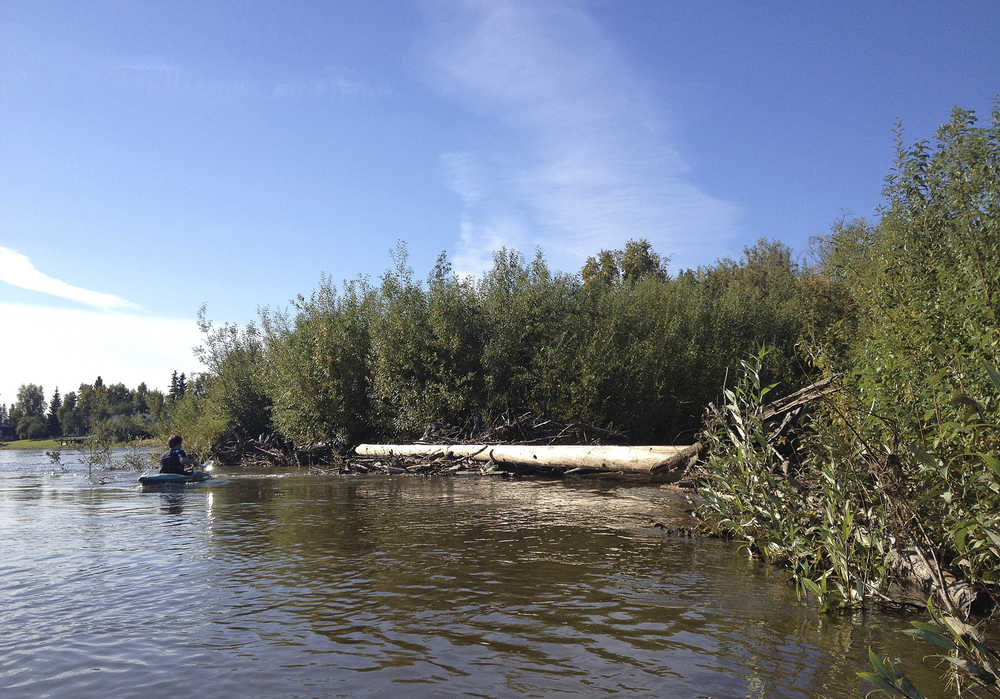
A large fallen tree blocked the main channel entrance. We paddled through a kayak-sized hole in a stand of flooded willows just to the right of the main opening.
At the mouth, the slough was narrow, about 15 feet wide and walled off by steep, muddy willow-covered banks. The current flowed steadily in this part of the slough. It changed character noticeably about a quarter of the way through, where it slowed down and widened.
I flipped my kayak in the first part of the slough at the only obstacle we encountered, a small tree downstream of the Minnie Street bridge that blocked most of the channel. After Duane paddled over a small opening without incident, I followed and lost my balance as my paddle tangled in some of the brush. I cursed myself for never learning that Eskimo roll as I popped out and dragged my kayak to the bank. Fortunately, my dry bag did its job keeping my cellphone and spare clothes dry. After a quick pause to dump water out of my boat, we were under way again.
We enjoyed orienting by landmarks we knew better from land.
“It’s the U-Haul building!” Duane called out suddenly after half a minute spent puzzling over a zig-zag shaped building along a bank near the Illinois Street Bridge.
Downstream of Illinois Street, we passed a series of bridges I’ve driven countless times but never thought much about, the on- and off-ramps of the Johansen Expressway. Cars zoomed by a few feet over our heads.
Farther down slough, we saw more homes with decks or other features built to enjoy the slough, but nothing like the large residential boat docks found outside the Chena River homes near the Pump House restaurant. People sat in their backyards and waved to us. A few look surprised to see activity on the slough; it doesn’t get nearly the traffic as the main channel of the Chena.
For me, the most scenic part of the trip was a stretch where the slough widened at a nice little park I’d only been to once — the Fairbanks Lions Recreation Area near Anne Wien Elementary School. We concluded the wide part of the slough would be just big enough to play Epic Kayak Ultimate, an aquatic version of Ultimate Frisbee that Duane and I both play.
The slough felt remote downstream for the half of the float beyond the Fairbanks Lions Recreation Area. After the Aurora Drive Bridge, there was only one other road crossing, the Johansen Expressway again, before the slough emptied into the Chena River.
We floated under a large railroad bridge I’d never seen before near the Gold Rush Estates trailer park and a walled-off pedestrian bridge that leads into the back of the George Horner Ice Park
After more than two hours on the slough, the Chena River looked enormous when we floated into it. The slough meets the river just upstream of the University Avenue Bridge, near where we’d left a car at the Chena River State Recreation Site.
The Noyes Slough has long been a dumping ground for oil, sewage and garbage. It’s one of five Interior water bodies on Alaska’s list of “impaired waters.” Unlike the Chena River, which isn’t on the list, the slough lacks the current to push contamination downstream.
The Noyes Slough wasn’t always so stagnant. Before flood control projects that started in 1945, higher water in the Chena cleaned out the slough more frequently.
Trash is the main contaminant of concern in the slough today, said Chandra McGee, an environmental program specialist with the Alaska Department of Environmental Conservation. During my float, I saw a handful of liquor bottles caught up along trees but fewer than I’d expected.
Fairbanks residents have long valued the slough and worked to clean it up. Volunteers and staff from local governments remove an average of about 1,000 pounds of garbage from the slough and the Chena River each year during an annual cleanup day in June, McGee said
In the future, the department would like to study bacteria levels in the slough as well as the levels of dissolved oxygen in the water, McGee said. Fish need certain levels of dissolved oxygen to breathe.
We didn’t see any fish during our float, but the slough was thick with ducks. Some kind of small raptor, I’d guess an American kestrel, flew alongside us near the mouth of the slough.
A thorough report on the slough that DEC wrote in 2008 details the long history of documented groundwater contamination and illegal dumping on the slough. Oil contamination in the slough has improved and now meets water quality standards, McGee said.
I’m still glad I floated the slough, but after reading about its history, I wish I had taken a shower right after taking my unexpected swim.
