
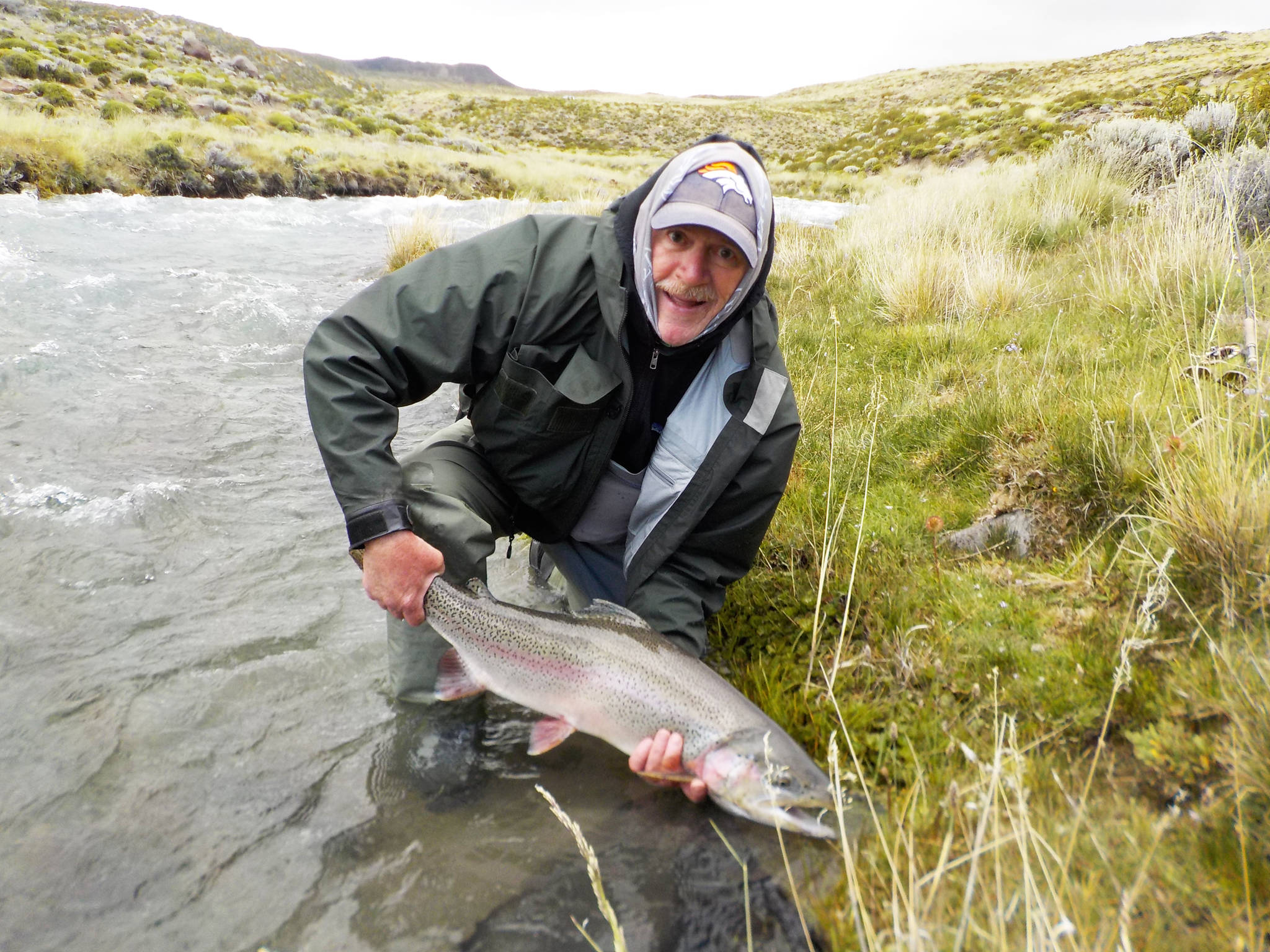
Soldotna resident Bruce King, a former fisheries biologist for the Alaska Department of Fish and Game, holds a rainbow trout he caught during a trip to Patagonia, Argentina in 2016. The areas he fished boasted trout upwards of 30 inches. (Photo courtesy Bruce King)

Soldotna resident Bruce King, a former fisheries biologist for the Alaska Department of Fish and Game, holds a rainbow trout he caught during a trip to Patagonia, Argentina in 2016. The areas he fished boasted trout upwards of 30 inches. (Photo courtesy Bruce King)

Travels, treks and trout

For some avid anglers, even the prolific fishing opportunities in the Last Frontier are sometimes not enough. That was true for Soldotna resident Bruce King, who went from Alaska to Argentina last year in search of the ultimate rainbow trout.

He wasn’t disappointed.

King told tales of huge fish, hiking trips and good food in a presentation called “Patagonia: Land of meat, wine, chocolate and gigantic rainbow trout,” which he gave to the local chapter of Trout Unlimited on March 29.

King and his wife, Mary, traveled 8,300 miles from Anchorage to Buenos Aires in late December 2015, and then went on to several different cities on their monthlong trip, returning to Alaska in February 2016. King, a former fisheries biologist for the Alaska Department of Fish and Game, said it “begs the question for a lot of people: Why would someone who’s a rainbow trout fisherman go that far to catch rainbow trout?”

He and his wife tried to spend about a week in each place. King’s fishing portion of the trip took place during the offseason since their trip spanned January and February, he said.

King did a lot of his fishing on two lakes in Santa Cruz, Argentina — the Quiroga and the Jurassic. Avid fly fishermen can stay at the Estancia Capitan ranch, which King said was transformed into a fishing destination years ago when its owner realized that would be more productive than actual ranching there.

“Basically was grinning all the time because he made this decision to switch from chasing his 3,500 sheep around to handling a half a dozen anglers every day,” he said.

The trout were placed in Quiroga Lake about 10 years ago, and are only available for catch and release, King said. There were areas of both lakes that were very windy, which King said boded well for fishermen as the wind kicked up weed beds in the water and freed crustaceans, which the trout would then come closer to eat.

“So the hardest part was really … how do you cast a scud pattern in this kind of wind?” he said.

Much of King’s experience interested him from a biological perspective. King said the trout at Lake Quiroga can grow to 30 inches in about 10 to 12 years.

“There was some pretty normal … growth for the first couple of years, and then years three through five, just explosive growth, more than I’ve ever seen even on a coho salmon,” he said. “… And then in the last few years you see the growth rate taper off.”

This led King to wonder whether the fish grow so fast and then taper off because they’ve exhausted their food resources, or if the phenomenon is due to some other factor. He said relatively little is known about these trout populations.

“My big question when I look at these kinds of systems is, is this sustainable?” he said. “Because it’s an artificial system.”

The fact that only a handful of anglers are allowed to fish from the ranch each week does at least guarantee some chance for the trout, King said.

All told, the trip cost about $8,000, King said. While not everyone can make such a trek to a different country, King said it was worth it from an angler’s perspective.

“The 30-inch rainbow is the holy grail,” he said. “And there’s a lot of people that claim to have caught a 30-incher in Alaska, but very, very few exist.”

Reach Megan Pacer at megan.pacer@peninsulaclarion.com.

More in Life

This 1903 photograph of mostly Kenai residents shows (back, far left) Hans Peter Nielsen, first superintendent of Kenai’s agricultural experiment station. Nielsen began work at the station in 1899 and resigned at the end of the 1903 season. (Photo from the Alaska State Library historical collection)
The experiment: Kenai becomes an agricultural test site — Part 2

AUTHOR’S NOTE: Presidential Executive Order #148, in January 1899, had set aside… Continue reading

Served together on a bed of greens, these pickled eggs and beets make a light but cheerful lunch. Photo by Tressa Dale/Peninsula Clarion
A wealth of eggs for good health

Pickled along with roasted beets and dill, these eggs have a cheerful hue and bright aroma.

This dish, an earthy and herbaceous vegetarian reimagining of the classic beef wellington, is finished nicely with a creamy maple balsamic sauce. Photo by Tressa Dale/Peninsula Clarion
A special dish for a special request

This mushroom wellington is earthy and herbaceous, and its preparation comes with much less pressure.

File
Minister’s Message: Lifelong learning is a worthwhile goal

Lifelong learning. That’s a worthwhile goal. Schools have been in session for… Continue reading

This E.W. Merrill photograph shows Charles Christian Georgeson, special agent in charge of all agricultural experiment stations in Alaska, starting in 1898. (Photo from Alaska History Magazine, July-August 2020)
The Experiment: Kenai becomes an agricultural test site — Part 1

Individuals deciding to explore Kenai’s historic district might start their journey by… Continue reading

File
Minister’s Message: Being ‘thank full?’

As a young dad, I remember teaching my toddler children to say… Continue reading

This virgin blueberry margarita made with blueberry flavored kombucha is perfect for sipping while playing cards.  Photo by Tressa Dale/Peninsula Clarion
Sweet fruit for sober fun

Blueberry kombucha gives this virgin margarita complexity in flavor and a lovely purple hue.

John W. Eddy was already a renowned outdoor adventurer and writer when he penned this book in 1930, 15 years after the mystery of King David Thurman’s disappearance had been solved. Eddy’s version of the story, which often featured wild speculation and deviated widely from the facts, became, for many years, the accepted recounting of events.
King Thurman: An abbreviated life — Part 6

AUTHOR’S NOTE: The fate of King David Thurman, a Cooper Landing-area resident,… Continue reading

Public photo from ancestry.com
James Forrest Kalles (shown here with his daughters, Margaret and Emma) became the guardian of King David Thurman’s estate in early 1915 after Thurman went missing in 1914 and was presumed dead.
King Thurman: An abbreviated life — Part 5

AUTHOR’S NOTE: King David Thurman left his Cooper Landing-area home in late… Continue reading

These heart-shaped chocolate sandwich cookies go perfectly with a glass of milk. (Photo by Tressa Dale/Peninsula Clarion)
Chocolate cookies for a sweet treat

A healthy layer of frosting makes these sandwich cookies perfectly sweet and satisfying.

File photo.
Minister’s Message: Memento mori

In the early centuries of Christianity, the Desert Fathers — Christian monks… Continue reading