
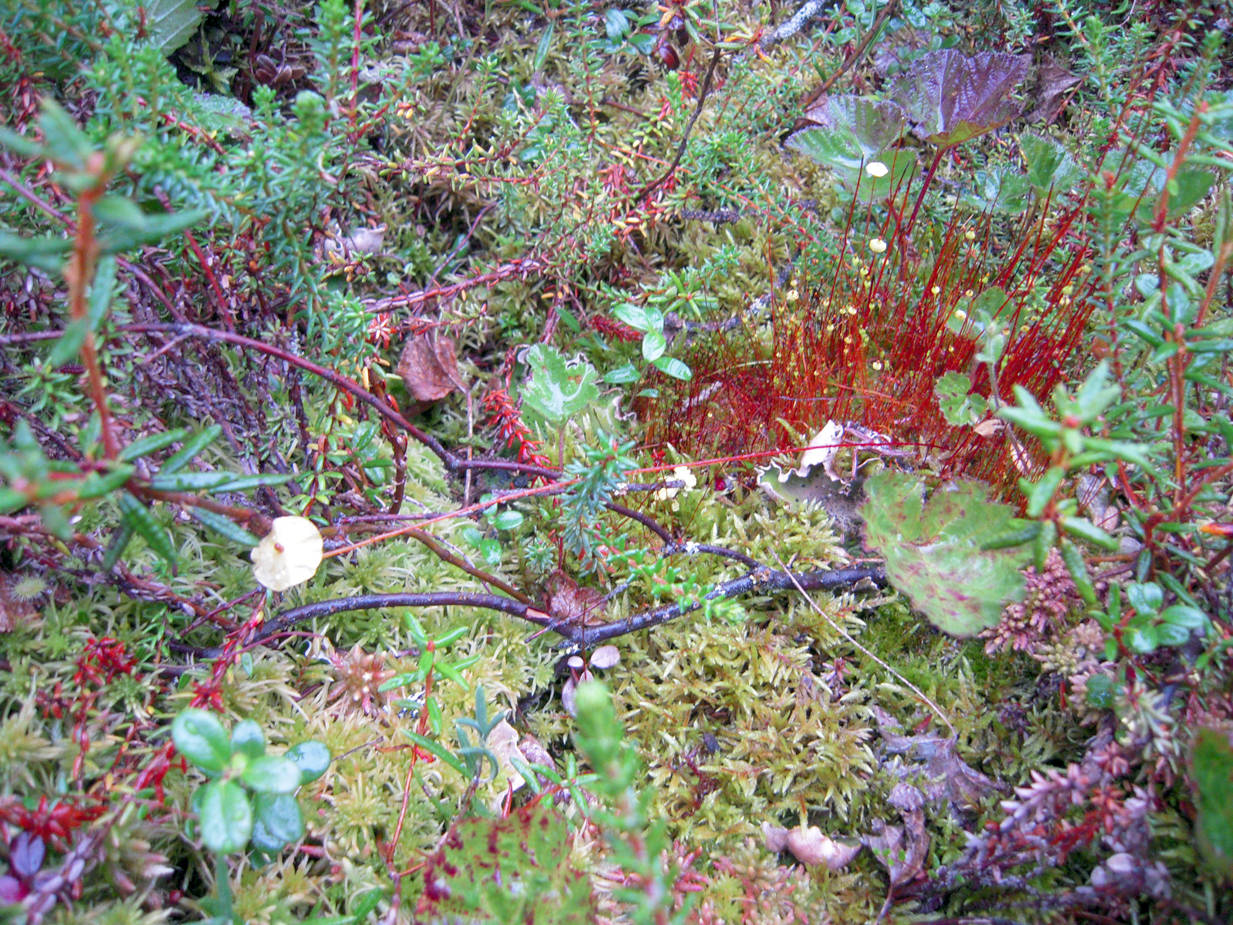
When you think about where moss grows, where do you think of? Perhaps on a tree or a stump or just directly on the ground. Well, that’s not the case with the infrequently seen moss Splachnum luteum, commonly referred to as yellow moosedung moss. This moss finds its home in, as the common name implies, moose dung!
One might mistake this moss for a flower due to its simple structure and bright colors. A thin, red-yellow stem extends upward from the small, green, leafy base to reach the cap. The bright yellow, umbrella-shape cap is branded in the scientific name “luteum,” the Latin word for yellow.
Mosses are plants, but function very differently when it comes to obtaining nutrients and reproduction. Mosses are nonvascular, which means they simply absorb nutrients through their stem and leaves instead of through vascular tissues. This is why most mosses are small and live in moist environments.
Mosses also reproduce much differently than most other plants. The familiar, leafy, green gametophyte phase of the moss produces sperm and eggs. The sperm and the egg form a zygote and the zygote is housed in what’s called the sporophyte or, in this case, the yellow cap on top of the red stalk. Then, the zygote produces spores that can travel to a different, suitable habitat and produce new individuals.
Splachnum luteum is part of the family Splachnaceae, which contains several unique mosses commonly referred to as the dung mosses. What is interesting about this family is that almost half of these species of mosses are entomophilous, which means that their spores are dispersed by insects. Reproducing through entomophily has yet to be observed in any other moss family.
Most mosses reproduce solely by relying on the wind or water to transport their spores. Entomophilous species attract their “pollinators,” mostly flies, by using both bright colors and odors that simulate decaying organic matter.
Yellow moosedung moss is no exception to these unique reproductive maneuvers — it attracts the blue bottle fly (Calliphora vomitoria), a species found on the Kenai National Wildlife Refuge, with the seductive double whammy of odor from a butyl compound and the bright yellow color of its spore cap. The spores of the moss are sticky enough to stick to the fly, and then the fly carries the spores to another pile of droppings.
As previously mentioned, Splachnum luteum, and other mosses in the family Splachnaceae, require a very unique habitat. Species in the genus Splachnum grow exclusively in herbivore dung. In addition to being restricted to growth in plant-eaters’ feces, yellow moosedung moss is also confined to bogs.
Another species in the same family found on the Kenai Refuge, Tetraplodon mnioides or “entire-leaved nitrogen moss,” specializes in carnivore dung, old bones and owl pellets.
With such a constrained habitat type, it makes sense for this moss to develop additional reproductive methods to supplement wind or water dispersal. Other than reproducing through entomophily, dung mosses may also be unwittingly eaten by foraging herbivores. Its spores might then be excreted as part of the animal’s waste, hopefully leading to a new individual.
These mosses picked a strange medium to set up home in, but they did it for a couple of reasons. Moose droppings contain about 2.5 percent nitrogen, which is more nitrogen than cow dung! Nitrogen is an important element for plants as it is a component of chlorophyll, which is essential to complete the photosynthetic process. Water is also a critical piece of photosynthesis, and is contained as moisture within moose scat.
Yellow moosedung moss is a rarely seen moss on the Kenai Peninsula, probably due to its limited habitat and reproductive methods. Even though this moss can transport its spores through flies to another pile of dung, they still have to have a pile of dung nearby for the fly to land on. Droppings don’t stay in the ecosystem very long either, typically one to three years, which means that habitat for the yellow moosedung moss is constantly changing and ultimately disappearing.
This moss is rare, but that doesn’t mean you should dismiss it. Keep an eye out for piles of moose droppings here and there and see if you can find it! Rare things are fun to find, and this little guy is no exception. If you do encounter it, take a second to appreciate the complexity of its life cycle because, as Aristotle said, “In all things of nature, there is something of the marvelous.”
Anthony Holzhauser is a biological intern this summer at Kenai National Wildlife Refuge. He is a junior in Wildlife Biology at Unity College during the rest of the year. Find more Refuge Notebook articles (1999-present) at https://www.fws.gov/refuge/Kenai/community/refuge_notebook.html.
